

What to Expect From a Texas Roof Insurance Payout in 2026
How much does insurance pay for roof replacement in Texas depends on three things: your coverage type, your deductible, and your roof’s age. Here’s a quick breakdown:
| Coverage Type | $20,000 Roof | Deductible | You Pay | Insurance Pays |
|---|---|---|---|---|
| Replacement Cost (RCV) | $20,000 | $2,000 | $2,000 | $18,000 |
| Actual Cash Value (ACV) – 15-yr roof | $20,000 | $2,000 | $14,000 | $6,000 |
| Roof Payment Schedule – 15-yr roof | $20,000 | $8,000 | $19,400 | $600–$4,600 |
| ACV – 20-yr roof, $200K home | $10,000 | $4,000 | $10,000 | $0 |
Note: Wind and hail deductibles in Texas are typically 2% of your home’s insured value — not a flat dollar amount. On a $400,000 home, that’s an $8,000 deductible.
The short version: with the right policy, you may pay only your deductible. With the wrong one, you could owe $10,000–$15,000 out of pocket on a storm-damaged roof — even with a valid claim.
Texas homeowners face some of the most severe hail and wind exposure in the country. Yet many don’t realize their coverage has quietly shifted — sometimes at renewal, without a phone call — from full replacement cost to a depreciated payout based on roof age. In hail-prone areas like Frisco, Plano, and the broader DFW Metroplex, this “age trap” can be a costly surprise.
I’m Mark Griffith, founder of Griffith Roofing, and after replacing over 3,000 roofs across the DFW Metroplex since 2001, I’ve seen how policy details — not storm severity — determine how much does insurance pay for roof replacement in Texas. In this guide, I’ll walk you through exactly how payouts are calculated so you can go into the process informed and protected.
Understanding How Much Does Insurance Pay for Roof Replacement in Texas
In the Lone Star State, our roofs take a beating. From the “Hail Alley” of North Texas to the high-wind corridors of the DFW Metroplex, your roof is the first line of defense. But insurance isn’t a maintenance plan; it is protection against sudden and accidental damage.
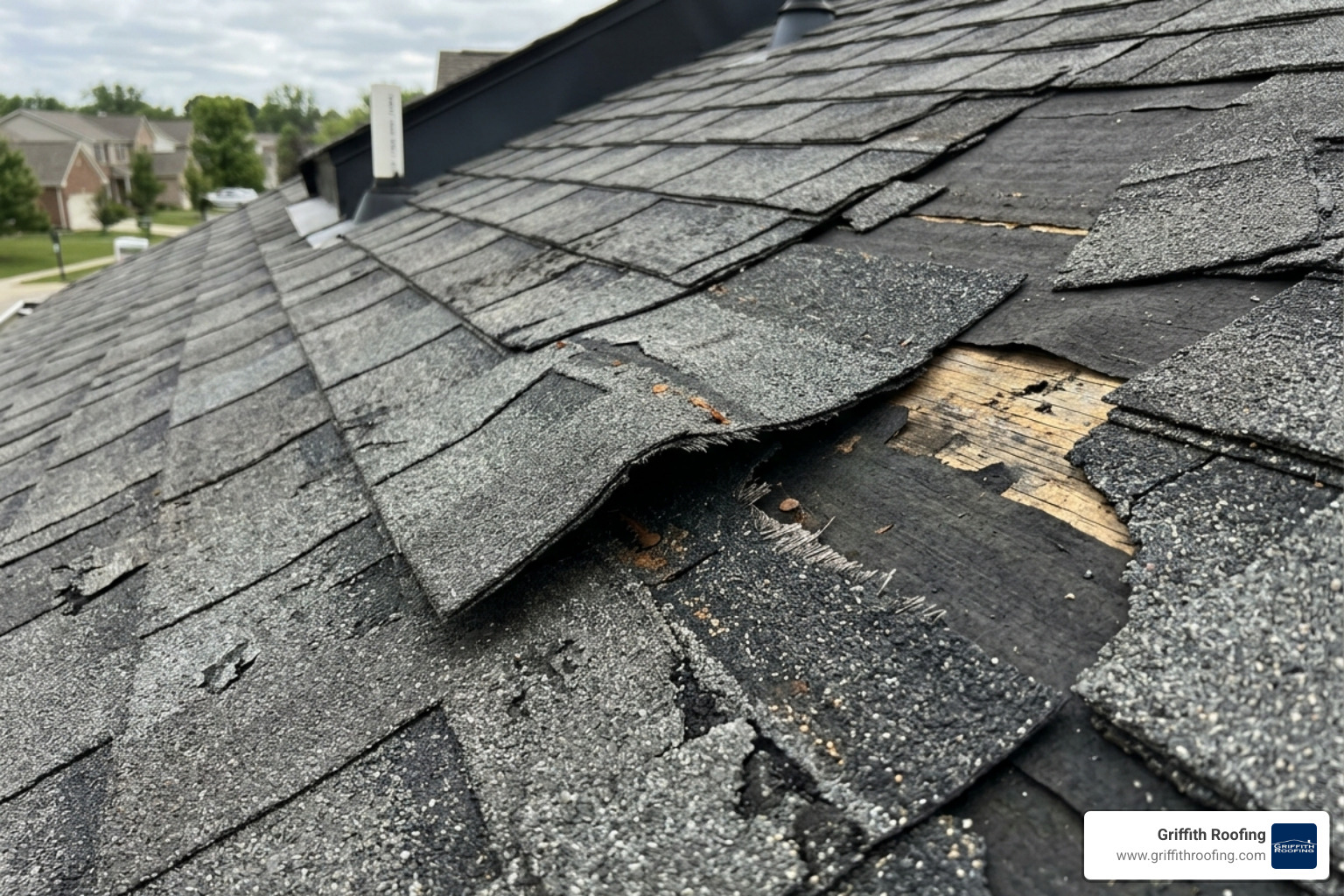
Generally, standard Texas homeowners policies (like the common HO-3 form) cover roof replacement if the damage is caused by a “covered peril.” These include:
- Hail Impact: The most common reason for claims in Southlake, Keller, and Colleyville.
- Windstorms and Tornadoes: High winds that lift or tear shingles.
- Falling Objects: A tree limb crashing down during a spring storm.
- Fire and Lightning: Sudden events that cause structural damage.
However, insurance will not pay for a new roof just because it is old or looks worn out. Gradual wear and tear, algae growth, or simple aging are considered maintenance responsibilities. If an inspection shows that the leaks are due to neglect rather than a specific storm event, your claim may be denied. Understanding Insurance and your roof: What to know when buying a policy or filing a claim is essential before you ever pick up the phone to call your adjuster. If you suspect you have storm damage, our Storm Damage Services can help you identify exactly what is covered before you file.
How Much Does Insurance Pay for Roof Replacement in Texas Based on Policy Type?
This is where the math gets “Texas-sized” complicated. As of April 2026, many carriers have moved away from standard replacement coverage to manage the $31 billion in annual roofing losses seen nationwide.
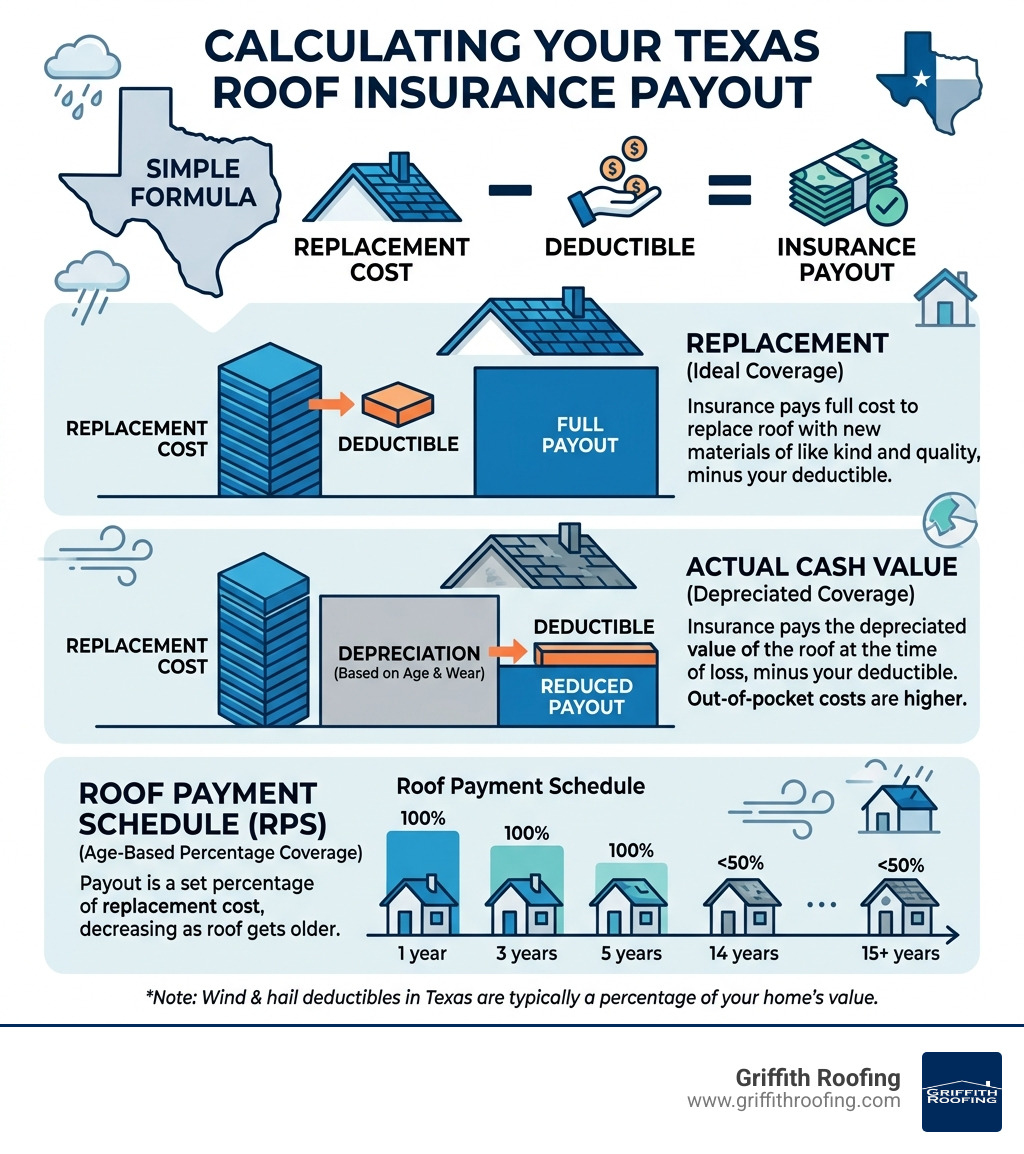
- Replacement Cost Value (RCV): This is the gold standard. RCV pays to replace your roof at today’s market prices, regardless of how old the shingles were. You are responsible for your deductible, and the insurance company covers the rest.
- Actual Cash Value (ACV): This is the “Age Trap.” ACV only pays for what your roof was worth at the time of the storm. If a 20-year-old roof is destroyed, the insurer calculates the current cost, subtracts 20 years of depreciation, and then subtracts your deductible. In many cases, this leaves the homeowner with a $0 payout.
- Roof Payment Schedule: A newer trend in Texas, this uses a fixed table to determine payouts. For example, a roof 11–15 years old might only qualify for 60% of its replacement value.
| Feature | RCV Policy | ACV Policy | Roof Payment Schedule |
|---|---|---|---|
| Payout Basis | Today’s Cost | Depreciated Value | Fixed % by Age |
| Depreciation | Recoverable | Non-recoverable | Non-recoverable |
| Out-of-Pocket | Deductible Only | Deductible + Depreciation | Deductible + Schedule Gap |
Choosing Home policies: Replacement cost or actual cash value? is a critical decision. In North Texas, where hail is a statistical certainty, an ACV policy can save you $200 a year in premiums but cost you $15,000 when the clouds turn green.
Calculating How Much Does Insurance Pay for Roof Replacement in Texas After Deductibles
In most states, a deductible is a flat $500 or $1,000. In Texas, we do things differently. Most policies now feature a percentage-based wind and hail deductible.
This deductible is calculated as a percentage of your home’s total insured value (Dwelling Coverage A), not the cost of the roof repair. If your home is insured for $500,000 and you have a 2% wind/hail deductible, your out-of-pocket cost is $10,000.
If a storm causes $15,000 in damage, the insurance company only pays $5,000. If the damage is $9,000, they pay nothing. This is why it’s vital to understand How Hail and Storms Impact Your Roof and have a professional estimate in hand before filing a claim that might fall below your deductible.
The Impact of Roof Payment Schedules and Age
The “15-year cliff” is a real phenomenon in the 2026 Texas insurance market. Many carriers now automatically switch roofs to a Roof Payment Schedule once they hit a certain age—often 10 or 15 years.
Under these schedules, the insurer doesn’t guess at depreciation; they use a fixed chart.
- 0–5 years: 100% coverage
- 6–10 years: 80% coverage
- 11–15 years: 60% coverage
- 16–20 years: 40% coverage
If you are in a city like Frisco or McKinney where the homes are reaching that 15-to-20-year mark, your payout could be slashed in half before the deductible is even applied. These Roof Payment Schedule in Texas: How It Affects Roof Claims & Payouts provisions are often buried in policy endorsements. This highlights The Importance of Regular Roof Inspections to ensure your roof is in peak condition, potentially allowing you to negotiate better coverage terms with your agent.
The Step-by-Step Texas Insurance Claim Process
Filing a claim can feel like a full-time job. To ensure you get the maximum payout, we recommend following this 2026-proven process:
- Professional Inspection: Before calling the insurance company, have a local expert (like us) inspect the roof. We document the damage with photos and “speak the language” of the adjusters.
- File Promptly: Texas policies require “prompt notice.” Waiting months after a storm makes it harder to prove the damage was caused by that specific event.
- The Adjuster Meeting: Your roofing contractor should be present when the insurance adjuster arrives. We ensure no damage is overlooked, from the shingles to the gutters and window screens.
- Review the Scope of Work: Once the adjuster provides an estimate, we compare it to our measurements. If they missed items (like local building codes or high-profile ridge caps), we file a supplement.
- The Two-Check System: For RCV policies, you’ll receive the first check (ACV) upfront. The second check (recoverable depreciation) is sent only after the work is completed and an invoice is submitted.
You can see examples of how we’ve helped DFW homeowners navigate this in our Storm Damage Portfolio. For a deeper dive into the mechanics, check out this Texas Roof Insurance Claims: How Payouts Work (2026 Guide).
Maximizing Your Payout and Avoiding Common Pitfalls
To get the most out of your claim, documentation is your best friend. In 2026, insurance companies are using high-resolution satellite imagery and drones to scrutinize claims.
Common Pitfalls to Avoid:
- Cosmetic Damage Exclusions: Some Texas policies now refuse to pay for “cosmetic” hail damage on metal roofs or shingles if it doesn’t cause a leak. Always check your endorsements for this.
- Illegal Deductible Waiving: It is a Class B misdemeanor in Texas for a contractor to offer to “waive” or “absorb” your deductible. If a roofer offers this, they are asking you to participate in insurance fraud.
- Inaccurate Measurements: Adjusters often use software that can underestimate the “waste factor” on complex Texas roofs with many valleys and gables.
Working with a company that provides detailed Roof Repair Services ensures that every line item is accounted for. Don’t fall for the ACV vs Replacement Cost Roofs Texas: The 2026 “Age Trap” Guide—be proactive and know your policy’s limits.
Frequently Asked Questions about Texas Roof Claims
Can a Texas contractor legally waive my insurance deductible?
No. Under Texas House Bill 2102 (effective since 2019), it is illegal for a contractor to pay, waive, or rebate a homeowner’s insurance deductible. Both the contractor and the homeowner can face legal consequences. Any contractor offering this is likely cutting corners on materials or labor to make up the difference.
How long do I have to file a roof claim in Texas after a storm?
While most policies allow up to one year from the date of loss, your contract likely requires “prompt” notice. In the DFW area, we recommend filing within 30–60 days. This prevents “collateral damage” (like interior leaks) from being denied due to homeowner negligence in failing to report the initial storm damage.
Will filing a roof claim cause my insurance premiums to go up?
In Texas, an insurance company cannot raise your rates solely because you filed a single “Act of God” claim (like hail or wind). However, they can raise rates for an entire ZIP code or region based on storm frequency. If everyone in Southlake or Plano is getting a new roof, your rates may go up regardless of whether you file a claim or not.
Conclusion
At Griffith Roofing, we’ve spent over two decades serving the Southlake and DFW communities with a commitment to flawless craftsmanship and customer-focused service. We know that navigating the question of how much does insurance pay for roof replacement in texas is stressful, especially when you’re dealing with the aftermath of a major storm.
From initial inspection to final cleanup, we handle the heavy lifting. Whether you’re in Keller, Colleyville, or anywhere in the Metroplex, our team is ready to provide the insurance handling expertise you need to ensure your home is protected for years to come.
If you’ve recently experienced a storm or just want to know where your roof stands, don’t wait for the next leak. Contact us today for our expert Storm Damage Services and let us help you calculate—and secure—the payout you deserve.


