

When a commercial roof starts showing its age, the instinct for many Dallas Fort Worth facility managers is to assume the worst and budget for a full replacement. But the decision between commercial roof restoration vs replacement is rarely that straightforward. Restoration, the industry term for coating and refurbishing an existing roof system rather than tearing it off, is one of the most underutilized options in commercial roofing. This guide cuts through the confusion and gives you a practical, financially grounded framework for making the right call.
Table of Contents
- Key takeaways
- Commercial roof restoration vs replacement: what each actually means
- When full replacement becomes necessary
- How to decide: the criteria that actually matter
- Financial and operational impact for DFW businesses
- Practical steps for facility managers
- My take on the decision most facilities get wrong
- Let Griffithroofing assess your commercial roof
- FAQ
Key takeaways
| Point | Details |
|---|---|
| Restoration costs far less | Restoration runs 50-70% less than full replacement per square foot when factoring in labor, materials, and disposal. |
| Substrate condition is the deciding factor | Moisture saturation, deck deterioration, and adhesion failure determine whether restoration is viable or replacement is required. |
| Tax treatment differs significantly | Restoration is often expensed immediately while replacement is depreciated over years, creating a real cash flow difference. |
| Restoration is faster and less disruptive | Projects average around 8 crew days vs. up to 30 for full tear-offs, reducing operational impact on occupied buildings. |
| Visual inspection alone is not enough | Proper moisture and adhesion testing, not just a walk-around, is required to make an accurate decision. |
Commercial roof restoration vs replacement: what each actually means
Before you can make a smart decision, you need to understand what each option actually involves. Restoration, sometimes called roof coating or roof refurbishment, is the process of cleaning, repairing, and applying a protective coating system over an existing roof membrane. It is not a patch job. When done correctly, it extends the life of the existing system by 10 to 20 years and can carry a manufacturer warranty.
Common roof types that qualify for restoration include:
- Single-ply membranes (TPO, EPDM, PVC) in structurally sound condition
- Built-up roofing (BUR) with intact plies and minimal moisture intrusion
- Metal roofing systems with surface oxidation but solid substrates
- Modified bitumen systems with good adhesion and no widespread delamination
The restoration process follows a defined sequence. A qualified contractor will conduct a full inspection, perform moisture and adhesion testing, complete localized repairs on any damaged areas, and then apply a manufacturer-approved coating system. NRCA 2026 guidelines make it clear that substrate evaluation and repair must happen before any coating is applied. Skipping that step is where restoration projects fail.
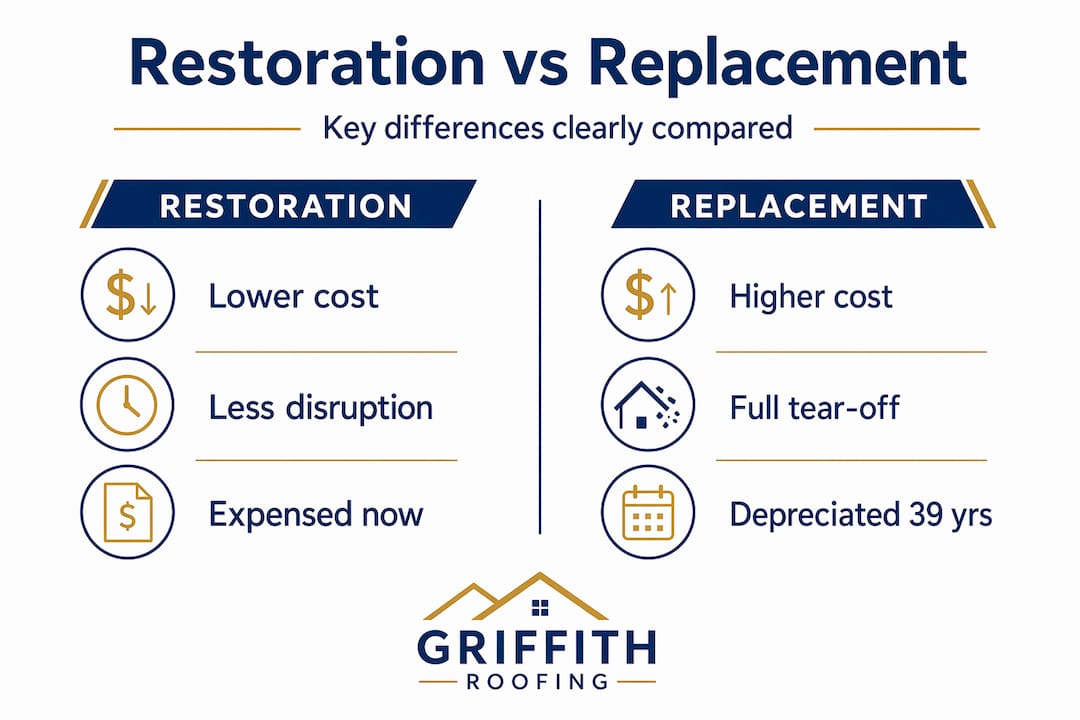
One financial advantage that many facility managers miss: restoration is typically classified as a maintenance expense by the IRS, meaning you can deduct it fully in the year it is completed rather than depreciating it over decades like a capital improvement.
Pro Tip: Ask your contractor to provide a written scope that explicitly classifies the work as maintenance. This documentation matters when your finance team reviews the project budget and when tax time arrives.
When full replacement becomes necessary
Replacement means tearing off the existing roof system down to the deck, inspecting and repairing the structural substrate, installing new insulation, and applying a completely new membrane system. It is a capital project. It takes longer, costs more, and disrupts building operations significantly more than restoration.
That said, there are situations where replacement is not just preferable but required:
- Widespread moisture saturation: When core samples or infrared scans reveal that insulation is wet across a large percentage of the roof, no coating will fix the underlying problem.
- Deck deterioration: Rotted wood decking or corroded steel decking compromises the structural integrity of the entire system. Replacement is the only path forward.
- Multiple prior coatings with adhesion failure: Replacement becomes necessary when layers of prior coatings have failed, since new coatings cannot bond to a compromised surface.
- Drainage and slope failures: If the roof has chronic ponding water caused by insufficient slope or deck deflection, restoration alone will not resolve the root structural causes.
A full replacement does offer one advantage that restoration cannot: complete visibility into the deck and insulation. This matters in the DFW climate, where summer heat cycles and occasional severe weather can accelerate hidden moisture damage. TPO overlays carry real risk when the existing substrate has trapped moisture, because you are essentially sealing problems inside the system.
From a financial standpoint, replacement is treated as a capital improvement and depreciated over 39 years for commercial properties under current tax law. That is a meaningful difference from the immediate expense treatment of restoration, particularly for businesses managing tight annual budgets.
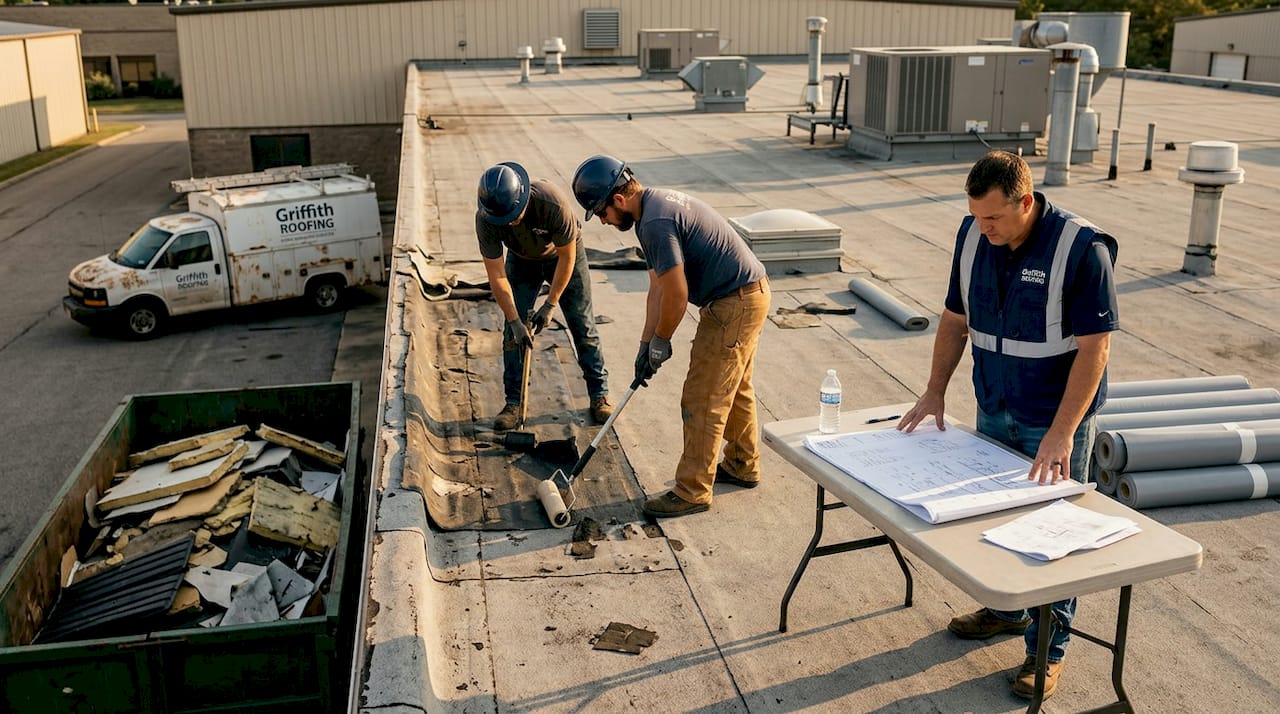
| Factor | Restoration | Replacement |
|---|---|---|
| Typical cost per sq ft | $2.50 to $5.00 | $8.00 to $16.00 |
| Project duration (30,000 SF) | ~8 crew days | Up to 30 crew days |
| Tax treatment | Maintenance expense | Capital improvement (depreciated) |
| Disruption level | Low | High |
| Addresses deck/insulation issues | No | Yes |
| Warranty potential | 10 to 20 years | 20 to 30 years |
How to decide: the criteria that actually matter
This is where most facility managers get tripped up. The decision should never be based on age alone or a quick visual scan. A 20-year-old roof with solid substrate and minimal moisture intrusion can absolutely be a restoration candidate. A 10-year-old roof with widespread wet insulation is a replacement job.
Here is a practical framework for your assessment:
- Moisture testing: Commission an infrared scan or nuclear moisture survey. If more than 25% of the roof area shows moisture intrusion, replacement is typically the right call.
- Adhesion testing: Pull tests on the existing membrane tell you whether a new coating will bond properly. Poor adhesion means restoration will fail prematurely.
- Deck condition: Any signs of structural compromise, sagging, or soft spots require a full replacement. No coating system can compensate for a failing deck.
- Drainage evaluation: Map all drains, scuppers, and slopes. Chronic ponding that stems from structural issues, not just clogged drains, signals a replacement need.
- Prior coating history: If the roof has already received two or more coating applications, the system may be at the end of its restorable life.
Proper condition testing, not a simple visual inspection, is the only reliable way to make this call. This is especially relevant for DFW properties, where the combination of intense UV exposure, heat cycling, and periodic hail damage creates roof conditions that look fine from the surface but hide significant subsurface problems.
Pro Tip: When reviewing contractor proposals, look for documentation of moisture testing and adhesion pull results. Any proposal that skips these steps and jumps straight to a scope of work is a red flag.
Understanding North Texas weather impacts on roofing systems is also worth factoring into your timeline. Heat and UV exposure in this region accelerate membrane degradation faster than in cooler climates, which can shift the restoration window earlier in a roof’s life cycle.
Financial and operational impact for DFW businesses
The numbers here are striking. Restoration projects deliver approximately 85% higher gross profit per crew day compared to full reroofing, which is why experienced contractors often prefer them when conditions allow. For building owners, the savings are equally compelling.
Restoration typically costs 50 to 70% less than replacement when you account for all the line items: tear-off labor, disposal fees, new insulation, new membrane, and the extended project timeline. For a 30,000 square foot commercial roof, that difference can easily represent $150,000 or more in direct project costs.
The operational disruption factor is just as significant for occupied commercial properties. Facility managers often underestimate scheduling risks from tear-offs, including noise, odor, debris, and the risk of weather exposure during a multi-week project. Restoration crews are smaller and faster, which means less time your tenants, employees, or customers are dealing with a construction zone above their heads.
There is also an environmental consideration worth noting. Tear-off replacements generate significant landfill waste. Restoration extends the life of existing materials, which aligns with sustainability goals that many DFW businesses are prioritizing in their facility management programs.
Practical steps for facility managers
Once you have a preliminary sense of which direction makes sense, here is how to move forward with confidence:
- Schedule a professional condition assessment that includes infrared moisture scanning, adhesion testing, and a structural deck review. Do not rely on a contractor who offers a free estimate based on a visual walk.
- Get multiple proposals and compare them on scope, not just price. A restoration proposal should include detailed repair line items before coating application. A replacement proposal should specify deck inspection and repair allowances.
- Communicate the financial classification to your finance team early. Whether the project is a maintenance expense or a capital improvement affects your budget approval process and your year-end tax position.
- Consider your building’s future plans. If you are planning an expansion, adding rooftop equipment, or re-roofing in phases, those factors affect which option makes more sense right now.
- Ask about warranty terms and maintenance requirements. A restoration warranty typically requires periodic inspections and maintenance. Understanding those obligations upfront prevents warranty voidance down the road.
Proactive maintenance programs combined with timely restoration can significantly extend roof service life and reduce the frequency of costly replacements. The facility managers who get the most value from their roofs treat them as managed assets, not problems to solve reactively.
For projects involving roof repair assessment before a final scope decision, working with a contractor who understands both restoration and replacement gives you an unbiased evaluation rather than a recommendation shaped by which service has better margins that month.
My take on the decision most facilities get wrong
I have seen restoration undervalued time and again, and it usually comes down to one of two things: a contractor who defaults to replacement because it is a larger ticket, or a facility manager who assumes age equals end of life. Neither assumption holds up under scrutiny.
What I have learned over years of evaluating commercial roofs is that the substrate tells the real story. A roof that looks rough on the surface but has dry insulation, solid adhesion, and a sound deck is a restoration candidate every time. Skipping the moisture and adhesion testing to save a few hundred dollars on the assessment is one of the most expensive shortcuts a facility manager can make.
The cash flow argument for restoration is also consistently underweighted in these conversations. Expensing a restoration project this year versus depreciating a replacement over 39 years is not a minor accounting distinction. For a business managing capital budgets carefully, that difference can fund other facility priorities.
My honest advice: do not let a contractor make this decision for you with a visual inspection and a proposal. Demand the data. The classification of the work as maintenance versus capital expense should be driven by the actual condition of your roof, not by what is easiest to sell.
— Ronkot
Let Griffithroofing assess your commercial roof
If you are weighing your options for a commercial roof in the Dallas Fort Worth area, Griffithroofing has been doing this work since 2001. We know the DFW climate, we know what it does to commercial roofing systems, and we know how to give you an honest assessment rather than a default recommendation.
Our process starts with a thorough condition assessment, including moisture testing and substrate evaluation, before we ever discuss scope or pricing. Whether your roof is a strong restoration candidate or genuinely needs replacement, you will get a clear explanation of why and a proposal that reflects the actual condition of your building. We handle both commercial roof repair and full replacement projects across the Metroplex, and we do not consider the job done until you are completely satisfied. Reach out to Griffithroofing today to schedule your professional assessment.
FAQ
What is the difference between roof restoration and replacement?
Roof restoration involves cleaning, repairing, and coating an existing roof system to extend its life, while replacement means tearing off the old system and installing a completely new one. Restoration costs significantly less and causes less disruption, but only works when the substrate and insulation are in sound condition.
How do I know if my commercial roof qualifies for restoration?
A professional moisture scan and adhesion testing will determine eligibility. If less than 25% of the roof area shows moisture intrusion and the deck is structurally sound, restoration is typically a viable option.
Is roof restoration or replacement better for my budget?
Restoration typically runs 50 to 70% less than full replacement and can be expensed immediately for tax purposes rather than depreciated over decades, making it the stronger short-term financial choice when conditions allow.
How long does a commercial roof restoration last?
A properly applied restoration system with a manufacturer-approved coating can extend roof life by 10 to 20 years, often backed by a warranty, provided the required maintenance and periodic inspections are performed.
When should a commercial roof be replaced instead of restored?
Replacement is required when there is widespread moisture saturation in the insulation, structural deck deterioration, chronic ponding from slope failures, or multiple layers of failed prior coatings that prevent proper adhesion of a new system.


