

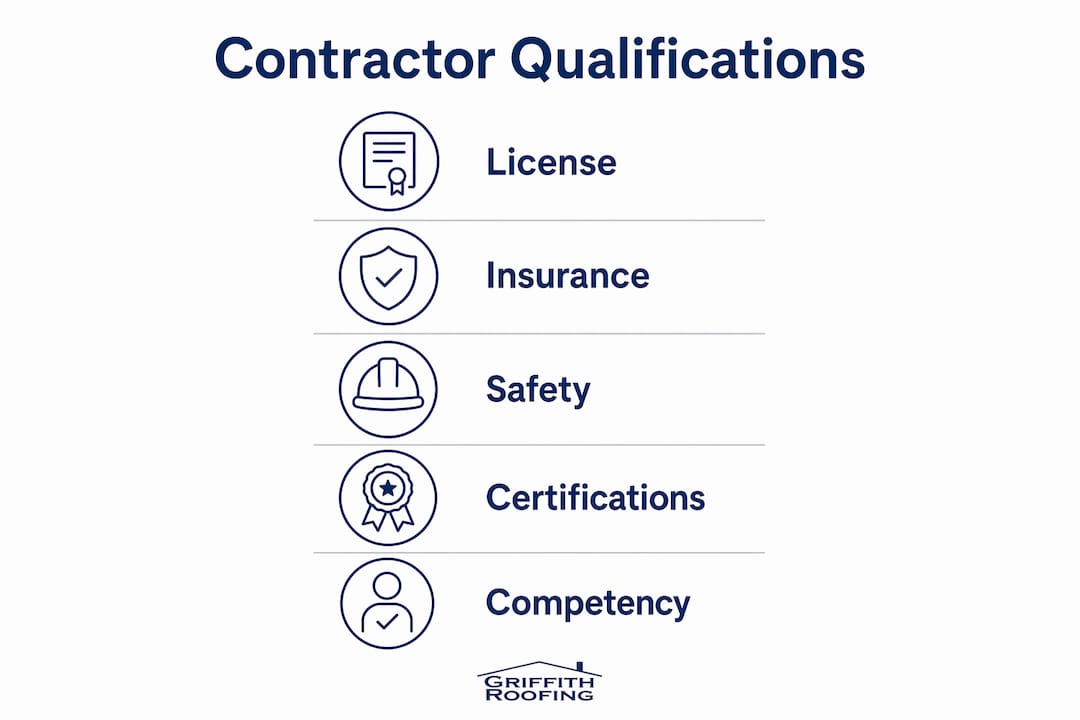
A qualified commercial roofing contractor is defined by five verifiable credentials: an active state license, adequate insurance coverage, current manufacturer certifications, OSHA safety compliance, and demonstrated installation competency. Understanding commercial roofing contractor qualifications explained in full protects your property investment and keeps your project legally sound. Licensing boards like Florida’s DBPR, certification bodies like the NRCA, and safety regulators like OSHA each set specific standards that separate legitimate contractors from risky ones. This guide walks you through every qualification category and tells you exactly how to verify each one before signing a contract.
What are the licensing requirements for commercial roofing contractors?
A contractor’s license is the legal foundation of any commercial roofing project. State licensing boards require contractors to pass trade exams, prove field experience, and maintain active registration before they can legally work on commercial properties. Without a valid license, a contractor cannot pull permits, and you as the property owner may be held liable for unpermitted work.
Licensing requirements vary by state, but the structure is consistent. Most states require roofing-specific licenses rather than general contractor licenses. Florida, for example, requires a CCC license verified through the DBPR, and that license must be active and registered under the contractor’s business entity name. Texas operates differently, with the Roofing Contractors Association of Texas (RCAT) offering a voluntary credentialing program, though some municipalities impose their own local licensing rules. For a detailed breakdown of how Texas handles this, Griffith roofing has published a guide on roofing contractor licensing in Texas that covers verification steps specific to the state.
When evaluating a contractor, verify the following before any work begins:
- Confirm the license is active, not expired or suspended
- Check that the license is issued to the specific business entity bidding your project
- Verify the license category covers commercial roofing, not just residential
- Cross-reference the license number on the official state licensing board website
- Ask for a copy of the license certificate and compare it to the online record
Pro Tip: Never accept a contractor’s verbal assurance about their license. Pull the record yourself on the state board’s website. It takes two minutes and eliminates a major risk.
Hiring an unlicensed contractor exposes you to voided permits, failed inspections, and personal liability if a worker is injured on your property. Licensing is not a formality. It is your first filter.
Which insurance policies and safety standards must commercial roofing contractors have?
Insurance and OSHA compliance are the two most overlooked qualifications in commercial roofing, and they carry the highest financial risk when missing. A contractor without proper coverage can turn your roofing project into a legal and financial liability overnight.
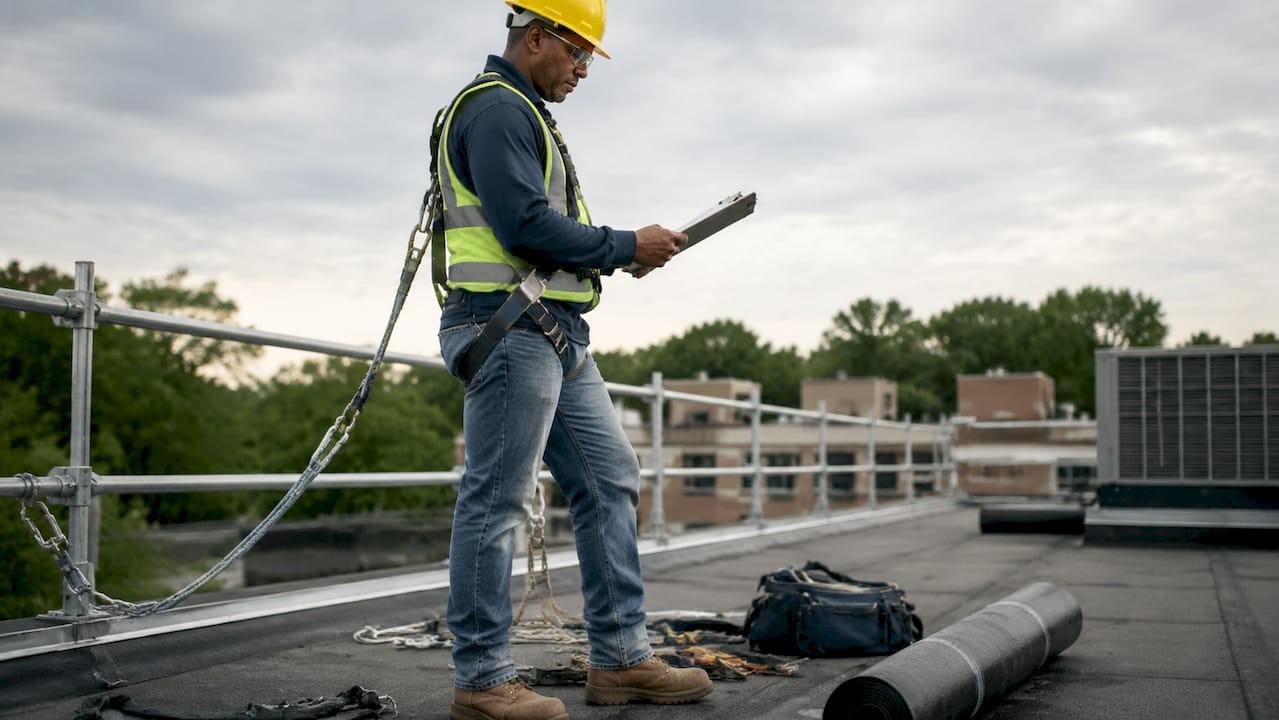
Commercial roofing contractors should carry general liability insurance at a minimum of $2M per occurrence, with aggregate limits of $4M or higher for large projects. Workers’ compensation coverage is equally non-negotiable. If a crew member is injured on your roof and the contractor lacks workers’ comp, your own general liability policy may be implicated in the claim. That means your premiums rise and your coverage takes the hit for someone else’s negligence.
For larger commercial projects, ask whether the contractor carries an umbrella or excess liability policy. These policies extend coverage beyond the primary limits and signal that the contractor takes risk management seriously. Griffith roofing’s guide on commercial roofing insurance claims explains how these policies interact when damage or injury occurs on a job site.
OSHA safety compliance adds another layer of qualification. The key standard every commercial property owner should know:
- OSHA requires fall protection at 6 feet or higher on unprotected edges, using guardrails, safety nets, or personal fall arrest systems (PFAS).
- When standard fall protection methods cannot be used, the contractor must provide a written fall protection plan signed by a qualified person.
- That plan must be site-specific, addressing the roof’s slope, edge conditions, and access points.
- Contractors must document worker training on fall protection equipment before work begins.
- OSHA violations on your property can trigger inspections and fines that affect you as the site owner.
Pro Tip: Ask every contractor for their written OSHA fall protection plan before work starts. A contractor who cannot produce one on request is not ready to work on your building.
One metric that cuts through the noise on safety is the Experience Modification Rate (EMR). An EMR below 0.85 signals a strong safety record. An EMR above 1.2 is a red flag, indicating the contractor has a history of worker injuries that exceed industry averages. Request the contractor’s current EMR from their insurance carrier before awarding any contract.
What manufacturer certifications should commercial roofing contractors hold?
Manufacturer certifications are the credentials that connect installation quality directly to warranty protection. A roof installed by a non-certified contractor may look identical to one installed by a certified contractor, but the warranty coverage will not be the same.
Major roofing manufacturers including GAF, Carlisle, Firestone, Johns Manville, and Soprema each run their own certification programs. These programs require classroom training, field installation testing, and periodic audits to confirm that contractors maintain the skills needed to install their systems correctly. Certification is not a one-time event. Contractors must renew and maintain current certificates to issue valid manufacturer warranties on completed projects.
| Manufacturer | Certification Program | Warranty Benefit |
|---|---|---|
| GAF | Master Elite Contractor | Up to 50-year system warranty |
| Carlisle | Authorized Applicator | Full system warranty coverage |
| Firestone | Authorized Contractor | Labor and material warranty |
| Johns Manville | Approved Contractor | System performance warranty |
| Soprema | Certified Applicator | Extended product warranty |
The warranty implications are significant. Commercial roofing warranties depend critically on certified installation. If a non-certified contractor installs a GAF or Carlisle system, the manufacturer can reject warranty claims outright. That leaves you with no recourse when a membrane fails at year three of a projected 20-year service life. Griffith roofing’s resource on roofing warranty benefits explains how certified installation protects your long-term investment in the Texas climate.
When evaluating manufacturer certifications, check these points:
- Request the actual certification document, not just a verbal claim
- Confirm the certificate is current and not expired
- Verify the certification covers the specific product system being installed on your building
- Check the manufacturer’s website directly to confirm the contractor’s listed status
How is contractor competency assessed beyond licensing and insurance?
Licensing proves legal standing. Insurance proves financial protection. Neither one proves that a contractor can actually install a commercial roof correctly. That is where competency-based credentials come in.
The NRCA ProCertification program is the industry’s most recognized standard for verified installation skill. Unlike attendance-based training programs that award certificates simply for showing up, NRCA ProCertification requires hands-on performance assessments and continuing education on a three-year renewal cycle. Assessors evaluate whether a technician can actually execute the installation tasks required for the specific roof type, not just recite procedures from a manual. This distinction matters enormously on commercial projects where a single installation error can compromise an entire membrane system.
Competency-based certifications like NRCA ProCertification are increasingly written into commercial project specifications by architects and facility managers. That trend reflects a real shift in how the industry evaluates contractor qualifications for roofing. Property owners who specify NRCA ProCertified crews get a documented assurance that the people on their roof have been tested, not just trained.
Additional credentials worth requesting include:
- OSHA 10-hour or 30-hour safety certification for crew members and supervisors
- Trade association memberships such as NRCA or RCAT, which require adherence to professional standards
- References from comparable commercial projects, with contact information for verification
- Documentation of continuing education completed within the past three years
Pro Tip: Ask specifically whether the crew assigned to your project holds NRCA ProCertification, not just the company’s owner or estimator. The certification needs to be on the hands doing the work.
Poor workmanship on a commercial roof is expensive to fix and difficult to attribute after the fact. Competency verification before the project starts is the only reliable way to reduce that risk.
What practical steps can you take to verify contractor qualifications before hiring?
Verification is where qualification checks either protect you or fail you. Collecting documents is not enough. You need to confirm that each document is current, authentic, and specific to the contractor and project in front of you.
Follow these steps before awarding any commercial roofing contract:
- Verify the license on the official state licensing board website using the contractor’s license number. Confirm it is active, not expired, and covers commercial roofing work.
- Request Certificates of Insurance that name you as an additional insured. A generic certificate is not sufficient. Your name on the certificate means you are notified if the policy is canceled.
- Request current manufacturer certification documents and cross-check the contractor’s status on the manufacturer’s website. GAF, Carlisle, and Firestone all maintain searchable contractor directories.
- Ask for the written OSHA fall protection plan for your specific project. A qualified contractor will have one ready. Vague answers about “following OSHA rules” are not acceptable.
- Request the contractor’s EMR mod sheet from their insurance carrier. An EMR below 0.85 is the benchmark for a contractor with a strong safety record.
Licensing and insurance documents function as risk controls, not mere formalities. A contractor who resists providing any of these documents is signaling that something may not be in order. Griffith roofing’s guide on hiring a roofing contractor in Frisco includes a practical prequalification checklist you can adapt for any commercial project in the Dallas-Fort Worth area.
Pro Tip: Build a simple qualification checklist and require every bidding contractor to submit the same documents. This creates a level playing field and makes it easy to spot gaps.
Key Takeaways
Hiring a qualified commercial roofing contractor requires verifying five distinct credential categories: licensing, insurance, manufacturer certifications, OSHA compliance, and hands-on competency.
| Point | Details |
|---|---|
| License verification | Confirm active status on the state licensing board website before any work begins. |
| Insurance minimums | Require general liability at $2M per occurrence and valid workers’ compensation certificates. |
| Manufacturer certifications | Request current documents and verify contractor status directly on the manufacturer’s website. |
| OSHA fall protection | Ask for a written, site-specific fall protection plan signed by a qualified person. |
| Competency credentials | Prioritize contractors with NRCA ProCertification, which requires hands-on performance testing. |
What I’ve learned after 20+ years of watching qualification checks succeed and fail
After more than two decades in the Dallas-Fort Worth roofing market, the pattern I see most often is this: property owners collect the right documents but never verify them. A license certificate looks legitimate on paper. An insurance certificate looks current. But if you do not pull the license record yourself and confirm the insurance certificate names you as an additional insured, you have paper compliance, not real protection.
The contractors who cause the most damage are not the ones who show up without any documents. They are the ones who show up with outdated or misrepresented documents that no one checks. I have seen manufacturer certifications presented for products that were not even being installed on the project. I have seen workers’ comp certificates that expired two weeks before the job started.
The OSHA fall protection requirement is the one that surprises property owners most. They assume the contractor handles it internally. But fall protection must be evaluated per the specific roof type, slope, and edge conditions of your building. A plan that worked on a flat TPO roof does not automatically apply to a sloped metal roof. Ask for the plan. Read it. If it does not reference your building specifically, it is not a real plan.
My honest advice: treat qualification verification the same way you treat contract review. Do it yourself, or assign someone with the authority to reject a contractor who cannot produce complete documentation. The cost of a thorough prequalification process is a few hours of your time. The cost of skipping it can be a failed roof, a rejected warranty claim, or an injury lawsuit.
— Mark Griffith
Griffith roofing: qualified commercial roofing for the DFW area
Griffith roofing has served commercial property owners and facility managers across the Dallas-Fort Worth Metroplex since 2001. Every project is backed by active state licensing, verified insurance coverage, and current manufacturer certifications from leading brands. The team holds OSHA safety compliance documentation and follows written fall protection plans on every commercial job site.
If you are evaluating contractors for an upcoming commercial project, Griffith roofing’s commercial roof restoration and replacement guide is a strong starting point for understanding your options. When you are ready to talk specifics, contact Griffith roofing directly for a consultation and a full review of our qualification documentation.
FAQ
What licenses does a commercial roofing contractor need?
Commercial roofing contractors must hold a state-issued roofing license, such as Florida’s CCC license verified through the DBPR. The license must be active, current, and registered under the contractor’s business entity name.
How much insurance should a commercial roofing contractor carry?
Contractors should carry general liability insurance at a minimum of $2M per occurrence and valid workers’ compensation coverage. Large projects may also require umbrella or excess liability policies.
What is NRCA ProCertification and why does it matter?
NRCA ProCertification is a competency-based credential that requires hands-on performance assessments and continuing education every three years. It verifies actual installation skill, not just classroom attendance, and is increasingly required in commercial project specifications.
Can a manufacturer reject a warranty claim if the contractor is not certified?
Yes. Commercial roofing warranties depend on certified installation by a manufacturer-approved contractor. Work performed by a non-certified contractor can result in the manufacturer rejecting warranty claims entirely.
What is an EMR and what score should I look for?
An EMR, or Experience Modification Rate, measures a contractor’s workplace injury history relative to industry averages. An EMR below 0.85 indicates a strong safety record, while a score above 1.2 signals elevated risk.


