

Commercial roofing square footage costs represent the fully installed price per square foot for a commercial roof replacement, covering materials, labor, tear-off, and all associated work. In 2026, that figure ranges from $4.50 to $18.00 per square foot depending on the roofing system, building size, and project complexity. For commercial property owners and managers in the Dallas-Fort Worth Metroplex, knowing this range is only the starting point. The real budget work begins when you factor in roofing system type, roof layout complexity, local labor rates, and the soft costs that most initial quotes leave out entirely.
What are the typical cost ranges for commercial roofing systems in DFW?
The roofing system you choose is the single biggest driver of your cost per square foot. Each system carries a different price point, lifespan, and best-use case, so matching the system to your building matters as much as the number itself.
Here is how the most common commercial systems compare in 2026:
| Roofing System | Installed Cost (per sq ft) | Typical Lifespan | Best Application |
|---|---|---|---|
| TPO | $6.50–$9.50 | 20–30 years | Flat/low-slope, energy efficiency focus |
| EPDM | $5.50–$8.50 | 25–35 years | Low-slope, budget-conscious projects |
| PVC | $7.50–$11.00 | 20–30 years | Restaurants, chemical exposure environments |
| Modified Bitumen | $5.00–$8.00 | 15–25 years | Low-slope, high-traffic roofs |
| Built-Up Roofing (BUR) | $5.50–$9.00 | 20–30 years | Heavy-duty flat roofs needing redundancy |
| Metal Roofing | $10.00–$18.00 | 40–70 years | Steep-slope, long-term investment properties |
| Spray Polyurethane Foam | $4.50–$7.50 | 15–20 years (with recoat) | Irregular shapes, insulation priority |
TPO and EPDM dominate the DFW commercial market because they perform well in Texas heat and offer solid value at mid-range price points. Metal roofing systems carry the highest upfront cost at $10.00–$18.00 per square foot, but their 40–70 year lifespan and fire resistance often translate into lower insurance premiums and reduced long-term maintenance. PVC is worth considering for DFW properties near food processing or chemical storage, where grease and solvent resistance matter.
Choosing a system based on price alone is a common mistake. A $5.50 EPDM roof on a building with heavy rooftop HVAC traffic will wear faster than a $9.00 modified bitumen system designed for that load. Matching system to use case protects your investment. For guidance on choosing the right system based on building usage and performance requirements, reviewing system design criteria before requesting bids is time well spent.
How does roof size and complexity affect your per-square-foot price?
Building size directly affects what you pay per square foot. A 5,000 square foot project typically costs $9.00–$11.50 per square foot, while a 100,000 square foot project on a similar system drops to $5.50–$7.25 per square foot. That gap exists because fixed mobilization costs, equipment setup, and crew travel get spread across more square footage on larger jobs.
Roof complexity adds cost on top of the base square footage price. Here is how complexity layers onto a project budget:
- Penetrations and rooftop equipment. Every HVAC unit, vent stack, or skylight requires custom flashing. A roof with 20 penetrations costs meaningfully more per square foot than a clean, open deck. Complex flashing and staging can raise labor costs significantly.
- Roof height and access. Multi-story buildings in DFW require lifts, cranes, or extended staging. That equipment adds daily rental costs and slows crew productivity.
- Tear-off and disposal. Removing an existing roof system adds $1.00–$3.00 per square foot before new materials touch the deck. Multiple existing layers multiply that cost.
- Wet insulation and deck repairs. Moisture-damaged insulation discovered during tear-off must be removed and replaced. Structural deck repairs add further cost that no pre-bid estimate can fully predict.
- Layout irregularities. L-shaped buildings, multiple roof levels, and parapet walls all increase labor time and material waste.
Pro Tip: Ask your contractor to walk the roof with you before bidding. A pre-bid inspection that identifies penetration counts, existing layers, and deck condition gives you a far more accurate quote than a measurement-only estimate.
DFW labor costs reflect a competitive market. Skilled commercial roofing crews are in high demand across the Metroplex, and commercial roofing costs have risen 18–22% since 2021 due to material price increases and labor shortages. Budget for 2026 pricing, not 2022 benchmarks.
What budgeting considerations go beyond the base square footage cost?
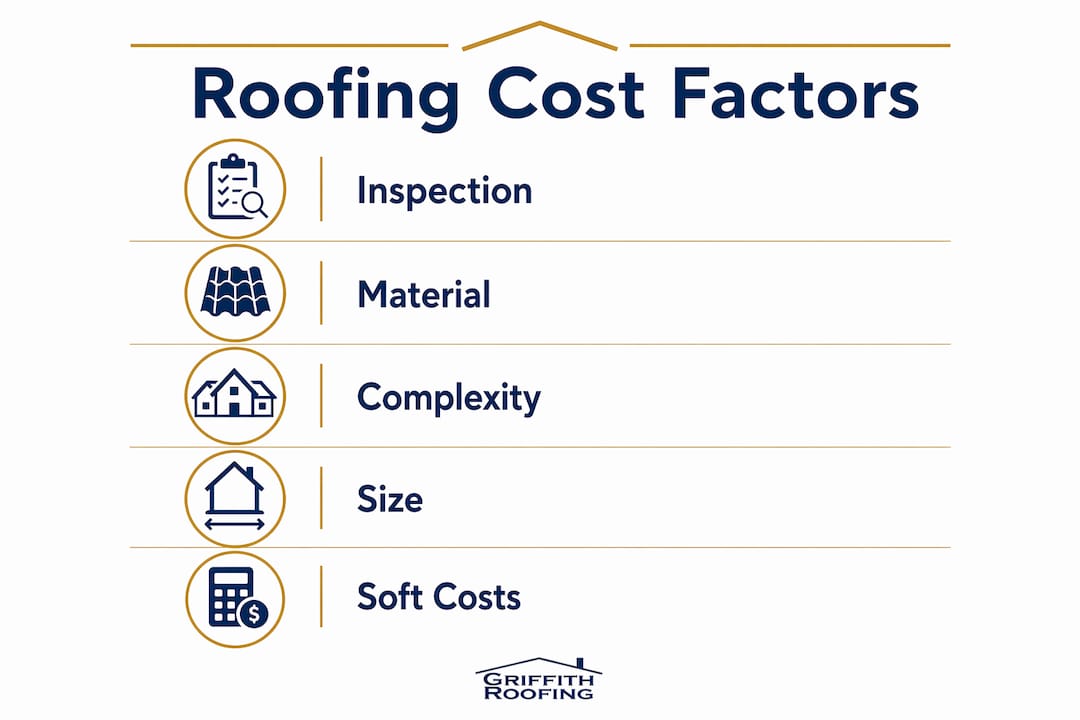
The base roofing cost per square foot covers membrane and installation. It rarely covers everything your project actually needs. Soft costs and contingencies are where budgets get bruised.
Key costs that sit outside the base square footage price include:
- Permits and inspections. DFW municipalities require permits for commercial roof replacements. Permit fees vary by city and project value, but skipping this step creates liability and code compliance problems.
- Engineering and drawings. Some jurisdictions require stamped drawings for large or structurally complex projects. Budget for this upfront.
- Staging and safety. OSHA-compliant fall protection, debris containment, and pedestrian safety barriers add real cost on occupied commercial properties.
- Insulation upgrades. Current energy codes in Texas often require upgraded insulation R-values when replacing a roof. This is a non-optional cost on many DFW projects. Reviewing DFW construction standards before budgeting helps you anticipate code-driven insulation requirements.
- Edge metal and flashing. Replacing deteriorated edge metal and counter-flashing is best practice on any full replacement. Skipping it creates leak points within years.
Adding a 10–20% contingency to your base estimate is the industry standard recommendation. That buffer covers wet insulation removal, deck repairs, and unforeseen complications discovered during tear-off. On a $200,000 project, that means keeping $20,000–$40,000 in reserve.
Pro Tip: Total cost of ownership beats upfront cost every time. A system that costs $2.00 more per square foot but lasts 15 years longer and requires less maintenance will save you money. Run the numbers over a 30-year horizon, not a 3-year budget cycle.
Prioritizing total cost of ownership over the lowest bid is the single most important shift commercial property owners can make in how they evaluate roofing proposals.
How to estimate and plan your commercial roofing budget in DFW
Getting an accurate budget starts with how you request bids. A single price-per-square-foot number tells you almost nothing useful. Detailed line-item bids that separate materials, labor, tear-off, insulation, flashing, permits, and warranty costs give you a real picture of what you are buying.
Follow these steps to build a reliable budget:
- Request itemized proposals from at least three qualified contractors. Compare line items, not totals. A lower total bid that excludes insulation or flashing will cost more in the end.
- Verify what the bid includes. Confirm that tear-off, disposal, insulation, edge metal, flashing, and warranty registration are all covered. Ask specifically about penetration flashing counts.
- Evaluate restoration before committing to replacement. Restoration costs $2.00–$5.00 per square foot and can extend roof life significantly when the existing insulation is dry and the deck is structurally sound. Full replacement runs $7.00–$15.00 or more per square foot. A core sample test tells you which path makes sense. The restoration vs. replacement decision deserves serious analysis before you commit to a full tear-off.
- Schedule around tenant operations. Phased installation, early-morning starts, and section-by-section sequencing reduce disruption to tenants and protect your rental income during the project.
- Verify contractor qualifications. Manufacturer certifications, local licensing, and verifiable DFW commercial project history matter. Understanding contractor qualifications before signing a contract protects you from unqualified crews and voided warranties.
Ignoring non-membrane costs like tear-off, wet insulation removal, edge metal upgrades, and staging is the most common budgeting mistake commercial owners make. These items easily add 10–20% to any estimate. Build them in from day one.
Key Takeaways
Commercial roofing square footage costs in DFW range from $4.50 to $18.00 per square foot installed, and accurate budgeting requires accounting for system type, project complexity, soft costs, and a 10–20% contingency.
| Point | Details |
|---|---|
| Cost range by system | TPO and EPDM run $5.50–$9.50/sq ft; metal runs $10.00–$18.00/sq ft fully installed. |
| Size affects unit price | Larger projects pay less per square foot due to economies of scale across fixed mobilization costs. |
| Soft costs add 10–20% | Permits, staging, insulation upgrades, and edge metal sit outside the base square footage price. |
| Restoration saves money | Restoration at $2.00–$5.00/sq ft beats replacement when insulation and deck are sound. |
| Itemized bids are non-negotiable | Line-item proposals reveal what is and is not included, preventing costly budget surprises. |
What I’ve learned about commercial roofing costs after 20+ years in DFW
I have been doing commercial roofing work in the Dallas-Fort Worth Metroplex since 2001. The single most consistent mistake I see property owners make is treating the average square footage cost as a budget. It is not a budget. It is a starting point.
The DFW market has its own pressures. Summer heat accelerates membrane degradation faster than in cooler climates. Hailstorms scar roofs that looked fine from the ground. And the local labor market is tight enough that the cheapest bid often reflects a crew cutting corners on flashing details or skipping insulation requirements that the city will catch on inspection.
What I tell every property owner who calls us: the system you choose should match how your building actually gets used. A warehouse with 30 rooftop HVAC units needs a different solution than a single-story retail strip with a clean deck. Treating commercial roofing as a performance-based investment rather than a commodity purchase is what separates owners who get 30 years out of a roof from those who are back on the phone in 10.
Transparent, itemized bids are not just a best practice. They are the only way to know what you are actually buying. If a contractor cannot or will not break down their quote by line item, that tells you something important before the project even starts.
— Mark Griffith
Griffith roofing is ready to help you budget your DFW commercial project
Planning a commercial roofing project in the Dallas-Fort Worth Metroplex takes more than a square footage estimate. It takes a contractor who knows local code requirements, understands DFW weather demands, and gives you a clear, itemized picture of every cost before work begins.
Griffith roofing has delivered commercial roofing solutions across DFW since 2001. Whether you are evaluating a full replacement, exploring restoration, or weighing metal roofing solutions for a long-term investment property, the team provides detailed proposals with transparent line-item pricing. Financing options are also available for qualifying projects. Reach out to Griffith roofing for a professional consultation and a bid that reflects the real scope of your project, not just a number per square foot.
FAQ
What is the average commercial roofing cost per square foot in 2026?
Fully installed commercial roof replacement costs range from $4.50 to $18.00 per square foot depending on the roofing system, building size, and project complexity. TPO and EPDM fall at the lower end; metal roofing sits at the top.
How does building size affect the total roofing square footage cost?
Larger buildings pay less per square foot because fixed mobilization and setup costs spread across more area. A 5,000 square foot project typically costs $9.00–$11.50 per square foot, while a 100,000 square foot project on a similar system runs $5.50–$7.25 per square foot.
Is roof restoration cheaper than full replacement?
Yes. Restoration costs $2.00–$5.00 per square foot compared to $7.00–$15.00 or more for full replacement. Restoration is viable when the existing insulation is dry and the roof deck is structurally sound.
What soft costs should I include in my commercial roofing budget?
Permits, engineering drawings, staging, insulation upgrades, and edge metal replacement all sit outside the base square footage price. Adding a 10–20% contingency covers unexpected deck repairs and wet insulation removal discovered during tear-off.
How do I get an accurate commercial roofing bid in DFW?
Request detailed, line-item proposals that separately list tear-off, insulation, membrane, flashing, permits, and warranty costs. Compare line items across at least three qualified contractors rather than comparing total bid amounts alone.


