

Dallas historic district roofing rules require any visible exterior roof alteration within a city-designated Landmark or Conservation District to receive a Certificate of Appropriateness (CofA) before work begins. These rules, enforced by Dallas Development Services and the Landmark Commission, govern materials, slope, massing, and design based on the Secretary of the Interior’s Standards for Rehabilitation. Skipping this process does not just delay your project. It can trigger stop-work orders, civil fines, and mandatory restoration at your expense. If you own or develop property in areas like Swiss Avenue, Kessler Park, or any other designated Dallas historic district, understanding these regulations protects your investment and keeps your project on track.
What is the Certificate of Appropriateness process in Dallas historic districts?
The Certificate of Appropriateness is the legal gateway for any roofing work in a Dallas Landmark or Conservation District. You cannot pull a building permit until the city issues a signed CofA. That means no purchasing materials, no scheduling crews, and no starting work until approval lands in your hands.
The CofA review process runs on two tracks depending on the scope of your project. Staff-level review handles routine, in-kind work and typically takes 4–10 weeks. Full Landmark Commission review applies to substantial changes and requires a public hearing, running 12–20 weeks. That is a meaningful difference when you are planning around weather windows or a property sale.
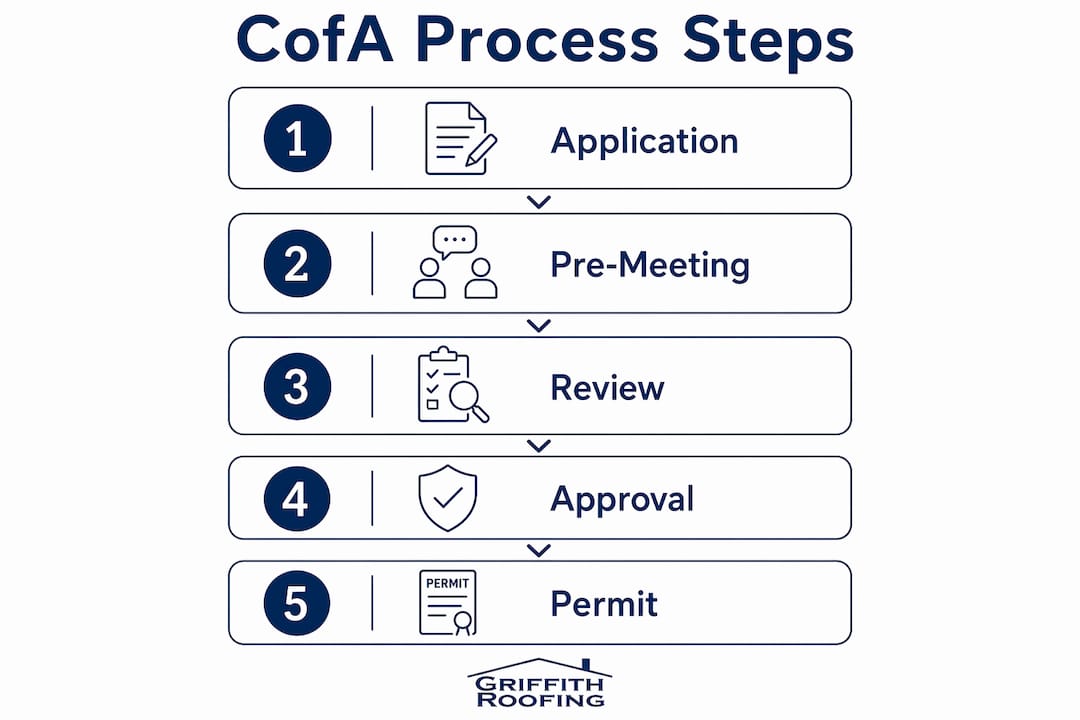
Here is how the two-track process works in practice:
- Pre-application consultation. Meet with Historic Preservation staff before finalizing your design. This step alone prevents the most common submission errors.
- Application submission. Submit dimensioned elevations, floor plans, material specifications, and photographs of the existing roof. Incomplete submissions cause delays that push your timeline back by weeks.
- Staff review or Commission scheduling. Staff determines whether your project qualifies for administrative approval or requires a public hearing before the full Landmark Commission.
- CofA issuance. Once approved, the signed CofA goes to Dallas Building Inspection, which then issues your building permit.
- Permit pull and work commencement. Only after the permit is in hand can your contractor legally begin work.
Pro Tip: Request a pre-application meeting with the Historic Preservation Office before you finalize any design decisions. Staff feedback at this stage costs you nothing and can prevent a denial that sets your project back by months.
What roof materials and design features are permitted or restricted?
Material authenticity is the core of Dallas preservation roofing rules. The Landmark Commission evaluates every application against the Secretary of the Interior’s Standards, which prioritize shape, material authenticity, and historic character over cost savings or personal preference. That standard is not negotiable.
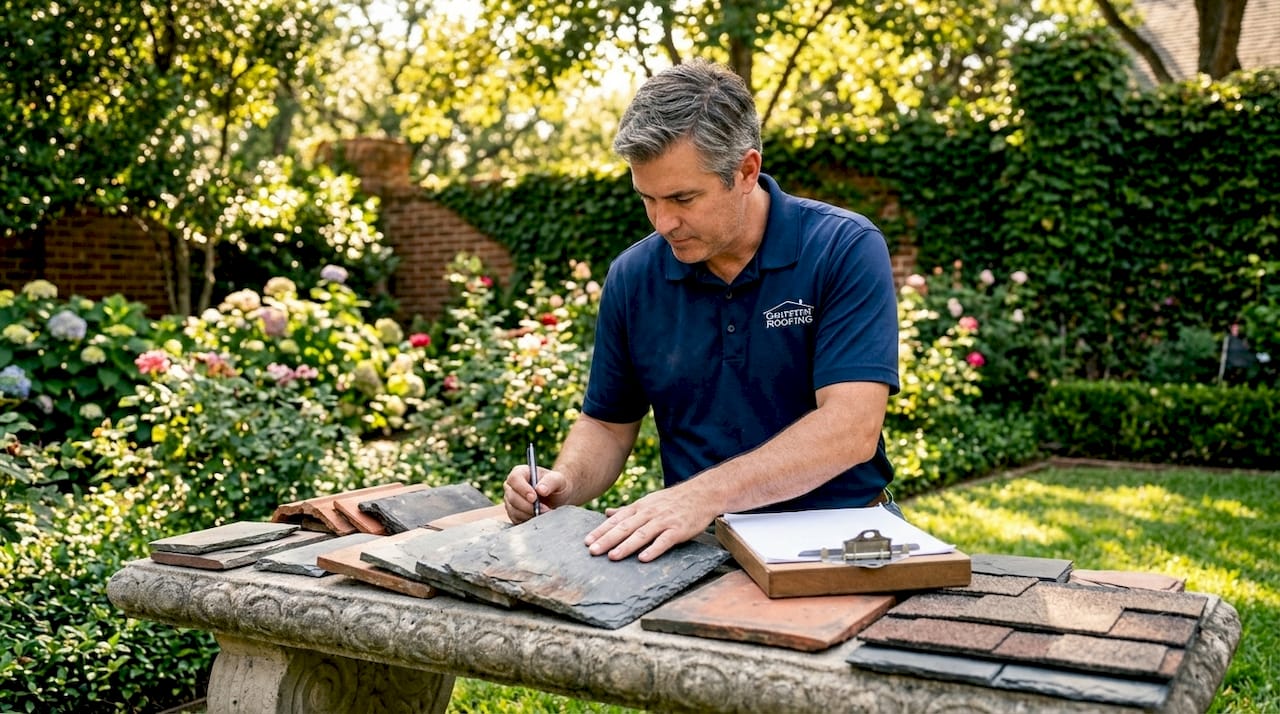
The Commission denied a synthetic slate roofing substitution on Swiss Avenue in july 2024, reinforcing that in-kind replacement with natural slate is required where slate was the original material. That decision signals a clear pattern. Budget-driven substitutions do not pass review, regardless of how closely a synthetic product mimics the original appearance.
Key material and design requirements include:
- Original materials must be matched. Natural slate, clay tile, wood shingles, and standing-seam metal must be replaced with the same material type, not a modern equivalent.
- Roof slope and configuration must match historic patterns. Changing the pitch or adding dormers that alter the roofline requires full Commission review.
- Massing and form must be preserved. Additions or modifications that change the visual mass of the roof from the street face are typically denied.
- Color and finish must align with the historic record. Paint colors, coatings, and surface treatments are subject to review.
- Modern materials require strong justification. Substitutions are considered only when the original material is no longer available and a documented case is made.
Homeowners sometimes assume that a material performing the same function as the original will satisfy the Commission. It does not. The review focuses on what the material looks like and how it relates to the building’s historic character, not how it performs under North Texas weather. For guidance on approved roofing materials that align with preservation standards, it pays to consult a contractor who knows both the technical and regulatory sides of the equation.
How do historic district roofing rules interact with Dallas building permits?
The CofA and the building permit are two separate documents, but one cannot exist without the other. A signed CofA must be in place before Dallas Building Inspection will issue a roofing permit. This sequencing catches many homeowners off guard, especially those used to pulling permits quickly for standard repairs.
Contractor registration adds another layer. All contractors pulling Dallas residential roofing permits must hold a current Certificate of Registration with Dallas Building Inspection, along with proof of general liability insurance. Hiring an unregistered contractor means the permit cannot be pulled, and any work performed is unpermitted.
Watch for these enforcement risks if you skip or shortcut the process:
- Stop-work orders issued immediately upon discovery of unpermitted work.
- Civil penalties assessed per day of violation.
- Mandatory restoration orders requiring the property to be returned to its pre-violation state, at the owner’s expense.
- Permit holds that can block future permits on the property until violations are resolved.
Jurisdictional boundaries also matter. Properties inside the City of Dallas limits follow city Landmark Commission rules. Properties in unincorporated Dallas County or in enclaved municipalities like University Park or Highland Park fall under different jurisdictions with their own permit and historic review processes. Confirm your property’s exact jurisdiction before submitting any application. For a full breakdown of DFW permit requirements, Griffith roofing has published a detailed guide covering the procedural steps across the metroplex.
Pro Tip: Verify your contractor’s Dallas Building Inspection registration number before signing any contract. Ask for it in writing. A registered contractor protects you from permit complications and enforcement liability.
What practical steps should homeowners and developers take?
Planning a roofing project in a Dallas historic district requires more lead time than a standard residential job. The review timeline alone can add 4–20 weeks before a single shingle is touched. Build that into your project schedule from day one.
Follow these steps to keep your project moving:
- Confirm your district status. Verify whether your property sits within a city-designated Landmark District, Conservation District, or simply on the National Register. National Register designation is largely honorary and does not legally mandate a CofA. Only city designation triggers the review requirement.
- Schedule a pre-application meeting. Contact the Historic Preservation Office early. Pre-application meetings with city staff significantly reduce documentation errors and improve approval odds.
- Prepare thorough documentation. Gather dimensioned elevations, existing condition photographs, material specifications, and product samples. Incomplete packages are the leading cause of delays.
- Select a contractor with historic district experience. Your contractor must understand CofA requirements, hold current Dallas Building Inspection registration, and have a track record with Landmark Commission submissions. Review the DFW contractor hiring guide to understand what qualifications matter most.
- Budget for historically accurate materials. Natural slate, clay tile, and period-appropriate metals cost significantly more than standard alternatives. Plan your budget around the materials the Commission will actually approve.
Two common mistakes derail projects before they start. First, homeowners assume that being on the National Register automatically triggers CofA requirements. It does not. Second, property owners sometimes believe that cost arguments or design preferences can sway the Commission. Decisions follow the Secretary of the Interior’s Standards, not personal circumstances.
Pro Tip: Start your CofA application at least six months before your target construction date. Commission-level reviews with public hearings can run 20 weeks, and that does not include time to gather documentation or respond to staff comments.
Key Takeaways
Dallas historic district roofing rules require a Certificate of Appropriateness before any permit is issued, and the Commission applies the Secretary of the Interior’s Standards without exception.
| Point | Details |
|---|---|
| CofA comes before permits | No building permit is issued until a signed Certificate of Appropriateness is in hand. |
| Two review tracks exist | Staff-level review takes 4–10 weeks; full Commission review takes 12–20 weeks. |
| Material authenticity is mandatory | Synthetic substitutes for original materials like natural slate are routinely denied. |
| National Register status is not enough | Only city-designated Landmark or Conservation District status legally requires a CofA. |
| Noncompliance carries real costs | Violations trigger stop-work orders, civil fines, and mandatory restoration at the owner’s expense. |
What I have learned after two decades of Dallas roofing work
After more than 20 years working on roofs across the Dallas-Fort Worth Metroplex, I have seen the same pattern repeat itself: a homeowner gets a roofing estimate, picks a material they like, and then discovers three months later that the Landmark Commission will not approve it. That delay costs real money and real stress.
The Commission is not unreasonable. It applies a consistent, well-documented standard. The Secretary of the Interior’s Standards exist precisely because subjective decisions would erode the character of districts like Swiss Avenue and Kessler Park over time. When I work with homeowners in these areas, I tell them the same thing: the rules protect your neighborhood’s value as much as they constrain your choices.
What surprises most people is how much the pre-application meeting changes the outcome. Homeowners who walk in with a finished design and a contractor already hired are the ones who face denials. Homeowners who engage Historic Preservation staff early, before any design decisions are locked in, almost always move through the process faster and with fewer revisions.
The other thing I have seen consistently is that budget surprises hurt more than timeline surprises. Natural slate costs significantly more than synthetic alternatives. Clay tile requires specialized installation. When you budget for the material the Commission will actually approve rather than the material you hoped to use, the project stays on track. Trying to negotiate your way to a cheaper substitute does not work. The Commission’s decisions are grounded in federal preservation standards, not cost analysis.
My honest advice: treat the CofA process as part of the project design phase, not a bureaucratic hurdle at the end. Start it early, document everything thoroughly, and work with a contractor who has done this before. That combination gets roofs approved and built without the costly detours.
— Mark Griffith
Griffith roofing and Dallas historic district compliance
Griffith roofing has worked in the Dallas-Fort Worth Metroplex since 2001, and that experience includes navigating Landmark Commission procedures, preparing CofA documentation, and sourcing historically appropriate materials that meet preservation standards. Historic district roofing is not a side specialty. It is a process that requires knowing both the regulatory requirements and the technical demands of period-accurate materials.
Griffith roofing coordinates directly with Dallas Building Inspection and Historic Preservation staff to keep your project moving through the approval process without surprises. From residential roofing projects in Landmark Districts to roof repair work requiring in-kind material matching, the team brings the documentation, registration, and hands-on experience your project needs. Contact Griffith roofing to discuss your historic district roofing project before your next planning cycle begins.
FAQ
What triggers a CofA requirement in Dallas?
Only properties within a city-designated Landmark District or Conservation District legally require a Certificate of Appropriateness. National Register listing alone does not trigger the requirement.
How long does the CofA review process take?
Staff-level review for routine work takes 4–10 weeks. Full Landmark Commission review for substantial changes takes 12–20 weeks, including a public hearing.
Can I use synthetic roofing materials in a Dallas historic district?
Synthetic substitutes for original materials are routinely denied. The Landmark Commission denied a synthetic slate substitution on Swiss Avenue in 2024, confirming that in-kind replacement with natural materials is required.
What happens if I roof without a CofA?
Unpermitted work in a historic district can result in stop-work orders, civil penalties, and mandatory restoration orders requiring the property to be returned to its original condition at the owner’s expense.
Does my contractor need special registration for historic district work?
All contractors pulling Dallas residential roofing permits must hold a current Certificate of Registration with Dallas Building Inspection. Hiring an unregistered contractor means no permit can be issued for the work.


