

The Dallas-Fort Worth climate is one of the most punishing roofing environments in the United States, defined by extreme temperature swings, intense UV radiation, and frequent hail events that collectively shorten roof lifespans and drive up repair costs. Understanding the DFW climate roofing impact, what roofing professionals call climate-driven material degradation, is the single most important factor in choosing materials, scheduling maintenance, and protecting your investment. Whether you own a home in Plano or a commercial building in Fort Worth, the forces working against your roof are the same. What separates a 15-year roof from a 30-year roof in this region is almost always how well the system was designed to handle those forces from day one.
How DFW climate roofing impact starts with temperature swings
The most consistent threat to roofing materials in the Dallas-Fort Worth area is not a single storm. It is the daily cycle of heating and cooling that grinds away at every component of your roof, year after year. On a summer afternoon, a dark asphalt shingle surface can reach 160°F or higher. By early morning, that same surface may have cooled by 50°F or more. This cycle repeats hundreds of times per year.
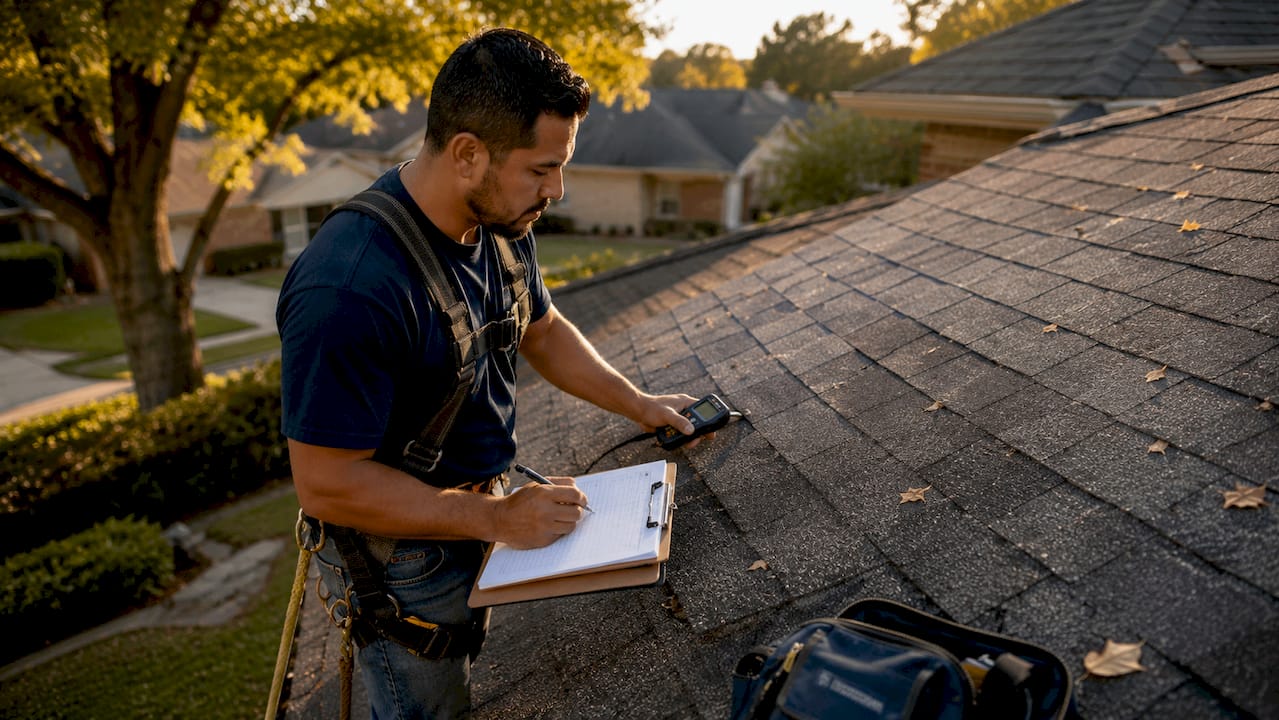
Thermal cycling stresses shingles, flashing, and fasteners through repeated expansion and contraction, leading to micro-cracks, sealant failure, and granule loss that raise your leak risk significantly. Each expansion-contraction cycle is small on its own, but the cumulative effect over five to ten years is measurable and often visible as cracking, curling, or lifted edges on shingles.
The specific components most vulnerable to thermal cycling include:
- Shingles: Granule loss accelerates as the asphalt binder softens in heat and stiffens in cold, loosening the protective surface layer.
- Flashing: Metal flashing around chimneys, vents, and valleys expands and contracts at a different rate than surrounding materials, breaking the seal over time.
- Fasteners: Nails and screws work loose through repeated movement, creating entry points for water.
- Sealant strips: The factory-applied adhesive on shingles loses bonding strength faster in extreme thermal environments.
Pro Tip: Schedule a roof inspection twice per year in DFW: once in late spring before peak heat, and once in fall after the first cold front. Catching micro-cracks early costs a fraction of what a water-damaged deck repair will run.
The practical takeaway is straightforward. A roof in DFW ages faster than the same roof installed in a moderate climate like Seattle or Denver. Inspection intervals that work in those cities are not adequate here.
Does attic ventilation really affect how long your roof lasts?
Poor attic ventilation is the hidden accelerator of roof failure in North Texas, and most property owners never think about it until the damage is already done. When your attic cannot exhaust heat properly, the underside of your roof deck can reach temperatures that bake shingles brittle from below, even while the surface looks intact from the street.
Attic temperatures without proper ventilation can climb to 140°F to 160°F, turning your attic into a heat chamber that degrades shingles, warps decking, and accelerates the breakdown of underlayment. This is not a minor inconvenience. It is a structural issue that cuts years off your roof’s service life.
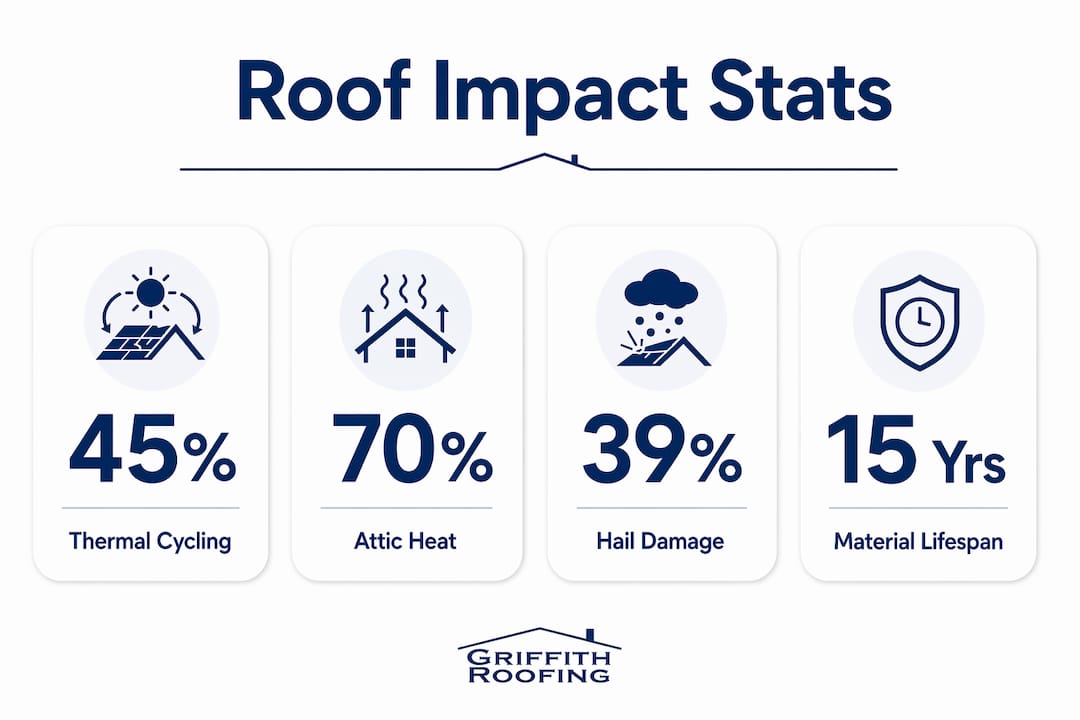
The IRC 2024 building code sets the standard for attic ventilation with a 1:150 NFVA ratio to attic floor area as the minimum requirement, meaning one square foot of net free ventilation area for every 150 square feet of attic floor. That ratio can be reduced to 1:300 when intake and exhaust are balanced and a vapor retarder is present. These numbers matter because they give you and your contractor a concrete benchmark to audit against.
Here is how to evaluate your attic ventilation system in practical terms:
- Check soffit vents for blockages. Blown-in insulation frequently covers soffit vents, eliminating intake airflow entirely. This is the most common ventilation failure Griffith roofing sees during inspections.
- Verify balanced intake and exhaust. Ridge vents without adequate soffit intake do not create airflow. They create negative pressure that can pull conditioned air from your living space.
- Calculate your NFVA. Measure your attic floor area and confirm your total vent area meets the IRC 2024 standard for your configuration.
- Inspect for moisture staining. Dark staining on rafters or decking indicates condensation from trapped heat and humidity, a sign that ventilation is failing.
- Consider powered ventilation for large attics. Attic fans or solar-powered ventilators can supplement passive systems in homes where geometry limits natural airflow.
Pro Tip: Diagnosing ventilation problems starts at the soffit, not the ridge. Before adding more exhaust vents, confirm your intake is unobstructed. Adding exhaust without intake makes the problem worse, not better.
A well-ventilated attic does more than protect shingles. It reduces your cooling load in summer, which lowers energy bills and extends the life of your HVAC system. In DFW’s climate, ventilation is not optional. It is foundational.
What is UL 2218 Class 4, and does it matter in DFW?
Hail is a fact of life in the Dallas-Fort Worth area. The region sits within what meteorologists call “Hail Alley,” and severe hail events occur multiple times per year across the Metroplex. Choosing the right impact resistance rating is one of the most consequential roofing decisions you will make here.
The UL 2218 standard rates roofing materials on a four-tier scale based on impact resistance. Class 4 passes the highest test, which involves dropping a 2-inch steel ball from 20 feet onto the same spot twice without the material cracking or fracturing. Class 4 is the benchmark Griffith roofing recommends for virtually every DFW property.
| UL 2218 Class | Steel Ball Diameter | Drop Height | DFW Recommendation |
|---|---|---|---|
| Class 1 | 1.25 inches | 12 feet | Not recommended |
| Class 2 | 1.5 inches | 15 feet | Marginal protection |
| Class 3 | 1.75 inches | 17 feet | Acceptable minimum |
| Class 4 | 2 inches | 20 feet | Strongly recommended |
The important nuance is that Class 4 does not guarantee zero damage. It guarantees structural resistance, meaning the material will not crack or allow water infiltration from the impact. Cosmetic damage such as granule scuffing or surface bruising can still occur. Standard manufacturer warranties do not cover hail damage, which is why maintaining adequate homeowners insurance remains non-negotiable in this region.
Beyond the shingle rating itself, the full roofing system determines how well your roof survives a hail event. Deck preparation, underlayment quality, flashing details, and installation precision all affect the outcome. A Class 4 shingle installed over a soft or deteriorated deck will not perform as rated. This is why Griffith roofing evaluates the entire system, not just the top layer, when advising clients on hail-resistant roofing choices.
One practical benefit of Class 4 materials: many Texas insurers offer premium discounts for homes with verified impact-resistant roofing. Ask your insurance agent about this before your next renewal.
Which roofing materials perform best in DFW’s climate?
Choosing roofing materials for DFW weather means evaluating three performance dimensions at once: thermal cycling resistance, UV and heat reflectance, and hail impact tolerance. No single material dominates every category, but the right choice for your property becomes clear once you understand the tradeoffs.
Materials rated for thermal cycling, such as architectural asphalt shingles and metal roofing with expansion joints, outperform standard three-tab shingles in DFW conditions by a significant margin. Here is how the main options compare:
- Architectural asphalt shingles: The most common choice in DFW residential roofing. Heavier than three-tab shingles, with better thermal cycling resistance and Class 4 options available from manufacturers like GAF and Owens Corning. Lifespan of 25 to 30 years with proper ventilation and maintenance.
- Metal roofing: Exceptional thermal cycling performance because expansion joints accommodate movement without cracking. Reflects UV radiation, reducing attic heat gain. Hail performance is strong, though large hail can cause cosmetic denting. Lifespan of 40 to 70 years. Griffith roofing’s metal roofing solutions are specifically designed for North Texas conditions.
- Cool roofing systems: Reflective coatings and membranes that reduce surface temperatures by reflecting sunlight rather than absorbing it. Particularly effective for flat or low-slope commercial roofs in DFW. Reduces attic temperatures and lowers cooling costs, which extends the life of the entire roof assembly.
- Tile roofing: High thermal mass and excellent UV resistance, but heavy and expensive. Hail performance varies by tile thickness and installation method. Less common in DFW but a strong performer in the right application.
| Material | Thermal Cycling | Hail Resistance | Typical DFW Lifespan |
|---|---|---|---|
| Architectural asphalt shingles | Good | Class 4 available | 25 to 30 years |
| Metal roofing | Excellent | Good (cosmetic risk) | 40 to 70 years |
| Cool roof coating | Good | Moderate | 15 to 25 years |
| Concrete tile | Excellent | Moderate to good | 30 to 50 years |
The best roofing material for your DFW property is the one that fits your budget, roof geometry, and risk tolerance, installed as part of a system that includes proper ventilation and quality underlayment. Griffith roofing’s guide to choosing North Texas roofing materials walks through this decision in detail for both residential and commercial applications.
Key takeaways
DFW roof failure is almost always systemic, combining UV damage from above, attic heat from below, and hail impact from the side, which means material choice alone cannot protect your investment without proper ventilation and regular inspection.
| Point | Details |
|---|---|
| Thermal cycling is the primary threat | Daily temperature swings cause micro-cracks, sealant failure, and granule loss that compound over years. |
| Attic ventilation is non-negotiable | Unventilated attics reach 140°F to 160°F, baking shingles brittle from underneath and cutting years off roof life. |
| Class 4 is the DFW standard | UL 2218 Class 4 impact resistance provides the best structural protection against hail but does not prevent cosmetic damage. |
| Material choice must match the system | Architectural shingles, metal, and cool roofing each perform differently; pair any material with proper ventilation and underlayment. |
| Inspections prevent costly repairs | Twice-yearly inspections timed around DFW’s seasonal transitions catch damage before it becomes a structural problem. |
What 23 years in DFW roofing taught me about climate and failure
I have been on thousands of roofs across the Metroplex since Griffith roofing opened in 2001, and the pattern I see most often is not storm damage. It is slow, preventable deterioration that accelerates because the roof was treated as a single layer rather than a system.
The conventional wisdom says, “Buy a good shingle and you’re covered.” That is wrong in DFW. I have seen Class 4 shingles fail prematurely on homes with blocked soffits and no ridge ventilation, because the attic was cooking the roof from underneath every summer. The shingle was fine. The system failed.
What I tell every property owner is this: the systemic nature of roof failure in North Texas means you cannot separate your material choice from your ventilation design, your underlayment selection, or your inspection schedule. These are not independent decisions. They interact, and when one element is weak, the others compensate until they cannot.
The other thing most owners overlook is timing. DFW’s spring storm season and summer heat peak are predictable. Scheduling an inspection in March, before hail season, and again in October, after the heat has done its work, is not excessive caution. It is the minimum standard for protecting a significant asset. The owners who call us after a catastrophic leak almost always skipped one of those windows.
My honest recommendation: treat your roof like you treat your HVAC system. You would not run your air conditioner for five years without a service check. Your roof deserves the same discipline, especially in this climate.
— Mark Griffith
How Griffith roofing helps DFW property owners protect their roofs
Griffith roofing has spent over two decades learning exactly how the Dallas-Fort Worth climate punishes roofing systems, and every service we offer is built around that knowledge. From selecting impact-resistant residential roofing materials rated for DFW’s thermal cycling to diagnosing ventilation failures that are silently shortening your roof’s life, our team approaches every project as a system, not just a surface. If your roof has not been inspected this year, or if you are planning a replacement and want guidance on materials that will actually perform in North Texas conditions, Griffith roofing is ready to help. Contact us to schedule a professional assessment and get a clear picture of where your roof stands today.
FAQ
What causes roofs to fail faster in DFW than other regions?
The combination of extreme heat, daily temperature swings, intense UV radiation, and frequent hail events creates a uniquely stressful environment that accelerates material degradation. Poor attic ventilation compounds all of these effects by adding heat stress from below.
How often should DFW property owners inspect their roofs?
Twice per year is the recommended minimum in DFW: once in spring before hail season and once in fall after summer heat stress. Regular inspections timed to DFW’s seasonal transitions catch damage before it becomes a costly structural problem.
Is Class 4 impact-resistant roofing worth the extra cost in DFW?
Yes. Class 4 materials provide the highest structural protection against hail under the UL 2218 standard and often qualify for insurance premium discounts in Texas. They do not prevent cosmetic damage, but they significantly reduce the risk of leaks and structural failure after a hail event.
What is the best roofing material for DFW’s heat and hail?
Metal roofing offers the best overall performance for thermal cycling and longevity, while architectural asphalt shingles with Class 4 ratings provide strong protection at a lower upfront cost. The right choice depends on your roof geometry, budget, and whether you prioritize long-term durability or initial affordability.
Can attic ventilation really affect my shingles?
Absolutely. Attic temperatures without proper ventilation reach 140°F to 160°F, which degrades shingles from underneath even when the surface appears undamaged. Fixing ventilation is often the single highest-return improvement a DFW property owner can make to extend roof life.


