

DFW roofing permit requirements follow two distinct sets of rules depending on whether your property sits inside Dallas or Fort Worth city limits. Dallas requires a Re-Roof permit for every full roof replacement and overlay. Fort Worth requires a permit only when roof decking is replaced. Minor repairs are exempt in both cities. Getting this wrong costs you time, money, and potentially your homeowner’s insurance coverage.
1. Which roofing projects require a permit in Dallas vs. Fort Worth?
The single most important thing to understand about roofing permits in DFW is that Dallas and Fort Worth treat the same project very differently. Knowing which category your job falls into before work begins prevents costly surprises.
Dallas permit triggers:
- Full roof replacement using any material (asphalt shingles, metal, tile, TPO)
- Overlays, meaning new shingles installed directly over existing ones
- Any re-roofing project regardless of whether decking is touched
- Minor repairs such as patching a few shingles or isolated flashing work are exempt
Fort Worth permit triggers:
- Replacement of roof decking boards, even if only a portion is replaced
- Any project where decking damage is discovered and repaired mid-job
- Shingle-only replacements with zero decking work are fully exempt
- Isolated flashing repairs and minor patching do not require a permit
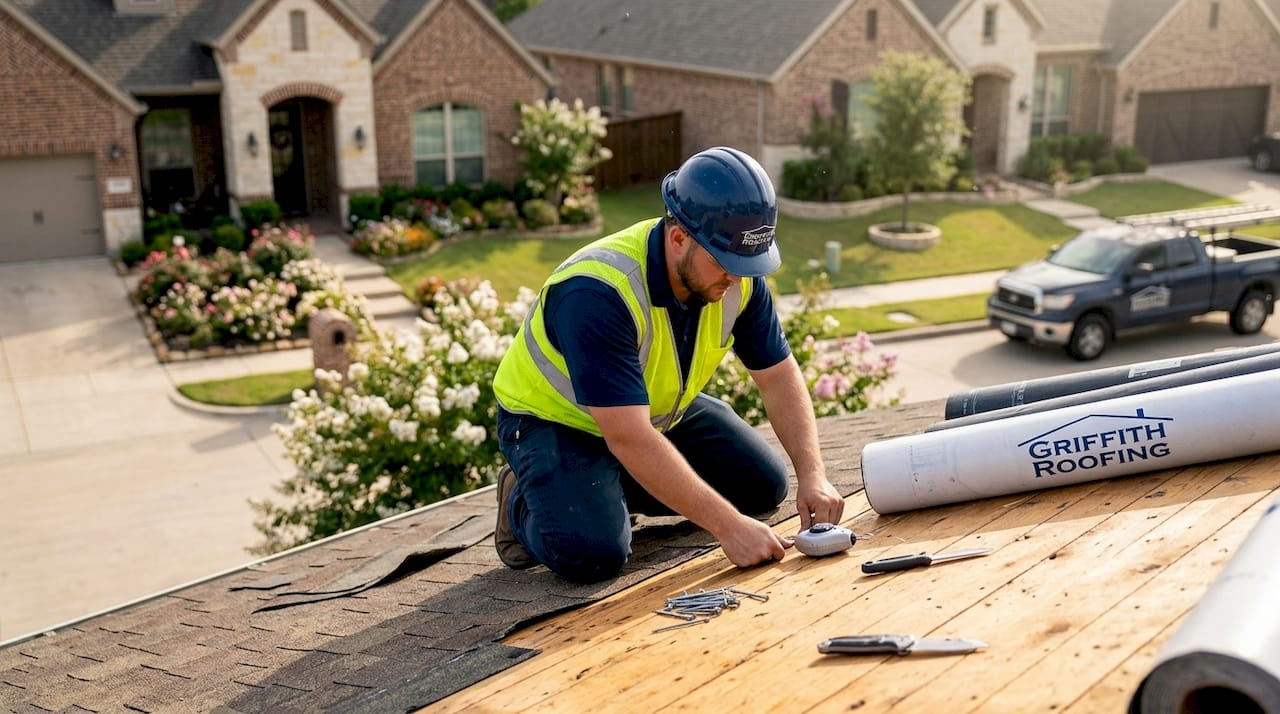
The Fort Worth rule creates a practical trap that catches homeowners off guard. A job that starts as a shingle-only replacement frequently uncovers rotted or damaged decking underneath. Once that decking is replaced, the project becomes permitted work, and your contractor must stop and apply before continuing. Griffith Roofing always scopes decking condition before quoting a Fort Worth job precisely because of this.
Pro Tip: Ask your contractor to inspect the decking before finalizing the contract in Fort Worth. If there is any visible sagging, soft spots, or storm damage history, budget for a permit from the start.
2. How to navigate the DFW roofing permit application process
The DFW construction permit process differs by city, but both follow a logical sequence once you know the steps. Here is how each municipality handles permit applications and inspections.
Dallas permit process:
- Your licensed contractor submits the application through the ePlan portal, Dallas’s online permitting platform.
- Review typically completes same-day to one business day for straightforward residential re-roofs.
- The permit is issued digitally, and work can begin.
- One inspection is scheduled after the roof installation is complete.
- The inspector verifies materials, layer count, flashing, and underlayment against the approved scope.
Fort Worth permit process:
- Your contractor submits through Accela Citizen Access, Fort Worth’s online permitting system.
- Initial review comments typically arrive within 1 to 3 business days.
- Permits carry a 180-day validity window from the date of issuance.
- One post-installation inspection is standard after decking and roofing work is complete.
- The inspector checks decking replacement, drip edges, crickets, and material compliance.
Permit fees range from approximately $75 to $200 in Dallas and $150 to $300 in Fort Worth depending on project scale. These fees are typically included in your contractor’s quote, so ask for an itemized breakdown if you do not see them listed.
Pro Tip: In most DFW jurisdictions, the licensed contractor pulls the permit, not the homeowner. If a contractor asks you to pull your own permit, treat that as a serious red flag.
You can track inspection status through the same portal your contractor used to apply. Both ePlan and Accela Citizen Access allow homeowners to log in and confirm that an inspection was scheduled, completed, and passed. Do not skip this step. Confirming inspection completion yourself protects you if a dispute arises later.
3. Key code differences between Dallas and Fort Worth roofing rules
Dallas and Fort Worth share the same Texas climate but enforce meaningfully different roofing regulations. These distinctions affect material choices, installation methods, and what your contractor must do before the inspector signs off.
| Requirement | Dallas | Fort Worth |
|---|---|---|
| Overlays permitted | Yes, with a permit | No. Full tear-off required |
| Permit for shingle replacement | Yes, always | Only if decking is replaced |
| Maximum roofing layers | Two total | Two total (full tear-off if exceeded) |
| Drip edge required | Yes | Yes, enforced as code upgrade |
| Cricket behind chimney | Not always required | Required for chimneys wider than 30 inches |
| Permit portal | ePlan | Accela Citizen Access |
Fort Worth prohibits overlays entirely and requires a full tear-off before any re-roofing. Dallas allows overlays but treats them as re-roof projects requiring permits and inspections. Both cities cap total roofing layers at two. If your home already has two layers, a full tear-off is mandatory regardless of which city you are in.
Dallas inspections specifically verify that approved materials and manufacturer specifications are followed, including proper flashing installation and underlayment placement. Fort Worth adds code upgrades as part of the permitted scope, meaning your contractor must install drip edges and crickets even if the original roof lacked them.
One upgrade worth discussing with your contractor is impact-resistant shingles, rated Class 3 or Class 4 by UL 2218 standards. Several major Texas insurers offer premium discounts for homes with Class 4 shingles. The upfront cost is higher, but the long-term savings on insurance and the reduced risk of hail damage make this a smart investment for DFW homeowners.
4. Common pitfalls and legal risks in the DFW permit process
Skipping permits is not just a technical violation. It exposes you to financial loss, failed home sales, and contractor fraud. The risks are real and documented.
A Texas Attorney General lawsuit exposed a DFW roofing company that collected payments from homeowners for work that was never completed and never permitted. Homeowners had no permit record to point to, no inspection to reference, and no legal leverage. The permit process exists partly to create that paper trail.
Red flags that signal a permit problem:
- Contractor quotes a price but never mentions permit fees
- Contractor asks you to pull the permit yourself for a full replacement
- Contractor cannot provide a permit number after work begins
- No inspection is scheduled after installation is complete
- Contractor pressures you to skip the permit to “save money”
“Permitting is not bureaucratic overhead. It is the single document that proves your roof was built to code, inspected by a city official, and completed by a licensed professional. Without it, you own a liability, not an asset.”
Unpermitted overlay work in Dallas creates a specific problem. If an inspector discovers a third layer during a future inspection or sale, the entire roof must be torn off at your expense. That cost far exceeds the original permit fee. Griffith Roofing recommends that homeowners verify contractor credentials before signing any contract, including license status and permit history.
How to protect yourself:
- Request the permit number in writing before work begins
- Log into the city portal yourself to confirm permit issuance
- Confirm the inspection was completed and passed before making final payment
- Keep copies of the permit and inspection report with your home records
Key takeaways
DFW roofing permit requirements differ sharply between Dallas and Fort Worth, and knowing which rules apply to your project before work begins is the single most effective way to avoid delays, fines, and fraud.
| Point | Details |
|---|---|
| Dallas requires permits broadly | Every full replacement and overlay in Dallas requires a Re-Roof permit, no exceptions. |
| Fort Worth targets decking work | Fort Worth only mandates permits when roof decking is replaced, not for shingle-only jobs. |
| Overlays treated differently | Dallas allows permitted overlays; Fort Worth requires a full tear-off before re-roofing. |
| Fees vary by city | Expect $75 to $200 in Dallas and $150 to $300 in Fort Worth for standard roofing permits. |
| Permit records protect homeowners | Confirming permit issuance and inspection completion is your best defense against contractor fraud. |
My take on DFW permits after 20+ years in roofing
I have been working roofs across Dallas and Fort Worth since 2001, and the permit question comes up on nearly every job. My honest observation is that most homeowner confusion does not come from the rules themselves. It comes from contractors who present the permit process as optional or as something that slows the job down.
The Fort Worth decking rule catches people off guard more than anything else. A homeowner gets a quote for a shingle replacement, the crew pulls up the first section, and suddenly there is rotted decking underneath. At that point, the job legally requires a permit. A contractor who did not plan for this either stops work and applies, or keeps going without one. The second choice puts you at risk, not them.
I always tell homeowners to ask one question before signing: “Will you pull the permit, and can I see the permit number before work starts?” A contractor who hesitates or deflects that question is telling you something important.
Dallas’s overlay rule is the other area where I see problems. Some contractors propose overlays to avoid the cost of a full tear-off. In Dallas, that still requires a permit and inspection. What concerns me is when contractors frame overlays as a way to avoid the permit process entirely. That is not how Dallas building codes work, and a homeowner who accepts that framing ends up with unpermitted work and no inspection record.
Staying current on DFW roofing regulations matters more than most people realize. Building codes in both cities have evolved over the past decade, and what was acceptable five years ago may not pass inspection today. The best protection is a contractor who knows the current code, pulls the permit without being asked, and hands you the inspection report when the job is done.
— Mark Griffith
Work with a DFW roofer who handles permits correctly
Griffith Roofing has managed residential and commercial roofing permits across Dallas, Fort Worth, and the broader DFW metroplex since 2001. The team knows the ePlan portal, the Accela Citizen Access system, and the specific code requirements each city enforces during inspections.
When you work with Griffith Roofing, permit management is part of the job from day one. The company pulls the permit, schedules the inspection, and provides documentation when the project closes. You never have to chase paperwork or wonder whether your roof was built to code. Explore Griffith Roofing’s residential roofing services to see how the team handles your project from permit application through final inspection.
FAQ
Does every roof replacement in Dallas require a permit?
Yes. Dallas requires a Re-Roof permit for all full roof replacements and overlays. Only minor repairs such as patching a few shingles are exempt.
Does Fort Worth require a permit for shingle replacement?
No. Fort Worth only requires a permit when roof decking is replaced. A shingle-only replacement with no decking work is exempt from the permit requirement.
Who is responsible for pulling the roofing permit in DFW?
The licensed roofing contractor is responsible for pulling the permit in both Dallas and Fort Worth. If a contractor asks the homeowner to pull the permit for a full replacement, that is a red flag.
What happens if roofing work is done without a permit in DFW?
Unpermitted work can result in fines, mandatory tear-offs, and complications when selling your home. The Texas Attorney General has pursued legal action against DFW contractors who completed unpermitted work while collecting full payment.
How long does it take to get a roofing permit approved in DFW?
Dallas typically reviews residential roofing permits same-day to one business day through the ePlan portal. Fort Worth reviews generally take 1 to 3 business days through Accela Citizen Access.


