

Financing residential roof replacement is defined as using loans, insurance proceeds, or government-backed renovation programs to cover the cost of a full roof replacement without paying everything out of pocket at once. In Dallas-Fort Worth, this process is more complex than most homeowners expect because Texas insurance policies carry percentage-based deductibles and two-stage payout structures that leave real gaps between what your insurer pays and what you owe the contractor. The right roof replacement financing options depend on your equity position, credit profile, and how quickly your roof needs to be replaced. Understanding all available paths, from personal loans and HELOCs to FHA 203(k) renovation loans, puts you in control of the timeline and the budget.
How do Texas insurance policies affect roof replacement financing?
Texas insurance policies are the single biggest variable in how much you need to borrow for a roof replacement. Most homeowners assume their insurer will simply cut a check for the full replacement cost. The reality is more layered, and understanding it prevents expensive surprises.
Texas policies typically fall into two categories: Actual Cash Value (ACV) and Replacement Cost Value (RCV). An ACV policy pays only the depreciated value of your old roof, meaning a 15-year-old roof gets paid out at a fraction of today’s replacement cost. An RCV policy pays the full replacement cost, but not all at once. RCV policies pay in two stages: first an initial ACV check, then a recoverable depreciation payment after the work is completed and invoices are submitted. That gap between the first check and the second payment is exactly where most DFW homeowners need short-term financing.
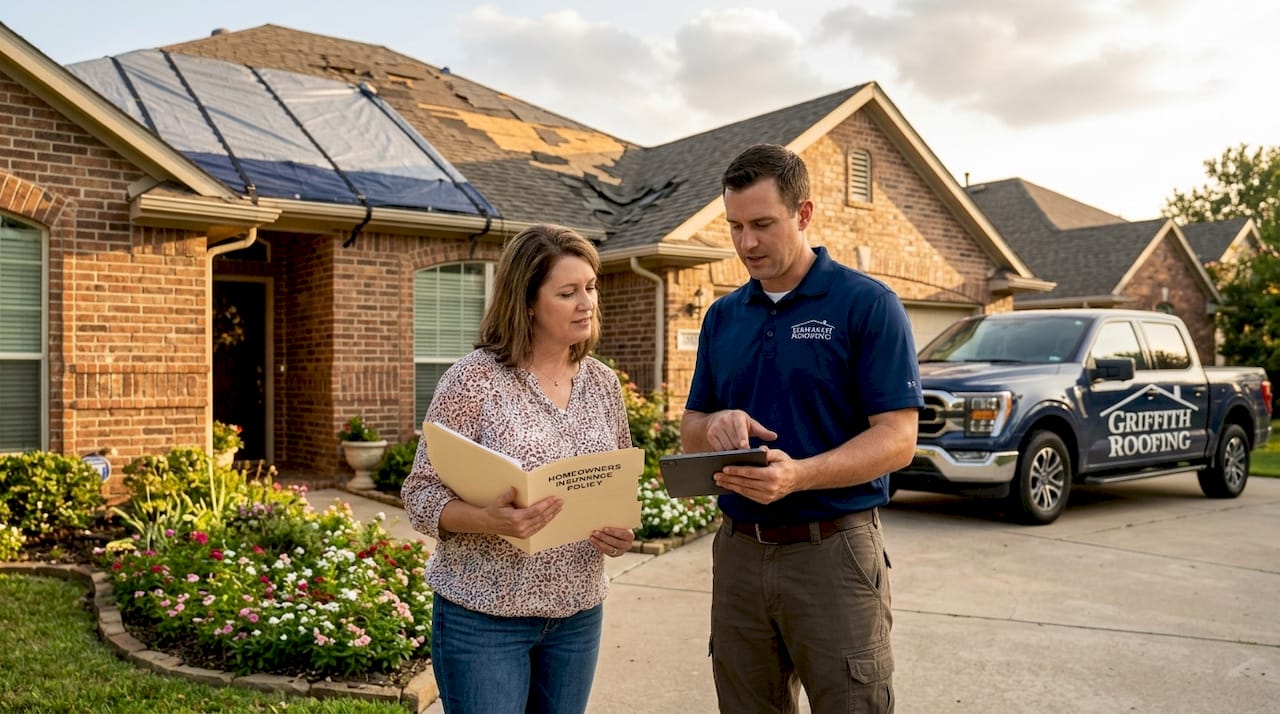
The deductible calculation adds another layer of complexity. Texas wind/hail deductibles are percentage-based, typically 1%, 2%, or 5% of the insured dwelling value, not a flat dollar amount. On a home insured for $400,000 with a 2% deductible, you owe the first $8,000 of storm damage before insurance pays a cent. That is a number many homeowners do not see coming.
Here is what typically drives DFW homeowners to seek financing even when they have insurance coverage:
- The deductible alone exceeds available cash savings
- The contractor requires a deposit before insurance issues the first ACV check
- The recoverable depreciation payment arrives weeks after work is complete, creating a cash flow gap
- ACV-only policies leave a permanent shortfall between the payout and actual replacement cost
Pro Tip: Pull your insurance declarations page before you call a single contractor. Find the line that says “wind/hail deductible” and confirm whether it is a percentage or a flat amount. That one number determines how much financing you actually need.
Knowing your insurance payout details before you start the financing process saves you from borrowing too little or too much.
What personal and home equity loan options are available?
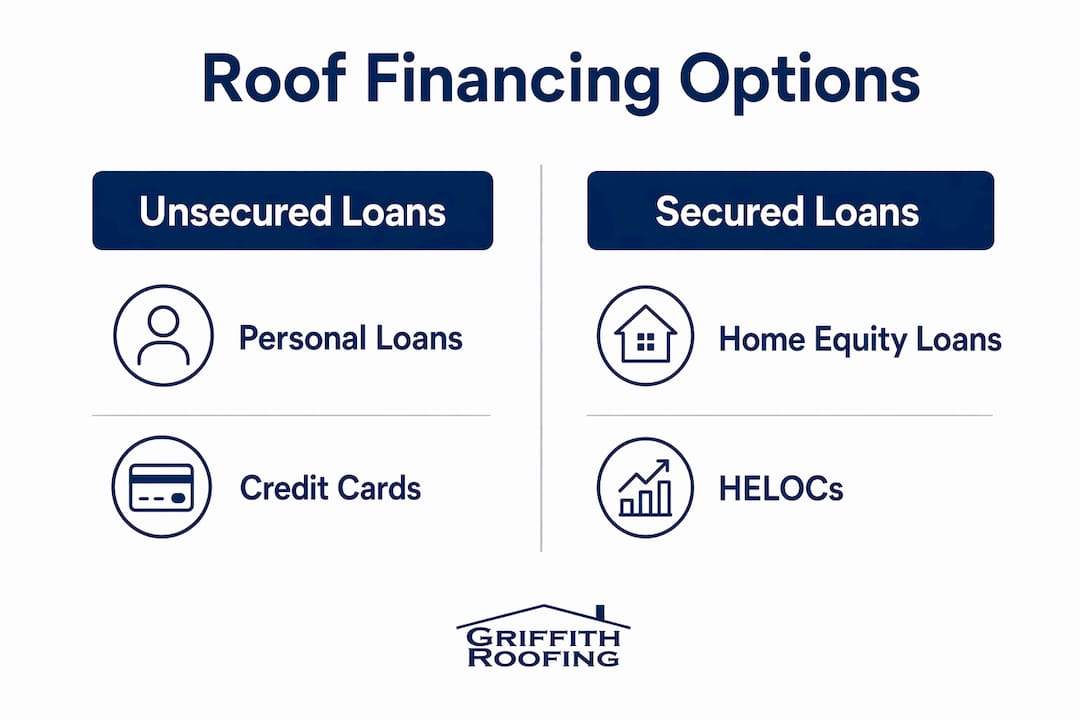
Personal loans, home equity loans, and HELOCs are the three most common roof replacement financing options for DFW homeowners who need to cover deductibles, contractor deposits, or the full replacement cost.
Personal loans
Personal loans are unsecured, meaning your home is not collateral. Personal loans in DFW typically range from $5,000 to $100,000 with terms from 24 to 84 months and APRs between 7% and 18%. Funding is fast, often within a few business days, which matters when a storm has left your roof exposed. The trade-off is a higher interest rate compared to secured options, and your credit score heavily influences the rate you receive.
Home equity loans and HELOCs
Secured home equity loans and HELOCs offer lower interest rates because your home backs the loan, but they require a home appraisal and carry the risk of foreclosure if you default. HELOCs function like a credit line with variable rates, while home equity loans deliver a lump sum at a fixed rate. HELOCs can provide between $25,000 and $400,000 depending on your equity, making them well-suited for larger replacement projects. The approval process takes longer than a personal loan, so they work best when your roof damage is not an emergency.
Comparing your main loan options
| Loan type | Typical amount | Rate range | Collateral required | Funding speed |
|---|---|---|---|---|
| Personal loan | $5,000 to $100,000 | 7% to 18% APR | No | 1 to 5 business days |
| Home equity loan | $25,000 to $400,000 | 6% to 10% fixed | Yes (home) | 2 to 4 weeks |
| HELOC | $25,000 to $400,000 | Variable, 6% to 12% | Yes (home) | 2 to 4 weeks |
| FHA 203(k) loan | Varies by project | FHA-insured rates | Yes (mortgage) | 30 to 60 days |
Pro Tip: If you have strong equity and time is not critical, a home equity loan at a fixed rate beats a personal loan on total interest paid over the life of the loan. If your roof is actively leaking, a personal loan gets you moving faster.
Your choice between these affordable roof replacement loans should reflect two things: how urgently the work needs to start and how much equity you have built in your home.
How do FHA 203(k) renovation loans work for roof replacement?
The FHA 203(k) loan is a government-backed mortgage product that combines home purchase or refinance financing with renovation funding in a single loan. It is the industry’s standard term for what many homeowners loosely call a “renovation loan.” For DFW homeowners who are buying a home with a damaged roof or refinancing to fund major repairs, this program deserves serious consideration.
The FHA 203(k) program comes in two versions. The Limited 203(k) covers non-structural repairs up to $35,000 and is the simpler path for a straightforward roof replacement. The Standard 203(k) handles major structural work, requires a HUD-approved consultant to oversee the project, and carries more paperwork. Roof replacement qualifies under both versions depending on scope.
Key features of the FHA 203(k) program:
- Renovation funds are held in an escrow account and released as work progresses after inspections confirm completion
- Minimum down payment is 3.5% for qualified borrowers, lower than most conventional renovation loans
- The property must be the borrower’s primary residence
- Standard 203(k) requires a HUD-approved consultant to review contractor bids and inspect work at each draw stage
- Contractors must be licensed and provide detailed bids before loan approval
The escrow-and-draw structure protects both the homeowner and the lender but adds time to the process. Expect 30 to 60 days from application to funding, which means this is not the right tool for an emergency repair. It works best when you are purchasing a home that needs a new roof or refinancing to address deferred maintenance alongside other improvements.
| 203(k) type | Repair limit | Consultant required | Best for |
|---|---|---|---|
| Limited 203(k) | Up to $35,000 | No | Standard roof replacement |
| Standard 203(k) | No set cap | Yes (HUD-approved) | Major structural + roof work |
The correct 203(k) loan type depends on whether your project involves structural repairs beyond the roof itself. Confirming project scope with your contractor before applying saves weeks of delay.
What steps should DFW homeowners take to secure roof financing?
Securing financing for a residential roofing loan program works best when you treat it as a project with a defined sequence, not a series of phone calls made in a panic after a storm.
-
Review your insurance policy first. Pull your declarations page and identify your deductible type, coverage category (ACV or RCV), and any exclusions. This tells you the minimum financing gap you need to fill before a contractor starts work.
-
Document all damage thoroughly. Photograph every damaged area, note the date of the storm, and file your claim promptly. Financing that covers your deductible and the interim gap before recoverable depreciation arrives keeps your contractor on schedule and prevents costly delays.
-
Get at least two contractor bids. A written bid with a line-item breakdown gives you the exact loan amount to request. Vague estimates lead to under-borrowing, which stalls the project mid-replacement.
-
Prequalify for multiple financing options simultaneously. Check your credit score, then prequalify for a personal loan and a HELOC at the same time. Prequalification does not hurt your credit score and gives you real rate offers to compare side by side.
-
Match your loan timeline to your contractor’s schedule. A personal loan funds in days; a HELOC takes weeks. Confirm your contractor’s start date before choosing a product, and build a buffer for inspection delays or material lead times.
-
Plan cash flow around the two-stage insurance payout. Texas RCV policies hold back recoverable depreciation until after work is complete and invoices are submitted. Budget for the possibility that the second insurance check arrives 30 to 60 days after your contractor finishes.
-
Avoid these common pitfalls. Many Texas homeowners treat their deductible as a flat amount rather than a percentage of dwelling coverage, leading to financial surprises at the worst possible moment. Always calculate the actual dollar amount before you commit to a loan size.
Pro Tip: Ask your roofing contractor if they have experience working with insurance adjusters. A contractor who understands the claims process can help you document damage correctly and avoid disputes that delay your second insurance payment.
Key takeaways
Financing a residential roof replacement in DFW requires understanding your Texas insurance deductible structure, selecting the right loan product for your timeline and equity position, and coordinating cash flow around the two-stage RCV insurance payout.
| Point | Details |
|---|---|
| Texas deductibles are percentage-based | A 2% deductible on a $400,000 home means $8,000 out of pocket before insurance pays anything. |
| RCV policies pay in two stages | Plan for a cash flow gap between the initial ACV check and the recoverable depreciation payment. |
| Personal loans fund fastest | Use personal loans for urgent repairs; home equity loans for larger projects with more time. |
| FHA 203(k) suits purchase or refinance | This program works best when buying a home with a damaged roof or refinancing for major repairs. |
| Prequalify before choosing a contractor | Real loan offers in hand let you match financing to contractor bids and project timelines accurately. |
What I’ve learned after 25 years of DFW roofing
I started Griffith Roofing in 2001, and the financing conversation has changed more than almost anything else in this business. When I first started, most homeowners either paid cash or filed an insurance claim and expected it to cover everything. Today, the combination of rising home values and percentage-based deductibles means the average DFW homeowner owes more out of pocket than they ever expected.
The homeowners who handle this best are the ones who read their insurance policy before a storm hits, not after. I have seen families delay repairs for months because they were shocked by an $8,000 or $10,000 deductible they did not know they had. That delay turns a $15,000 roof replacement into a $20,000 project once interior water damage is factored in.
My honest advice: do not treat financing as a last resort. Treat it as a planning tool. A short-term personal loan that covers your deductible and contractor deposit, repaid when your recoverable depreciation check arrives, costs far less in interest than the water damage you accumulate waiting for funds to align. The math almost always favors moving fast.
I also tell homeowners to be transparent with their lender and their contractor from the start. Tell your contractor you are waiting on a loan approval. Tell your lender the project has a hard start date. Both parties can work around real constraints. What they cannot work around is silence.
— Mark Griffith
How Griffith Roofing helps DFW homeowners get their roof replaced
Griffith Roofing has served Dallas-Fort Worth homeowners since 2001, and we know that a damaged roof rarely waits for your finances to line up perfectly.
Our team works directly with homeowners to provide detailed, line-item bids that satisfy lender requirements for personal loans, HELOCs, and FHA 203(k) applications. We coordinate with insurance adjusters to document damage accurately and support your claim through both payment stages. Whether you need a full residential roof replacement or targeted roof repair services, Griffith Roofing gives you the documentation, timeline, and professional execution that lenders and insurers require. Contact us for a free estimate and let us help you build a financing plan that gets your roof replaced without delay.
FAQ
What is the most common way to finance a roof replacement in Texas?
Most DFW homeowners finance roof replacement through a combination of insurance proceeds and a personal loan or HELOC to cover the deductible and any gap before the recoverable depreciation payment arrives. The right mix depends on your policy type and available home equity.
How does a percentage-based deductible affect how much I need to borrow?
A percentage-based wind/hail deductible is calculated on your insured dwelling value, not the repair cost. On a $400,000 home with a 2% deductible, you owe $8,000 before insurance contributes anything, which is the amount most homeowners need to finance.
Can I use an FHA 203(k) loan just for a roof replacement?
Yes. The Limited FHA 203(k) loan covers non-structural repairs up to $35,000, which includes most standard roof replacements. The property must be your primary residence and the funds are released from escrow as work is verified complete.
How long does it take to get a personal loan for roof replacement?
Personal loans from banks, credit unions, and online lenders typically fund within one to five business days after approval. This makes them the fastest residential roofing loan program option when your roof needs immediate attention.
What documents do I need to apply for roof replacement financing?
Most lenders require proof of income, a credit check, and a contractor bid showing the project scope and total cost. For FHA 203(k) loans, you also need a licensed contractor’s detailed proposal and, for Standard 203(k), a HUD-approved consultant’s report.


