

Fort Worth roofing code is defined by the 2021 International Residential Code with local amendments that determine when permits are required, what materials are allowed, and how reroofing must be performed. The core rule is binary: a permit is required when roof decking (plywood or OSB) is replaced, but a shingle-only replacement without any decking work does not trigger a permit. Fort Worth also prohibits overlay installations, meaning no contractor can legally install new shingles over an existing layer. Knowing these distinctions before your project starts protects you from failed inspections, unexpected costs, and compliance headaches.
What is Fort Worth roofing code and how does it work?
Fort Worth enforces residential roofing requirements through the 2021 IRC with local amendments that modify the base code to fit the city’s climate and construction practices. The city’s Development Services department handles enforcement, and the code covers building, mechanical, energy, and residential standards. Local amendments are not minor footnotes. They change real requirements in ways that affect every reroofing project in the city.
One of the most notable local changes is the removal of the ice barrier underlayment requirement. Because Fort Worth’s climate rarely produces the sustained freezing conditions that cause ice dams, the city dropped this requirement from the base IRC. That said, some contractors still install ice barriers as a best practice on low-slope sections, and there is no prohibition against it.
Fort Worth also mandates full tear-offs for all reroofing work. Overlay roofs, where new shingles are laid directly over old ones, are not compliant with Fort Worth roofing regulations. This rule protects structural integrity and makes inspections more reliable since inspectors can see the actual deck condition.
Two additional code upgrades apply to all reroofing projects regardless of whether the original roof had them:
- Crickets: Required behind chimneys and wide roof penetrations to divert water away from the base of the chimney.
- Drip edges: Must be installed on all reroofing projects, even if the original roof lacked them.
- Full tear-off: No overlay installations permitted under any circumstances.
- Underlayment: Ice barriers are not required due to local climate, but standard underlayment is still mandatory.
Pro Tip: Do not rely solely on the base IRC text when planning a Fort Worth roofing project. The city issues its own roofing FAQ and inspection checklist through Development Services, and those documents reflect the local amendments that actually govern inspections.
When do you need a roofing permit in Fort Worth?
The permit decision in Fort Worth comes down to one question: is the roof decking being replaced? If yes, a permit is required. If the project involves only shingle replacement with no decking work, no permit is needed. This binary rule simplifies most decisions, but the reality on job sites is more complicated than it sounds.
Here is how the permit process works when a permit is required:
- Submit through Accela Citizen Access. Fort Worth uses the Accela Citizen Access online portal for permit applications. Most contractors pull the permit on the homeowner’s behalf, which is standard practice and advisable.
- Pay the permit fee. Roofing permit fees in Fort Worth typically range from $150 to $300 depending on project scope. This is a relatively low cost compared to the risk of unpermitted work.
- Wait for approval. Turnaround time for roofing permits is generally one to three business days, so a short wait should not delay your project significantly.
- Complete the work within the permit window. Roofing permits in Fort Worth are valid for 180 days. Work must be completed and inspected within that window.
- Schedule the final inspection. Most roofing permits require one inspection upon project completion. The inspector reviews deck condition, flashing installation, drip edges, and drainage details before signing off.
One detail that catches homeowners off guard: the permit decision can shift mid-project. If a contractor starts a shingle replacement and discovers damaged decking after tear-off, the project scope changes and a permit becomes required. This is not unusual after hail storms, where surface damage often hides deeper structural issues.
What are the key technical requirements for reroofing in Fort Worth?
Beyond the permit question, Fort Worth building code roof requirements include several technical rules that apply to every reroofing project. These rules exist to protect your home’s structure and drainage performance over the long term.
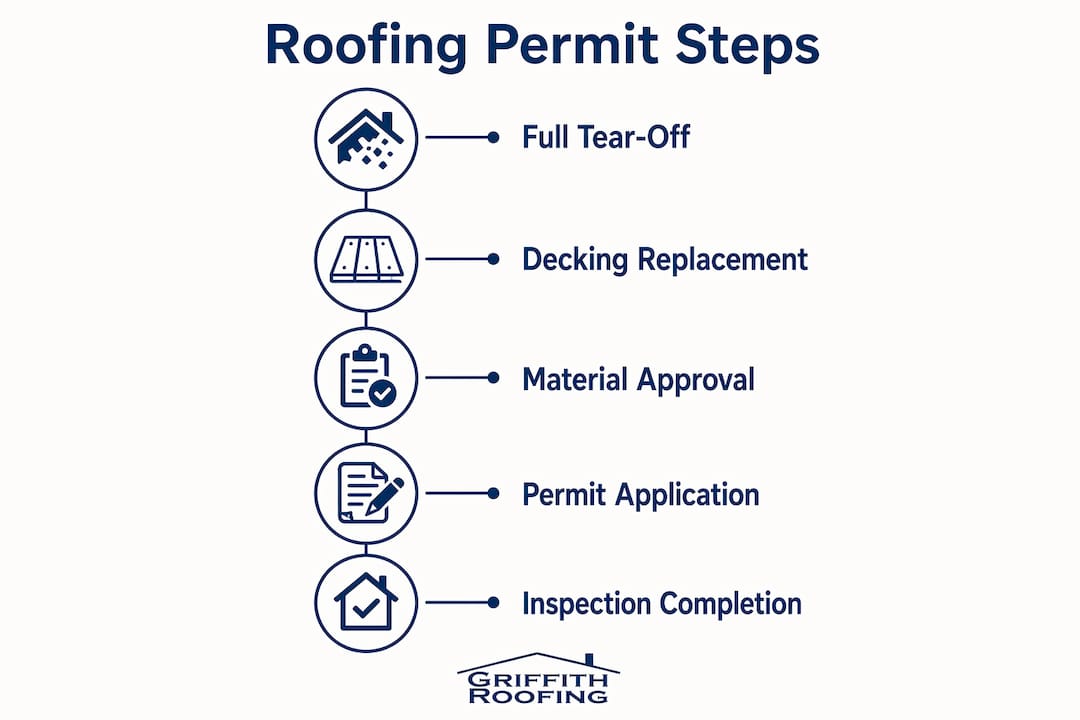
Full tear-off is the starting point. No shingles may be installed over existing layers, which means every reroofing project begins with removing the old material down to the deck. This gives the contractor a clear view of the deck’s condition and gives the inspector a clean surface to evaluate.
Crickets and drip edges are the two most commonly overlooked code upgrades. A cricket is a small peaked structure built behind a chimney or wide penetration to redirect water around the base rather than letting it pool. If your original roof lacked a cricket and you are reroofing, the contractor must install one. Drip edges, the metal strips that guide water off the roof edge into the gutter, are now required on all reroofing projects even if the previous roof did not have them.
Material changes add another layer of complexity. Switching from asphalt shingles to metal roofing, for example, triggers a permit regardless of whether decking replacement is involved. If your home sits in a historic district, a material change may also require review and approval from the Historic Preservation Council before work begins.
- Asphalt to metal conversion: Always requires a permit and possible historic district review.
- Chimney crickets: Required on all reroofing projects where the penetration width exceeds 30 inches.
- Drip edge installation: Mandatory on all reroofing projects under current Fort Worth roofing regulations.
- Underlayment: Standard underlayment is required; ice barriers are optional but not mandated.
Pro Tip: When choosing roofing materials for a Fort Worth home, confirm with your contractor whether the material change triggers a permit or a historic review before signing any contract. Finding out after tear-off is far more disruptive.
What pitfalls catch homeowners and contractors off guard?
The most common mistake in Fort Worth roofing compliance is assuming a shingle replacement will stay a shingle replacement. Hail damage repairs frequently uncover decking problems that were invisible from the surface. Once the old shingles come off and damaged OSB or plywood is found, the project scope expands and a permit becomes mandatory. Homeowners who hired a contractor expecting a no-permit job suddenly find themselves in a permitted project with inspection requirements.
Contractors face a related challenge: aligning manufacturer instructions, local code amendments, and the submitted permit scope so that the final inspection passes cleanly. A shingle manufacturer may specify a particular nailing pattern or underlayment type. The local code may require something slightly different. The permit application describes a specific scope. All three must be consistent, or the inspection can fail on a technicality.
“The permit decision is not always made at the start of a project. It can be forced on you mid-job when the deck comes off and the damage is worse than expected. The contractors who handle this well are the ones who communicate immediately, pull the permit the same day, and keep the homeowner informed throughout.”
Selecting a licensed contractor who knows Fort Worth’s specific amendments is not optional. It is the single most effective way to avoid failed inspections and compliance gaps. Contractors unfamiliar with local rules may follow the base IRC correctly while still violating a Fort Worth amendment. Regular roof inspections in DFW also help catch deck deterioration before it becomes an emergency that forces a mid-project permit scramble.
Key areas inspectors focus on during a Fort Worth roofing inspection:
- Deck condition and any replaced sections
- Flashing installation at chimneys, valleys, and penetrations
- Drip edge presence and proper installation
- Cricket installation behind chimneys where required
- Drainage performance and slope compliance
Key takeaways
Fort Worth roofing code requires a permit when decking is replaced, mandates full tear-offs, and enforces local amendments that differ meaningfully from the base 2021 IRC.
| Point | Details |
|---|---|
| Permit trigger | A permit is required only when roof decking is replaced, not for shingle-only replacements. |
| No overlays allowed | Fort Worth prohibits installing new shingles over existing layers on all reroofing projects. |
| Code upgrades apply | Crickets and drip edges are required on all reroofing projects, even if the original roof lacked them. |
| Mid-project permit shifts | Hail damage can reveal decking issues after tear-off, converting a no-permit job into a permitted one. |
| Local amendments matter | Fort Worth’s amendments to the 2021 IRC differ from the base code, so city-issued FAQs are the authoritative reference. |
What I’ve learned after 20+ years of Fort Worth roofing projects
I have seen homeowners get blindsided by permit requirements more times than I can count, and almost every time the root cause is the same: someone assumed the project was simpler than it turned out to be. The binary permit rule sounds clean on paper. Decking replacement means permit, shingles only means no permit. But roofs do not cooperate with clean rules. Hail storms leave bruises you cannot see until the old shingles are off. Decking that looked solid from the attic turns soft the moment you walk on it after tear-off.
What I tell every homeowner before we start: the permit decision is a living thing. It can change. The contractors who serve you well are the ones who treat that possibility as normal, not as a crisis. They communicate the moment they find something unexpected, pull the permit the same day if needed, and keep the project moving without drama.
I also want to push back on the idea that code upgrades like crickets and drip edges are bureaucratic nuisances. They are not. A cricket behind a chimney is one of the most effective water management tools on a residential roof. A properly installed drip edge extends the life of your fascia and prevents rot at the roof edge. When Fort Worth requires these on every reroofing project, the city is doing homeowners a favor. The contractors who resent these requirements are usually the ones cutting corners elsewhere.
My advice: call Fort Worth Development Services before your project starts if you have any doubt about scope. They are accessible, and the roofing FAQ they publish is genuinely useful. Proactive communication with the city costs nothing and prevents the kind of mid-project surprises that turn a straightforward reroofing job into a stressful ordeal.
— Mark Griffith
Work with a contractor who knows Fort Worth’s code inside and out
Navigating Fort Worth roofing regulations is straightforward when you have a contractor who has done it hundreds of times. Griffith Roofing has served the Dallas-Fort Worth Metroplex since 2001, handling permit applications, code-compliant installations, and the kind of mid-project surprises that catch less experienced crews off guard.
Whether you are dealing with hail damage, planning a full reroof, or simply want a professional assessment before committing to a scope, Griffith Roofing’s team handles the compliance details so you do not have to. From pulling permits through Accela to scheduling final inspections, every step is covered. Explore Griffith Roofing’s residential roofing services to see how the team approaches code-compliant work in Fort Worth and across the DFW area. You can also reach the Fort Worth roofing team directly for a project consultation.
FAQ
Does replacing shingles in Fort Worth require a permit?
No. Shingle-only replacement without any decking work does not require a building permit in Fort Worth. A permit is only triggered when roof decking such as plywood or OSB is replaced.
How much does a roofing permit cost in Fort Worth?
Roofing permit fees in Fort Worth typically range from $150 to $300 depending on project scope. Most permits are approved within one to three business days.
Can a contractor install new shingles over old ones in Fort Worth?
No. Fort Worth roofing code prohibits overlay installations entirely. A full tear-off down to the deck is required on all reroofing projects.
Are ice barriers required under Fort Worth roofing code?
Ice barriers are not required in Fort Worth due to the local climate. The city’s local amendments to the 2021 IRC removed this requirement, though some contractors install them voluntarily on low-slope sections.
What happens if decking damage is found after a project starts?
If damaged decking is discovered after tear-off, the project scope changes and a permit becomes required. The permit decision can shift mid-project, so contractors should pull the permit immediately and notify the homeowner before proceeding.


