

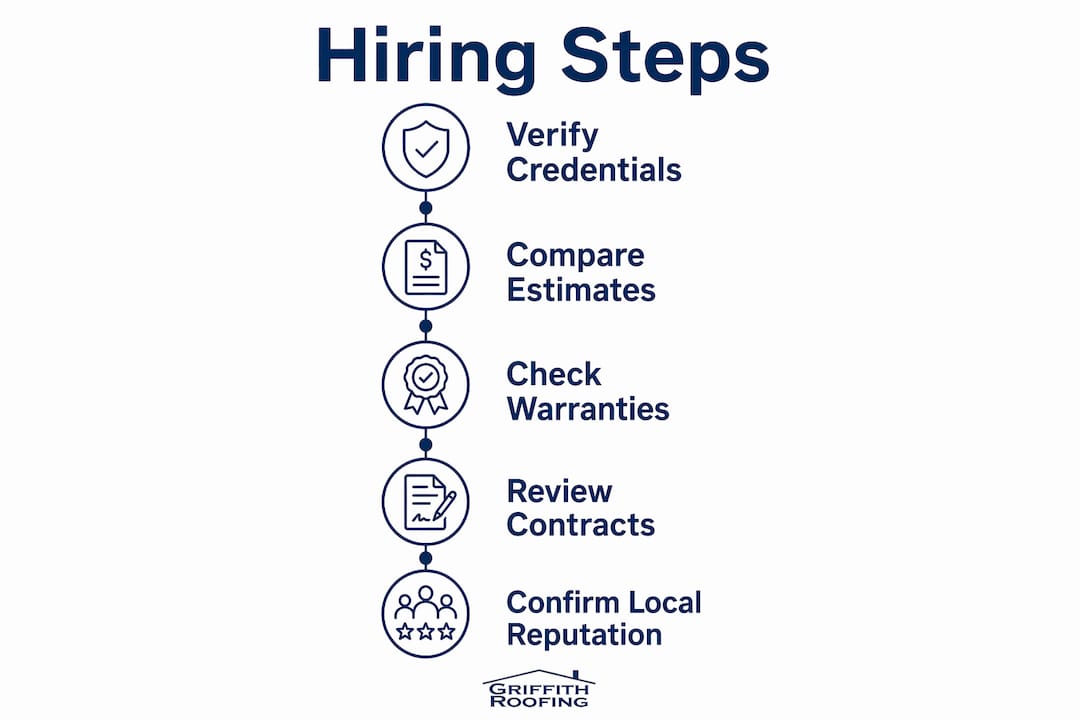
Hiring a residential roofing contractor means verifying licensing, insurance, written estimates, and warranty coverage before a single shingle gets touched. This hire residential roofing contractor guide is built specifically for Dallas-Fort Worth homeowners who want to protect their investment, avoid post-storm scams, and make confident decisions in 2026. The DFW area faces some of the most punishing hail and wind events in the country, which means the stakes for choosing the wrong contractor are higher here than almost anywhere else in Texas. Get this right and your roof will perform for decades. Get it wrong and you may be dealing with leaks, voided warranties, and legal headaches within a year.
What credentials should DFW homeowners verify before hiring?
A licensed, insured contractor is the non-negotiable starting point for any residential roofing project. Texas does not require a statewide roofing license, but many municipalities in the Dallas-Fort Worth area have local registration requirements. The Texas Department of Licensing and Regulation (TDLR) database is the right place to confirm any applicable state-level credentials. Checking this database takes five minutes and can save you from hiring a contractor who has no legal standing to work on your property.
Insurance is equally critical. Request a certificate of general liability insurance and workers’ compensation coverage before signing anything. General liability protects your home if the crew causes accidental damage. Workers’ compensation protects you from being held financially responsible if a worker is injured on your roof. A contractor who hesitates to provide these certificates is a contractor you should walk away from immediately.
Manufacturer certifications add another layer of quality assurance. Programs like GAF Master Elite and Owens Corning Platinum Preferred are awarded only to contractors who meet strict installation training and customer satisfaction standards. These certifications also unlock extended warranty options that standard contractors cannot offer. Fewer than 2% of roofing contractors in the U.S. hold GAF Master Elite status, which makes it a genuine differentiator rather than a marketing label.
Finally, check the contractor’s Better Business Bureau rating and review their complaint resolution history. A pattern of unresolved complaints tells you more than a five-star average on any review platform. The BBB advises verifying licensing, insurance, written estimates, and contract details including cleanup and weather protection before committing to any contractor.
Pro Tip: Ask the contractor to provide their insurance certificate directly from their insurance agent, not just a copy they hand you. This confirms the policy is current and has not lapsed.
You can also read Griffith Roofing’s detailed breakdown of identifying a licensed roofer in Texas for a step-by-step verification walkthrough.
How to compare roofing estimates the right way
Consumer Reports recommends getting at least three bids before committing to a roofing contractor. This is not just about finding the lowest price. It is about understanding what each contractor is actually proposing to do. Two bids that look similar in price can represent dramatically different scopes of work, and the difference only becomes visible when you compare line items side by side.
A fully itemized estimate is the standard you should demand. Detailed written estimates protect you from vague lump-sum quotes that leave room for disputes later. Every legitimate bid should break down the following:
- Materials: Brand name, product line, and shingle grade (e.g., GAF Timberline HDZ, Owens Corning Duration)
- Labor: Installation cost separated from materials
- Permit fees: Required by most DFW municipalities for full replacements
- Tear-off and disposal: Number of layers being removed and how debris will be handled
- Underlayment: Type specified (synthetic vs. felt) and coverage area
- Flashing: Around chimneys, vents, and valleys
- Ventilation: Ridge vents, soffit vents, or attic fans included or excluded
Hidden scope items are one of the most frequent causes of bid disputes and project overruns. Layers removed, decking replacement, and permit fees are commonly omitted from estimates, leaving homeowners with surprise charges mid-project. If a contractor cannot explain every line item in their estimate, that is a red flag.
| Estimate element | What to look for |
|---|---|
| Materials | Brand name, product line, and shingle class specified |
| Labor | Itemized separately from materials cost |
| Permit fees | Listed explicitly, not buried in overhead |
| Tear-off and disposal | Number of layers and disposal method stated |
| Underlayment and flashing | Type and coverage area specified |
| Ventilation | Included or excluded clearly noted |
Pro Tip: Ask each contractor to walk you through their estimate line by line. A contractor who cannot explain their own numbers is one who will struggle to manage your project.
What roofing warranties actually cover
Roofing warranties fall into two distinct categories, and most homeowners only learn the difference after a claim gets denied. Manufacturer material warranties cover defects in the shingles themselves, typically ranging from 25 to 50 years depending on the product line. Contractor workmanship warranties cover the quality of the installation, and these vary widely. A minimum of five years is the baseline, but reputable contractors offer workmanship coverage of 10 to 25 years.
The gap between these two warranties is where most problems occur. A shingle may be perfectly manufactured, but if the flashing was installed incorrectly, water intrusion is a workmanship issue. If your contractor’s warranty has expired or was never clearly defined, you are paying for that repair out of pocket.
RoofVista differentiates material warranties from workmanship warranties and cautions specifically about coverage gaps that arise when installation instructions are not followed. The National Roof Authority confirms that warranty claims often fail when documented manufacturer installation requirements for ventilation, ice and water shield, and flashing are not followed and recorded. This means the written contract must specify that the contractor will follow manufacturer installation guidelines, not just that they will install the product.
Key warranty questions to ask every contractor before signing:
- What is the length and scope of your workmanship warranty?
- Does the manufacturer warranty require certified installation to activate extended coverage?
- Is the warranty transferable if I sell the home?
- What documentation will you provide at project completion to support a future warranty claim?
Warranty transferability matters more than most homeowners realize. A 50-year manufacturer warranty that transfers to a new buyer adds measurable value to your home at resale. Confirm this in writing before the project starts. Griffith Roofing’s guide on roofing warranty benefits for Texas weather covers these specifics in detail.
What should a roofing contract include?
A written contract is your legal protection if anything goes wrong. Handshake agreements and verbal commitments carry no weight when a dispute arises over incomplete work or unexpected charges. The National Association of Realtors’ consumer guide advises interviewing multiple contractors and avoiding vague contracts or large down payments. Every roofing contract should include the following elements:
- Scope of work: Exact materials, brands, and installation methods
- Project timeline: Start date, estimated completion, and weather contingency language
- Payment schedule: Milestone-based payments tied to project phases
- Permit responsibility: Who pulls the permit and who is responsible for inspections
- Cleanup plan: Daily debris removal, nail sweep, and landscaping protection
- Change order process: Written approval required before any scope changes
Payment structure deserves special attention. The BBB warns that full upfront payments are a common feature of roofing scams, particularly after major storms in Texas. A reasonable structure is a modest deposit of 10 to 20 percent at signing, a second payment at material delivery, and the final balance upon satisfactory completion. Never pay the full amount before work begins.
The cleanup and protection plan is a detail many homeowners overlook until it is too late. Texas storm conditions mean debris, nails, and torn materials can scatter across your yard and damage landscaping. The BBB stresses that cleanup responsibility and weather protection must be written into the contract to prevent secondary damage and disputes. If a contractor’s contract does not address this, add it before you sign.
Watch for signs of post-storm scams by reviewing Griffith Roofing’s guide on common roofing scams after Texas storms. Storm chasers often appear within days of a major weather event, pressure homeowners into signing quickly, and disappear before the work is finished or warranted.
Key takeaways
Hiring a reliable residential roofing contractor in Dallas-Fort Worth requires verifying credentials, comparing itemized estimates, securing dual warranties, and protecting your project with a detailed written contract.
| Point | Details |
|---|---|
| Verify credentials first | Confirm licensing, general liability insurance, and workers’ comp before any other step. |
| Demand itemized estimates | Compare at least three bids with full line-item breakdowns, not lump-sum quotes. |
| Secure dual warranties | Require both a manufacturer material warranty and a contractor workmanship warranty in writing. |
| Use milestone payments | Structure payments by project phase and never pay the full amount upfront. |
| Prioritize local contractors | Local contractors with established DFW presence offer better accountability and warranty support. |
Why local reputation is the credential that matters most in DFW
I have been in the Dallas-Fort Worth roofing market since 2001, and the single most reliable predictor of a good project outcome is whether the contractor has a real, verifiable presence in the community. Not a Google listing. Not a rented office. A physical address, a local phone number, and neighbors who can vouch for their work.
After every major hail event in DFW, out-of-state crews flood the market. They offer fast timelines and low prices, and some of them do decent work. But when a warranty issue surfaces 18 months later, they are gone. A local contractor with 5-plus years in the market has something to lose. Their reputation is tied to every roof they install in your neighborhood.
DFW weather is genuinely punishing. Hail bruises shingles in ways that are not always visible from the ground, and wind-driven rain finds every gap in improperly installed flashing. I have seen roofs that passed a casual visual inspection but had underlayment that was never sealed correctly. Those problems show up two years later as water stains on a ceiling. A contractor who knows Texas weather builds for it, not just to minimum code.
My honest advice: ask every contractor for three local references from jobs completed in the past 12 months. Call those references. Ask specifically whether the crew cleaned up thoroughly each day, whether the project finished on time, and whether the contractor responded quickly when a concern came up after completion. Those three questions will tell you more than any online review.
— Mark Griffith
Ready to get a trusted estimate from Griffith Roofing?
Griffith Roofing has served Dallas-Fort Worth homeowners since 2001, and every project we take on comes with transparent estimates, manufacturer-certified installation, and workmanship warranties that stand behind our work long after the crew leaves your property.
Whether you need a full residential roof replacement or targeted roof repair services, our team provides fully itemized bids with no hidden fees and no pressure. We also offer financing for roof replacement so cost does not stand between you and a roof that protects your family. Contact Griffith Roofing today for a free estimate and see why DFW homeowners have trusted us for over two decades.
FAQ
How do I find licensed roofing contractors in Texas?
Search the Texas Department of Licensing and Regulation (TDLR) database and verify local municipal registration requirements in your DFW city. Always request a certificate of insurance alongside any license documentation.
What should a roofing estimate include?
A complete estimate lists materials by brand and product line, labor, permit fees, tear-off and disposal, underlayment, flashing, and ventilation. Lump-sum quotes lacking detail are a warning sign and make accurate comparison impossible.
How much should I pay upfront to a roofing contractor?
A deposit of 10 to 20 percent at contract signing is reasonable. The BBB warns against large upfront payments as a common fraud indicator, particularly after storm events in Texas.
What is the difference between a material warranty and a workmanship warranty?
A manufacturer material warranty covers defects in the shingles themselves, typically 25 to 50 years. A workmanship warranty covers installation quality and should run a minimum of five years, with reputable contractors offering up to 25 years.
Why should I hire a local DFW roofing contractor instead of a storm chaser?
Local contractors with an established presence in Dallas-Fort Worth are accountable to their community and available for warranty service long after the project ends. Out-of-state storm chasers frequently leave the market before warranty issues surface, leaving homeowners without recourse.


