

Texas has a roofing problem most homeowners don’t see coming. When a hailstorm scars your roof or a leak starts spreading, the scramble to hire someone fast can override the judgment to hire someone right. The challenge is that Texas does not require a statewide roofing license, which means nearly anyone can pick up a ladder and call themselves a roofer. Knowing how to identify licensed roofer Texas credentials the right way, including what voluntary certifications actually signal, can protect your home, your wallet, and your peace of mind before a single shingle is replaced.
Table of Contents
- Key takeaways
- How to identify a licensed roofer in Texas
- Step-by-step: how to verify a roofer’s credentials
- Insurance claims and compliance: what you need to know
- Common scams and how to protect your investment
- My perspective on Texas roofing licensing
- Why Griffith Roofing is worth your call
- FAQ
Key takeaways
| Point | Details |
|---|---|
| No state license exists | Texas has no mandatory roofing license, so you must verify voluntary credentials like RCAT. |
| RCAT is the gold standard | RCAT-licensed roofers have passed exams and met experience requirements that prove real competence. |
| Insurance verification is non-negotiable | Always confirm general liability and workers’ comp certificates before signing anything. |
| Roofers cannot act as adjusters | Texas law prohibits roofing contractors from negotiating your insurance claim without a separate adjuster license. |
| Verify before you compare prices | Confirm credentials and permits first. Price comparison comes after you know who you’re actually dealing with. |
How to identify a licensed roofer in Texas
Here’s what catches most homeowners off guard: no Texas agency issues a general roofing contractor license. Unlike states such as Florida or Louisiana, where state licensing is mandatory before a roofer can touch your home, Texas leaves the credentialing largely up to the market. That does not mean there are no standards. It means you have to know where to look.
The term “licensed roofer” in Texas almost always refers to credentials issued by the Roofing Contractors Association of Texas (RCAT), a voluntary industry body that has created a meaningful credentialing framework. RCAT’s voluntary licensing offers both residential and commercial designations, and the bar to earn either one is genuinely high.
What RCAT licensing requires
To earn RCAT licensing, a contractor must meet all of the following:
- Verified field experience. Candidates must be principals at a Texas roofing company for at least two years before they can even apply.
- Passing multiple exams. Applicants must score 70% or higher on open-book exams based on the NRCA Roofing Manual, which covers technical installation, safety, and materials knowledge.
- Active insurance coverage. Proof of general liability and workers’ compensation insurance is required to obtain and maintain the license.
- Ongoing compliance. Licenses must be renewed, which means credentials stay current rather than reflecting a one-time milestone.
The residential designation applies to shingles, tile, and common sloped roof systems. The commercial designation covers flat, low-slope, and membrane roofing typical on office buildings and multi-unit properties. A contractor holding both is equipped to work across property types.
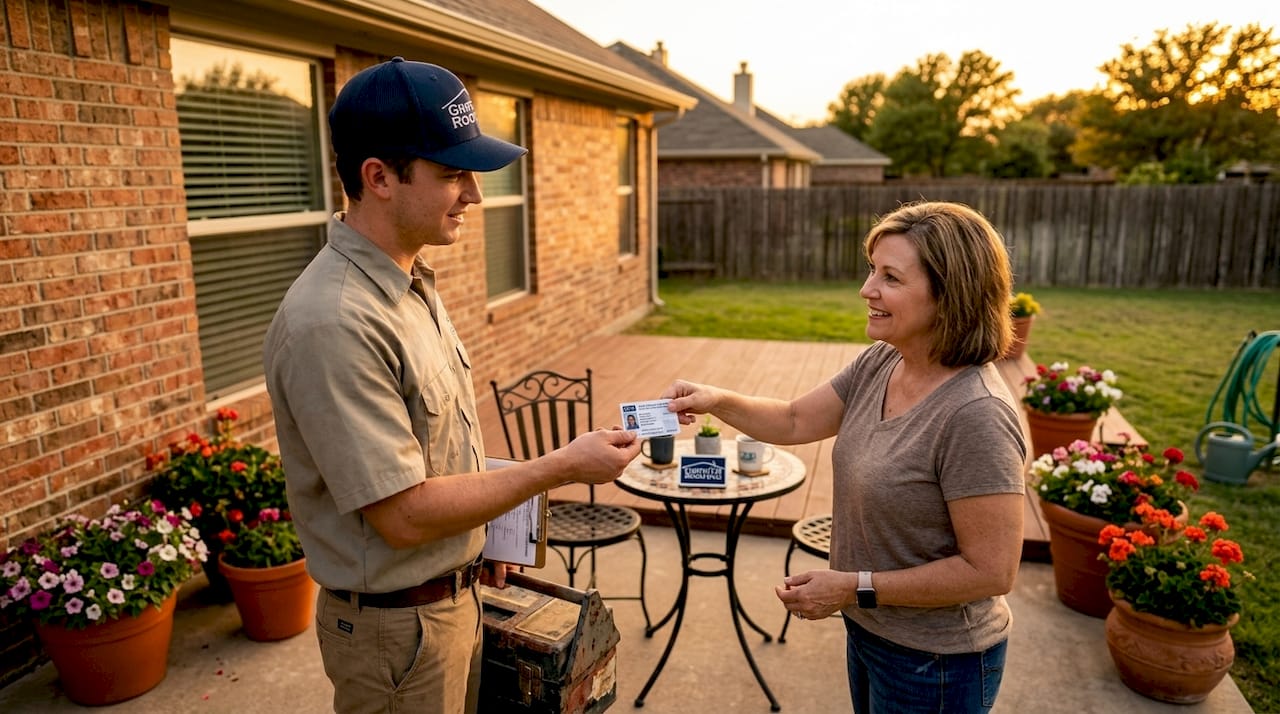
Pro Tip: Ask any roofer you consider hiring whether they are RCAT-licensed and request their license number. A legitimate contractor will give it to you without hesitation. If they don’t have one, that’s information you need.
Why does voluntary licensing matter? Because it signals that a contractor chose to be accountable before the work started. In a market where anyone can buy a truck and print business cards, that choice separates roofing professionals in Texas from opportunists looking to capitalize on storm season.
Step-by-step: how to verify a roofer’s credentials
Once you understand what to look for, verifying a roofing contractor in Texas is a straightforward process. The steps below apply whether you’re hiring for a full roof replacement, storm damage repair, or a commercial re-roofing project.
-
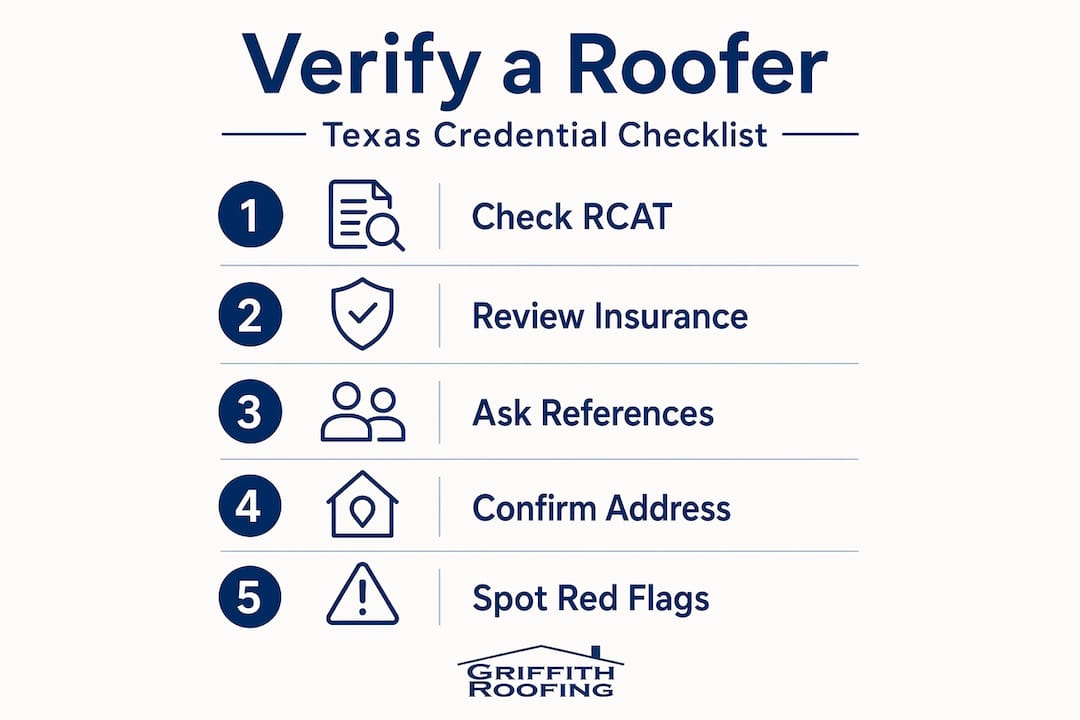
Search the RCAT directory. The RCAT directory allows you to search for licensed contractors by zip code and service type. This is your first filter. If a company isn’t listed, they are not RCAT-certified.
-
Request certificates of insurance. Ask for both a general liability certificate and a workers’ compensation certificate. Verifying insurance protects you from being held liable if a worker is injured on your property or if accidental damage occurs to a neighbor’s home.
-
Confirm permit-pulling ability. In Texas, pulling permits is the contractor’s responsibility. Ask directly: “Will you pull the required permits for this job?” A contractor who hedges or suggests skipping permits is a red flag. Unpermitted roofing work can create problems when you sell or file an insurance claim.
-
Check for local city or county registration. Some Texas municipalities, including Dallas, require roofing contractors to register locally. Call your city’s building department or check their website to confirm the contractor is registered in your jurisdiction.
-
Contact RCAT or local roofing associations directly. If you want a second layer of confirmation, call RCAT or your local chapter directly. Staff can verify whether a contractor’s license is active.
-
Review complaint history. Search the Texas Attorney General’s consumer protection database and the Better Business Bureau for any filed complaints. One or two resolved complaints may be acceptable; a pattern of unresolved disputes is not.
“Confirm RCAT licensed status, insurance certificates, and local permit compliance before comparing prices or signing any contract.” — Industry guidance from the Central Texas Roofing Contractors Association
Pro Tip: When you receive an insurance certificate, call the insurance company listed directly to confirm the policy is active. Certificates can be falsified. A 60-second phone call eliminates that risk entirely.
Watch for these red flags: door-to-door solicitation right after a storm, requests for large upfront cash payments, no physical business address, and pressure to sign a contract on the spot. Each one is a pattern seen repeatedly in Texas roofing fraud cases.
Insurance claims and compliance: what you need to know
Storm damage roofing is where compliance gets complicated, and where homeowners often unknowingly step into legal gray areas. The core issue centers on role separation: your roofing contractor and your insurance adjuster are two different people with two different jobs.
Here is why this matters for you:
- Roofing contractors cannot negotiate your claim. A roofing contractor in Texas cannot legally act as a public adjuster on the same claim unless they hold a separate public adjuster license issued by the Texas Department of Insurance. Any contractor who offers to “handle everything with your insurance company” without that separate license is operating outside their legal scope.
- Public adjusters work exclusively for you. Licensed public adjusters in Texas are regulated by the Texas Department of Insurance and are paid on a contingency basis, typically a percentage of your settlement. They represent your interests, not the insurance company’s.
- Mixing roles creates conflicts of interest. When a roofer negotiates the claim, they have a financial incentive to inflate the damage estimate to increase their own contract value. Keeping the roles separate protects you from that dynamic.
- Storm damage projects require particular care. Violating Texas Insurance Code by blurring roofing and public adjusting roles without proper licensing is a serious legal issue, and it can jeopardize your claim entirely.
The practical takeaway: when hail or wind damages your roof, hire your roofing contractor to assess and repair the physical damage. If the claim is complex or your insurer is disputing coverage, hire a separately licensed public adjuster to advocate for your settlement. Understanding when insurance pays for roofing work before the storm hits puts you in a much stronger position when the paperwork starts.
Common scams and how to protect your investment
Roofing fraud in Texas is not a hypothetical risk. The Texas Attorney General has pursued legal action against roofing contractors sued for collecting tens of thousands of dollars from homeowners and failing to complete contracted work. These are not isolated cases. After major hail events, storm chasers flood Texas neighborhoods with the specific intent of collecting deposits and disappearing.
Protecting yourself comes down to a short checklist before you ever agree to work:
- Never pay more than 10 to 15 percent upfront. A reputable contractor does not need a large deposit to start your job. Excessive upfront payment requests are a red flag.
- Get everything in writing. Your contract should specify materials, start and completion dates, payment schedule, warranty terms, and who is responsible for pulling permits.
- Verify the physical business address. Search the address independently. A P.O. box or a residential address with no business presence is worth questioning.
- Check reviews across multiple platforms. Google, the BBB, and Yelp together give a more complete picture than any single source. Look specifically for patterns in negative reviews, not just the overall star rating.
- Confirm licensing status independently. Don’t take a contractor’s word for it. Search the RCAT directory yourself, verify contractor credentials using the tools described above, and confirm their insurance is active with a direct call.
One more layer of protection: ask any prospective contractor for three recent local references and actually call them. Ask those homeowners whether the crew showed up on schedule, whether the job was completed as quoted, and whether the contractor pulled permits. Five minutes of reference checks can reveal more than any online review.
My perspective on Texas roofing licensing
I’ve been working roofing projects in the Dallas-Fort Worth area since 2001, and the licensing question comes up on nearly every job we consult on. Here’s my honest take.
The absence of a mandatory state license does not make Texas homeowners defenseless. It does mean you have to do work that other states do for you. RCAT licensing is not a perfect system, but in my experience, contractors who invest the time and effort to earn it are almost always worth your trust. The exam requirement alone eliminates a significant portion of the opportunists. Passing a technical exam based on the NRCA Roofing Manual requires actual knowledge. You cannot fake it.
What I’ve seen in practice is that the insurance compliance piece trips homeowners up more than the licensing piece. A roofer who offers to “take care of your insurance claim” can sound helpful in a stressful moment. But that offer can put you in legal jeopardy. I’ve watched homeowners lose claim coverage because a contractor overstepped their role. Keep your roofer and your adjuster in their respective lanes, and you’ll have a far smoother process.
My real advice: before you look at a single estimate, confirm RCAT status, request insurance certificates, and ask who pulls the permits. Those three things tell you almost everything you need to know about a contractor’s professionalism. Evaluating a roofing contractor before the pressure is on is always easier than trying to unwind a bad hire after the fact.
— Mark Griffith
Why Griffith Roofing is worth your call
Griffith Roofing has served the Dallas-Fort Worth Metroplex since 2001, building a track record that speaks for itself across thousands of residential and commercial projects. Every job comes with verified insurance, full permit compliance, and the kind of hands-on accountability that comes with two decades of local experience. Whether you need residential roofing services after a severe storm or are planning a complete roof repair for your property, Griffith Roofing gives you the credentials, the process, and the results you should expect from licensed roofing companies in Texas. Contact us today for a detailed estimate and see firsthand what a properly credentialed contractor looks like from the first conversation to the final inspection.
FAQ
Does Texas require a license to be a roofer?
No. Texas does not require a statewide roofing license. Consumers should focus on voluntary credentials like RCAT certification and local municipality registration instead.
How do I verify a roofer’s RCAT license?
Search the RCAT online directory by zip code or company name. You can also contact RCAT directly to confirm whether a contractor’s license is active and in good standing.
Can a roofer handle my insurance claim in Texas?
Not without a separate license. A Texas roofer cannot legally negotiate your insurance claim unless they also hold a public adjuster license issued by the Texas Department of Insurance.
What insurance should a licensed roofer carry?
Any reputable roofing contractor should carry both general liability insurance and workers’ compensation insurance. Always request the actual certificates and verify them directly with the issuing insurer before work begins.
What are the biggest red flags when hiring a roofer in Texas?
Watch for door-to-door solicitation after storms, large upfront cash payment demands, no verifiable business address, resistance to pulling permits, and offers to manage your insurance claim without a public adjuster license.


