

Metal standing seam roofing is defined as a concealed-fastener metal roof system featuring raised, interlocking vertical panels that run continuously from ridge to eave. The industry term is “standing seam metal roofing,” and it represents the premium tier of metal roofing types available today. Where asphalt shingles last 20–30 years, a standing seam system delivers a lifespan of 40–70 years, with copper variants exceeding 100 years. For property owners and builders in the Dallas-Fort Worth area, that longevity translates directly into lower lifetime costs and fewer headaches.
How does metal standing seam roofing differ from other metal roofing types?
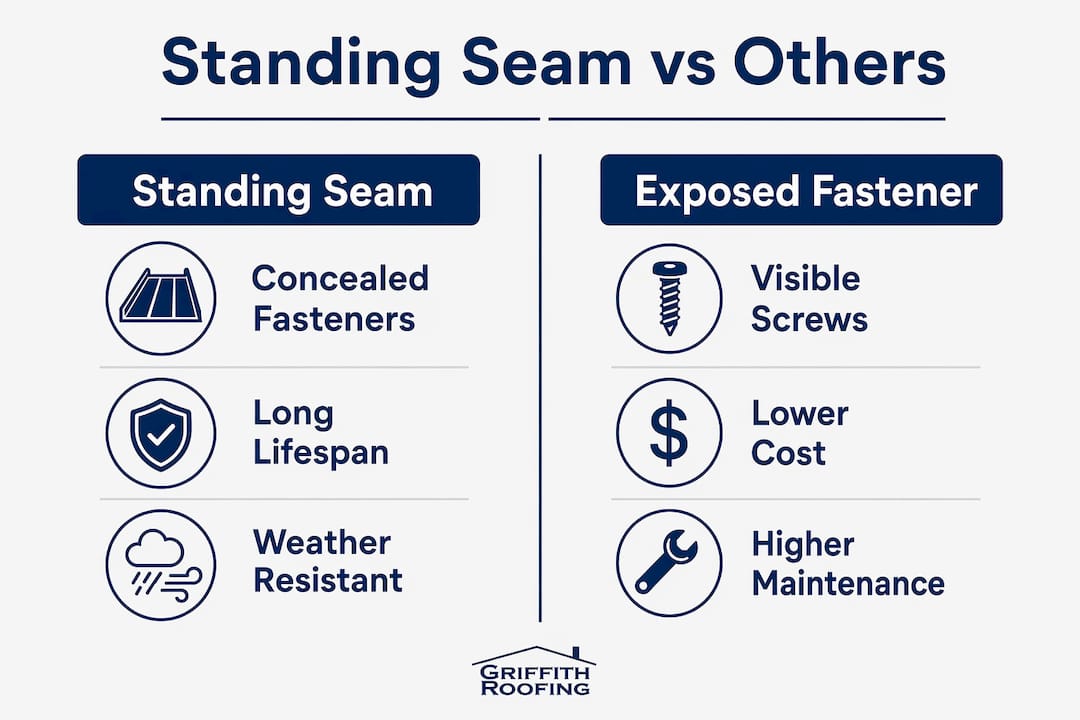
Standing seam metal roofing separates itself from other systems through one defining feature: no fastener ever touches the exposed panel surface. Every screw and clip sits hidden beneath the raised seams. That single design decision changes everything about how the roof performs over time.
Concealed vs. exposed fastener systems
Exposed-fastener metal roofs drive screws directly through the panel face. Each screw sits under a rubber washer that degrades within 10–15 years, creating hundreds of potential leak points. Standing seam systems hide thousands of fastener penetrations under raised seams, eliminating the rubber-washer failure mode entirely. The result is a roof that stays watertight far longer without routine re-fastening.
The floating clip advantage
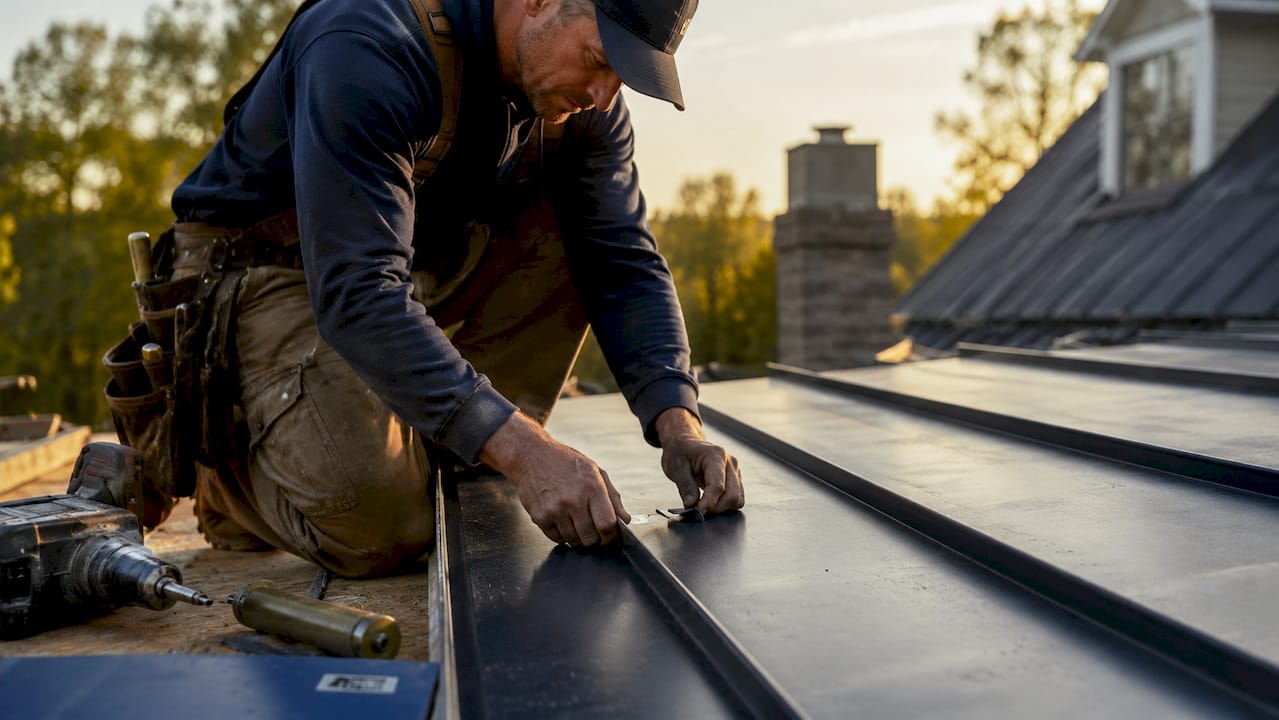
Metal expands and contracts with temperature changes. Corrugated and exposed-fastener panels are screwed rigidly to the deck, so thermal movement stresses every fastener hole. The clip system in standing seam roofs allows panels to slide freely, absorbing that movement without buckling or loosening. This is the engineering detail that separates a 50-year roof from a 15-year one.
Pro Tip: Ask any contractor bidding your job to explain how their clip system handles thermal expansion. If they cannot answer clearly, keep looking.
Here is how the three main metal roofing systems compare side by side:
| Feature | Standing Seam | Exposed Fastener | Corrugated Metal |
|---|---|---|---|
| Fastener exposure | Fully concealed | Fully exposed | Fully exposed |
| Leak risk over time | Very low | Moderate to high | Moderate to high |
| Thermal movement | Floating clip system | Rigid, stress-prone | Rigid, stress-prone |
| Typical lifespan | 40–70 years | 20–30 years | 15–25 years |
| Upfront cost | Higher | Lower | Lowest |
| Aesthetic profile | Clean, vertical lines | Visible fasteners | Corrugated texture |
What materials and panel gauges are standard for standing seam roofing?
The metal you choose and the thickness of each panel determine how your roof handles weather, weight, and time. Four metals dominate the standing seam market: steel, aluminum, copper, and zinc.
Steel: the industry workhorse
24-gauge steel panels are the industry standard for residential standing seam roofing. They run 25–30% thicker than the 26-gauge panels used in budget metal roofs. That extra thickness resists denting from hail, reduces the risk of oil canning, and holds paint finishes longer. In North Texas, where hailstorms are a seasonal reality, that thickness difference is not cosmetic. It is structural.
Aluminum, copper, and zinc
- Aluminum resists corrosion without any coating, making it the right call for coastal or high-humidity environments. It weighs less than steel, which reduces structural load.
- Copper is the prestige choice. It develops a natural patina over decades and carries a lifespan that can exceed 100 years. The upfront cost is significant, but no other roofing material matches its longevity.
- Zinc self-heals minor surface scratches through a natural patina process. It performs exceptionally well in wet climates and carries a lifespan comparable to copper.
Pro Tip: Oil canning, the wavy distortion you sometimes see on metal panels, is almost always a gauge or installation problem. Choosing 24-gauge panels and an experienced installer eliminates most of the risk before the first panel goes up.
What performance advantages does standing seam metal roofing offer?
Standing seam metal roofing outperforms virtually every other residential roofing material across the metrics that matter most to property owners: weather resistance, longevity, energy efficiency, and maintenance demand.
Weather resistance you can count on
The raised seam design physically blocks water from reaching the panel joints. Rain, ice, and wind-driven debris hit the seam face and deflect away rather than finding a path through a fastener hole or cracked shingle. Standing seam metal roofs provide superior resistance against wind uplift, freeze-thaw cycles, and UV degradation compared to other roofing materials. For DFW homeowners who deal with spring hailstorms, summer heat, and the occasional ice event, that multi-threat resistance is genuinely valuable.
Lifespan that changes the math
A standard asphalt shingle roof lasts 20–30 years. A standing seam steel roof lasts 40–70 years. That means one standing seam installation likely replaces two or three shingle jobs over the same period. When you factor in the labor and material cost of those replacement cycles, the total cost of ownership over 50 years often favors standing seam despite its higher upfront price.
Energy efficiency and maintenance
Metal roofs reflect solar radiation rather than absorbing it, which reduces attic heat gain and lowers cooling loads during Texas summers. Paired with proper insulation and ventilation, a standing seam roof can meaningfully cut your energy bills. On the maintenance side, there are no exposed screws to re-torque, no washers to replace, and no granules to lose. Annual visual inspections and occasional cleaning are typically all the system needs.
Here is a summary of the core performance benefits:
- No exposed fasteners means no rubber washer degradation and no leak points at penetrations.
- Floating clip design prevents buckling and fastener-hole enlargement from thermal movement.
- Lifespan of 40–70 years for steel, exceeding 100 years for copper.
- Superior resistance to wind uplift, freeze-thaw cycles, and UV damage.
- High solar reflectivity reduces cooling costs in hot climates like North Texas.
- Minimal maintenance with no screws, washers, or granules to monitor.
What should you consider when selecting and installing standing seam roofing?
Getting the most from a standing seam system depends as much on the installer as on the product itself. Poor installation erases every performance advantage the system offers.
Cost and long-term value
Standing seam costs more upfront than exposed-fastener metal or asphalt shingles. That premium is real. But the long-term investment pays off through reduced maintenance, fewer repairs, and a longer replacement cycle. If you plan to own your property for more than 15 years, the math almost always favors standing seam.
Choosing the right contractor
Standing seam installation requires specific knowledge of clip systems, panel profiles, and thermal movement. A contractor who only installs asphalt shingles will not have that knowledge. Look for a roofer with documented standing seam experience and references from completed metal roofing projects. Griffith roofing has installed metal roofing solutions across the DFW area since 2001, with the hands-on experience to match the right system to each property.
Installation details that determine performance
- Panel profile and roof pitch: Not every standing seam profile suits every roof pitch. Confirm your chosen profile is rated for your slope before ordering.
- Flashing design: High-quality flashing that accommodates thermal expansion is critical. Faulty flashing is the most common cause of premature leaks in standing seam systems.
- Underlayment selection: Use a synthetic underlayment rated for metal roofing. Standard felt underlayment can trap moisture and degrade faster under metal panels.
- Rigid fastening errors: Screwing panels directly to the deck instead of using the clip system causes buckling and enlarged fastener holes. Confirm your contractor uses the correct clip for your panel brand.
Pro Tip: Before signing any contract, ask to see a completed standing seam project the contractor installed at least five years ago. Time reveals installation quality better than any portfolio photo.
Key takeaways
Standing seam metal roofing is the most durable and weather-resistant residential roofing system available, but its performance depends entirely on correct material selection and experienced installation.
| Point | Details |
|---|---|
| Concealed fastener design | Hidden clips eliminate rubber washer failure and dramatically reduce leak risk over time. |
| Lifespan advantage | Steel systems last 40–70 years; copper exceeds 100 years, far outlasting asphalt shingles. |
| Material and gauge matter | 24-gauge steel is the residential standard, running 25–30% thicker than budget 26-gauge panels. |
| Installation quality is critical | Floating clip systems and proper flashing design determine whether the roof performs as promised. |
| Long-term cost favors standing seam | Higher upfront cost is offset by fewer repairs and a longer replacement cycle over 50 years. |
Why i think most homeowners underestimate the installation variable
After more than two decades installing roofs across the Dallas-Fort Worth area, I have seen standing seam systems that looked flawless on day one and leaked within three years. Every single time, the failure traced back to installation, not the product. Faulty flashing, rigid screwing instead of floating clips, or the wrong panel profile for the roof pitch. The metal itself was fine.
The conversation most homeowners have focuses almost entirely on cost per square foot. That is the wrong question. The right question is: does this contractor understand thermal movement, and can they show me a standing seam roof they installed five or more years ago that still performs perfectly? A cheap installation on a premium product is still a cheap roof.
I also want to address the resale value question directly. A standing seam roof does add measurable curb appeal and buyer confidence, particularly in higher-value neighborhoods. The clean vertical lines read as premium from the street. But the real value is not aesthetic. It is the inspection report that shows a roof with 30 years of life remaining instead of 5. That changes a negotiation.
If you are a builder, standing seam is the specification that separates your projects from the competition. If you are a homeowner, it is the last roof you will likely ever need to buy. Either way, get the installation right.
— Mark Griffith
How griffith roofing can help with your standing seam project
Griffith roofing has served property owners and builders across the Dallas-Fort Worth Metroplex since 2001. Standing seam metal roofing is one of our core specialties, and we bring the hands-on experience to back that up.
Whether you are building new or replacing an aging roof, our team will assess your property, recommend the right panel profile and gauge for your climate and pitch, and install the system with the clip and flashing details that determine long-term performance. Explore our residential roofing portfolio to see completed standing seam projects, or visit our metal roofing solutions page for a full overview of what we offer. Contact Griffith roofing today for a no-obligation consultation and quote.
FAQ
What is a standing seam metal roof?
A standing seam metal roof is a concealed-fastener roofing system where vertical metal panels interlock at raised seams running from ridge to eave. All fasteners are hidden beneath the seams, eliminating exposed screw penetrations and the leak risk they create.
How long does standing seam metal roofing last?
Steel standing seam roofs last 40–70 years, roughly twice the lifespan of asphalt shingles. Copper standing seam systems can exceed 100 years with proper maintenance.
Why is standing seam more expensive than other metal roofing?
The higher cost reflects the concealed clip system, thicker panel gauges, and the specialized labor required for correct installation. Over a 50-year period, total ownership costs are often lower than exposed-fastener alternatives due to reduced maintenance and fewer repairs.
What is oil canning in metal roofing?
Oil canning is a visual waviness or distortion in metal panels caused by improper installation or undersized panel gauges. Using 24-gauge panels and an experienced installer eliminates most oil canning risk before installation begins.
Can standing seam metal roofing be installed on any roof pitch?
Most standing seam profiles require a minimum pitch of 3:12, though some low-slope profiles are rated for pitches as low as 1:12. Always confirm the panel profile matches your specific roof pitch before purchasing materials.


