

Residential reroofing building code is defined as the set of regulations governing permits, roofing layer limits, approved materials, and inspections required for safe and compliant roof replacement in the Dallas Fort Worth Metroplex. The governing standard is IRC 2026 Chapter 9, which Texas adopts as a baseline. Every DFW municipality then layers its own amendments on top. Knowing these rules before you replace your roof protects your home’s structural integrity, keeps your insurance valid, and prevents costly violations that can surface at resale. Griffith roofing has navigated these codes across DFW since 2001, and this guide covers everything you need to stay compliant.
What permits and inspections are required for reroofing in DFW?
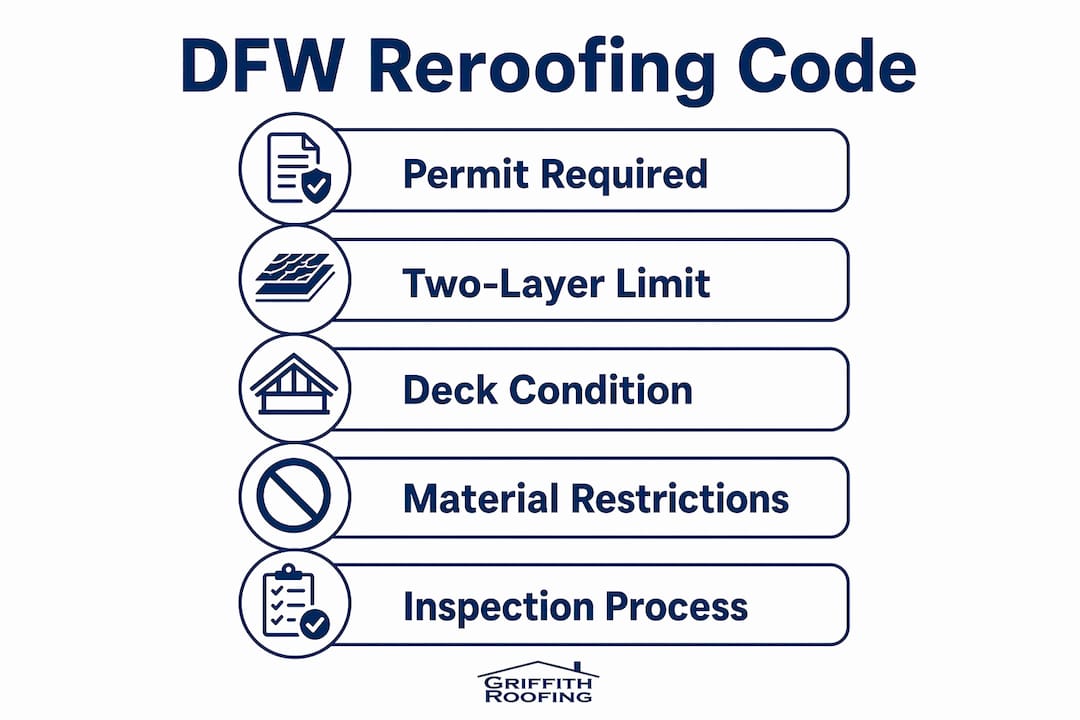
A building permit is mandatory for all full roof replacements and most overlay projects in jurisdictions adopting IRC 2026 standards. Small repairs covering less than 100 sq ft or a defined percentage of total roof area may qualify for an exemption, but that threshold varies by city. In DFW, you cannot assume an exemption applies without checking your specific municipality’s current rules.
The permit application process requires you to disclose the number of existing roofing layers already on your home. Disclosing existing layers on the permit application is standard practice and critical for proper permit processing and inspection planning. Omitting this information creates liability and can invalidate your permit after the fact.

Permit costs vary by municipality across DFW, often calculated based on project value or total roof square footage. Cities maintain their own fee databases, and those fees change periodically. Your contractor should pull the permit on your behalf and confirm the current fee schedule before work begins.
Once the permit is issued, an inspection follows the completed installation. Inspections verify that the contractor installed underlayment, flashing, and shingles per both manufacturer instructions and local code. This step protects you directly. A passed inspection is documented proof that your roof meets current residential roof standards.
- Permit required for full replacements in all DFW IRC 2026 jurisdictions
- Minor repairs under local exemption thresholds may not require a permit
- Permit applications must disclose existing layer count
- Inspections check underlayment, flashing, and shingle installation accuracy
- Permit fees vary by city and project scope
Pro Tip: Ask your contractor to provide a copy of the issued permit and the final inspection report. Store both documents with your home records. Your insurance company and future buyers will ask for them.
How many roofing layers does DFW building code allow?
The IRC hard limit is two total layers of asphalt shingles. That means one existing layer plus one new layer. A third layer is never compliant under any circumstance. Installing a third layer violates code and signals unprofessional roofing practice regardless of what a contractor tells you.
An overlay is only permitted when the existing single layer is in acceptable condition. Deteriorated decks must be replaced before any roofing application. Water-soaked, rotted, or structurally compromised decking disqualifies a home from an overlay entirely. A full tear-off becomes the only compliant path forward.
Local DFW jurisdictions can adopt stricter rules than the IRC baseline. Fort Worth, for example, maintains its own local roofing code amendments that affect what qualifies as an acceptable existing layer condition. Always verify the specific rules for your city before assuming an overlay is an option.
| Scenario | Code-compliant approach |
|---|---|
| No existing layers | New installation allowed |
| One existing layer, good condition | Overlay permitted under IRC 2026 |
| One existing layer, deteriorated | Full tear-off required |
| Two existing layers | Full tear-off required, no third layer |
| Wood shakes or slate beneath | Full tear-off required |
Pro Tip: Even when an overlay is technically allowed, a full tear-off gives your contractor a clear view of the deck. Hidden rot discovered mid-project costs far more to fix than a planned tear-off would have.
What materials and deck conditions meet reroofing code requirements?
Certain existing roofing materials disqualify a home from any overlay. The IRC prohibits recovering over wood shakes, slate, clay tile, and cement tile. These materials create an uneven base that prevents proper shingle seating and compromises wind resistance. If your home has any of these beneath the surface, a full tear-off is the only compliant and safe option.
The deck itself must be structurally sound before any new roofing goes on. Roof recoveries are subject to deck condition and compatibility requirements. Deteriorated decking must be replaced before application. Your contractor should inspect every section of exposed decking during a tear-off and document any areas requiring replacement.
Beyond the deck, three components are non-negotiable under updated IRC 2026 standards:
- Underlayment: A water-resistant barrier installed directly over the deck before shingles. IRC 2026 specifies minimum weight and overlap requirements.
- Flashing: Metal flashing at all roof penetrations, valleys, and wall intersections prevents water intrusion at the most vulnerable points.
- Drip edge: A metal strip along eaves and rakes that directs water away from the fascia. IRC 2026 requires drip edge installation on all new and replacement roofs.
When overlaying shingles, nail length must increase to penetrate through multiple layers plus the sheathing by at least 3/4 inch. This maintains wind resistance ratings. Using standard-length nails on an overlay is a common code violation that inspectors catch and that can void your shingle warranty. For a full overview of compliant material options, the residential roofing shingles guide covers what meets current DFW standards.
Common pitfalls in residential reroofing compliance and how to avoid them
Code violations in reroofing rarely happen because homeowners are careless. They happen because contractors cut corners or homeowners do not know what questions to ask. These are the most common compliance failures Griffith roofing sees across DFW projects.
- Installing a third layer. This is the single most serious violation. No third layer is allowed under any circumstance. Any contractor who suggests it is not working in your interest.
- Hiding deteriorated decking. Overlaying shingles over rotted or water-damaged sections creates structural risk and voids warranties. Inspectors find this during the inspection phase, and the remediation cost is always higher than addressing it upfront.
- Misrepresenting existing layers on the permit. Listing one layer when two exist is fraud. It also creates an inspection failure when the inspector counts layers during the job.
- Using a contractor unfamiliar with local amendments. Building codes are dynamic, and older roofs that complied with previous codes may not meet current IRC 2026 standards. Your contractor must price and plan based on current local requirements, not what was acceptable five years ago.
- Skipping documentation. Even when permits are not required for minor repairs, homeowners’ insurance may require proof of professional, code-compliant work to maintain coverage or process future claims. Always get written documentation of any roofing work performed.
Pro Tip: Before signing any roofing contract, ask the contractor to confirm in writing which IRC 2026 sections and local DFW amendments apply to your specific project. A contractor who cannot answer that question is not the right contractor for the job.
For a detailed walkthrough of the DFW permit requirements specific to your area, that resource covers exemption thresholds and inspection timelines by municipality. Understanding structural remodeling requirements also helps when deck replacement becomes part of the scope.
Key Takeaways
Residential reroofing compliance in Dallas Fort Worth requires permits, a two-layer maximum under IRC 2026, sound deck conditions, and proper documentation to protect your home’s safety, warranty, and insurance coverage.
| Point | Details |
|---|---|
| Permits are mandatory | Full replacements require a permit in all DFW IRC 2026 jurisdictions; disclose existing layers accurately. |
| Two-layer maximum | IRC 2026 allows one existing layer plus one new layer; a third layer is never compliant. |
| Deck condition controls the path | Deteriorated or prohibited material decks require full tear-off before any new roofing application. |
| Flashing, underlayment, and drip edge | All three are required under IRC 2026 for every new or replacement roof installation. |
| Documentation protects you | Permit records and inspection reports support insurance claims and protect resale value. |
What 23 years of DFW reroofing taught me about building codes
I have been on thousands of DFW roofs since Griffith roofing opened in 2001. The homeowners who end up with the most expensive problems are almost never the ones who asked too many questions. They are the ones who hired someone who told them what they wanted to hear.
The biggest misconception I see is that building codes are bureaucratic obstacles. They are not. The two-layer limit exists because a third layer adds hundreds of pounds of dead load to a structure that was not engineered for it. The deck inspection requirement exists because water damage hides under shingles for years before it shows up as a ceiling stain. These rules are written in the language of structural failures that already happened.
The second thing I tell every homeowner: the inspection is not your enemy. A passed inspection is the only independent verification that your contractor did the job correctly. I have seen overlays installed with standard-length nails that failed the first major wind event. The inspection would have caught it. Skipping the permit to save a few hundred dollars in fees is a trade that costs thousands when the claim gets denied.
Local amendments matter more than most people realize. Roofing professionals confirm that local code amendments can significantly affect reroofing requirements even when based on the IRC. Fort Worth, Arlington, and Southlake each have their own wrinkles. What passes in one city may fail in another. Know your city’s rules before the crew shows up.
— Mark Griffith
Griffith roofing: compliant reroofing across Dallas Fort Worth
Griffith roofing has handled code-compliant residential reroofing across the Dallas Fort Worth Metroplex for over two decades. Every project starts with a thorough deck and layer assessment, followed by accurate permit filing and a final inspection that closes the job correctly.
Whether you need a full tear-off replacement or are evaluating an overlay, Griffith roofing’s licensed team knows the current IRC 2026 requirements and the specific amendments that apply in your city. From permit to final inspection, the process is handled for you. Visit the residential roofing services page to review what a compliant DFW reroofing project looks like from start to finish, or contact Griffith roofing directly to schedule a roof assessment.
FAQ
Do I need a permit to replace my roof in DFW?
Yes. A building permit is required for all full roof replacements in DFW jurisdictions following IRC 2026. Minor repairs under local exemption thresholds may not require one, but the threshold varies by city.
Can I put new shingles over my existing roof?
Only if your home has a single existing layer in acceptable condition and the deck is structurally sound. The IRC 2026 hard limit is two total layers; a third layer is never permitted.
What happens if I skip the roofing permit?
Skipping a permit can result in an insurance claim denial, a failed home inspection at resale, and a requirement to remove and redo the work at your expense.
What materials disqualify a roof from an overlay?
Wood shakes, slate, clay tile, and cement tile all prohibit an overlay under IRC 2026. Any home with these materials beneath the surface requires a full tear-off before new shingles can be installed.
How do I find the specific reroofing rules for my DFW city?
Contact your city’s building department directly or work with a licensed local contractor. Texas adopts the IRC as a baseline, but each municipality maintains its own amendments that can affect permit fees, exemption thresholds, and material requirements.


