

Residential roof cost factors explained is the process of breaking down every element that drives the final price of a roof replacement or installation. For homeowners in the Dallas Fort Worth Metroplex, those factors include material choice, roof size and pitch, labor rates, and project complexity. Understanding each one puts you in control of your budget and helps you read contractor quotes with confidence. Griffith roofing has worked with DFW homeowners since 2001, and the questions we hear most often come down to one thing: why does my quote look the way it does?
How material choice drives residential roofing costs in DFW
Material selection is the single largest lever in any roofing cost analysis. The gap between the least and most expensive options is not marginal. Architectural asphalt shingles are the standard choice in DFW, while standing-seam metal costs 60%–90% more and natural slate costs 150%–300% more than asphalt.
For a typical 2,300 sq ft DFW home, that price spread is significant. Architectural asphalt runs $11,500–$20,500, while standing-seam metal climbs to $23,000–$41,500 for the same footprint. That difference reflects not just raw material cost but also installation complexity and the specialized labor each product requires.
The table below shows how common materials compare on cost, lifespan, and DFW suitability.
| Material | Relative cost | Typical lifespan | DFW suitability |
|---|---|---|---|
| Architectural asphalt shingles | Baseline | 25–30 years | Excellent |
| Standing-seam metal | 60%–90% more | 40–70 years | Excellent |
| Clay or concrete tile | 80%–120% more | 40–50 years | Good |
| Natural slate | 150%–300% more | 75–100+ years | Limited |
Metal roofing carries a higher upfront cost, but its lifespan in the Texas heat and hail environment often makes it the better long-term investment. Clay and concrete tile perform well in DFW’s climate but add structural load that some homes require reinforcement to support.
Pro Tip: Ask your contractor to show you the cost per year of service for each material option. A $35,000 metal roof lasting 60 years costs less annually than a $15,000 asphalt roof replaced every 25 years.
How does roof size, pitch, and complexity affect your price?
Roof size is not the same as your home’s footprint. A professional roof area calculation produces a number 10%–20% larger than the ground-level square footage because pitch and eave overhangs add real surface area. Homeowners who budget based on their home’s floor plan consistently underestimate material and labor needs.
Pitch multipliers convert your flat footprint into actual roof surface. Common pitch multiplier values range from 1.031 for a low-slope roof to 1.414 for an extreme steep pitch. A 2,000 sq ft footprint with a steep 12/12 pitch produces nearly 2,830 sq ft of actual roof surface. That extra area means more shingles, more labor hours, and more waste.
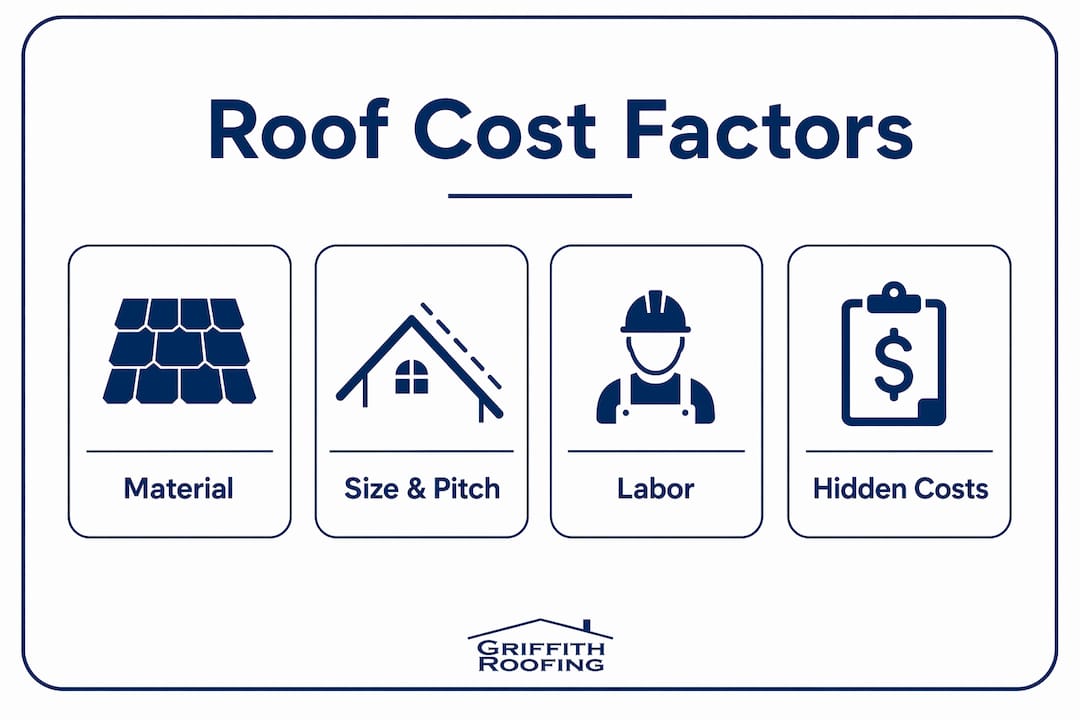
Steep roofs carry a direct labor premium. Roofs with an 8/12 pitch or greater add a 25%–60% labor premium because crews need additional safety equipment, work more slowly, and require larger teams. That premium applies to every trade on the job, including flashing, ventilation, and cleanup.
Complexity multiplies the cost further. Features that raise your bill include:
- Valleys: Where two roof planes meet, water concentrates and flashing is critical. Each valley adds cutting, fitting, and sealing time.
- Dormers: These vertical projections require custom framing, flashing, and trim work that standard flat runs do not.
- Hips and ridges: More linear feet of hip and ridge cap mean more material and more labor per square.
- Penetrations: Chimneys, skylights, and pipe boots each require custom flashing and add time to every crew member’s schedule.
Complex roof designs add 15%–30% in combined waste and labor costs compared to a simple gable roof of the same square footage. Two homes on the same DFW street with identical footprints can carry quotes that differ by thousands of dollars because of these structural differences.
What do labor rates and contractor experience cost in DFW?
Labor is the cost factor homeowners most often overlook when budgeting. Labor accounts for 40%–60% of total installed roofing costs on a standard project. That means a $20,000 roof replacement includes $8,000–$12,000 in labor before a single shingle is priced.
DFW homeowners benefit from a regional pricing advantage. Roofing costs in the Texas Triangle run 5%–15% below the national median, driven by lower relative labor rates compared to markets like the Northeast or California. The Texas regional cost multiplier sits at approximately 0.85–0.95 versus the national average. That gap is real money on a large project.
Contractor experience and certification directly affect both price and outcome. Certified contractors carry manufacturer credentials that unlock extended material warranties, sometimes doubling the coverage a standard installation provides. The residential roof replacement process in DFW involves permit pulls, inspections, and code compliance steps that experienced crews handle without delays or costly corrections.
When comparing quotes, watch for these red flags:
- A quote with no line-item breakdown. Lump-sum bids hide assumptions about tear-off layers, decking allowance, and material grade.
- No mention of permit fees. Any contractor who skips the permit is skipping the inspection that protects your warranty and resale value.
- A price significantly below other quotes. Below-market bids typically reflect thinner crews, lower-grade materials, or missing scope items.
Pro Tip: When you compare contractor quotes, require each bidder to use identical material specs. Comparing a 30-year architectural shingle quote to a 3-tab shingle quote is not a fair comparison.
Griffith roofing provides fully itemized proposals on every DFW project so you can see exactly where each dollar goes. That transparency is the baseline for any honest roofing estimate.
What hidden costs should DFW homeowners budget for?
Several cost items appear after the contract is signed and the old roof comes off. Unexpected structural damage during tear-off adds 5%–15% to total project costs on average. Soft spots, rotted decking, and deteriorated flashing are invisible until the old material is stripped away.
Deck repairs are the most common surprise. Damaged plywood sheets cost $50–$100 each to replace after tear-off. A roof with moderate moisture damage might need 10–20 sheets replaced, adding $500–$2,000 to the final bill. Contractors who provide a decking allowance in the original quote reduce the shock of mid-project change orders.
Tear-off itself carries a direct cost. Removing existing roofing layers runs $1.00–$2.50 per sq ft per layer. Most DFW building codes limit overlays to two layers, so a home with two existing layers requires full tear-off before new material goes down. Disposal fees add $150–$500 per dumpster load, and a typical residential project fills one to two loads.
Permits trigger mandatory code upgrades that many homeowners do not anticipate. Pulling a tear-off permit in most DFW jurisdictions requires new ice-and-water shield installation and updated flashing details, adding $400–$1,200 to the project. These upgrades are not optional. They are code requirements that protect your home and your insurance coverage. For a full breakdown of local requirements, the DFW permit requirements guide covers what to expect before work begins.
Build a contingency of 10%–15% into your roofing budget before you sign any contract. That buffer covers decking repairs, code upgrades, and any flashing work the tear-off reveals.
Key Takeaways
Residential roofing costs in DFW are driven by material choice, roof geometry, labor rates, and hidden structural variables that only appear after tear-off begins.
| Point | Details |
|---|---|
| Material is the biggest cost lever | Architectural asphalt sets the baseline; metal and slate cost 60%–300% more. |
| Roof area exceeds home footprint | Pitch multipliers add 10%–20% to actual surface area, raising both material and labor needs. |
| Labor is 40%–60% of total cost | DFW labor rates run 5%–15% below the national median, giving local homeowners a pricing advantage. |
| Hidden costs are predictable | Budget a 10%–15% contingency for decking repairs, permit upgrades, and disposal fees. |
| Line-item quotes are non-negotiable | Lump-sum bids hide assumptions; require itemized proposals to compare contractors fairly. |
What I’ve learned after 25 years of DFW roofing projects
The number I see homeowners fixate on is the total at the bottom of the quote. That instinct is understandable, but it is the wrong place to start. The most revealing number in any roofing proposal is the labor rate per square, because that tells you immediately whether the contractor has priced the job honestly or is cutting corners somewhere.
I have seen DFW homeowners accept the lowest bid and then face $3,000 in change orders two days into the project. The tear-off revealed rotted decking the contractor had not allowed for, and suddenly the “savings” evaporated. A contractor who builds a realistic decking allowance into the original quote is not padding the price. That contractor is being honest about what the job actually costs.
My advice is direct: get three fully itemized quotes, not three lump sums. Require each contractor to specify the shingle brand and grade, the number of tear-off layers included, the decking allowance per sheet, and the permit fee. When all three quotes use the same inputs, the price differences become meaningful. You can see who is pricing labor fairly and who is betting you will not notice what they left out.
The hire a residential roofing contractor guide we put together covers exactly what to ask before you sign. Quality and longevity always cost more upfront. In DFW’s hail and heat environment, that investment pays for itself.
— Mark Griffith
Griffith roofing’s residential roofing services for DFW homeowners
Griffith roofing has served the Dallas Fort Worth Metroplex since 2001, and every project starts with a fully itemized estimate so you know exactly what you are paying for before work begins.
Whether you are replacing aging asphalt shingles or considering a metal roofing upgrade, Griffith roofing’s team brings over two decades of local experience to every job. Our residential roofing services cover everything from initial inspection through final cleanup, with no surprises on the final invoice. Contact Griffith roofing today for a detailed, no-obligation estimate tailored to your home’s specific structure and your budget.
FAQ
What is the biggest factor in residential roof replacement cost?
Material choice is the largest single cost driver, with options ranging from architectural asphalt at the baseline to natural slate costing 150%–300% more for the same roof area.
How do I estimate the true area of my roof?
Multiply your home’s ground-level footprint by the appropriate pitch multiplier, then add a waste factor. The result is typically 10%–20% larger than your floor plan square footage.
Why do two similar DFW homes get different roofing quotes?
Structural differences like valleys, dormers, roof penetrations, and the number of existing tear-off layers create significant cost variation even between homes with identical footprints.
Are roofing permits required in DFW, and do they add cost?
Permits are required for tear-off and replacement in most DFW jurisdictions. Pulling a permit typically triggers mandatory code upgrades that add $400–$1,200 to the project total.
How much contingency should I budget for a roof replacement?
A 10%–15% contingency covers the most common surprises: rotted decking at $50–$100 per sheet, flashing repairs, and code-required upgrades revealed after tear-off begins.


