

The residential roof replacement process is a defined sequence of steps beginning with permit acquisition and ending with a final inspection, covering tear-off, decking assessment, waterproofing, shingle installation, ventilation, and cleanup. For Dallas-Fort Worth homeowners, understanding this process is the difference between a confident project and a costly surprise. DFW’s severe hail seasons, strict Fort Worth building codes, and rising material costs make it more important than ever to know exactly what your contractor should be doing and in what order. This roof replacement guide walks you through every phase so you can plan, budget, and communicate with your contractor from a position of knowledge.
What does the residential roof replacement process involve?
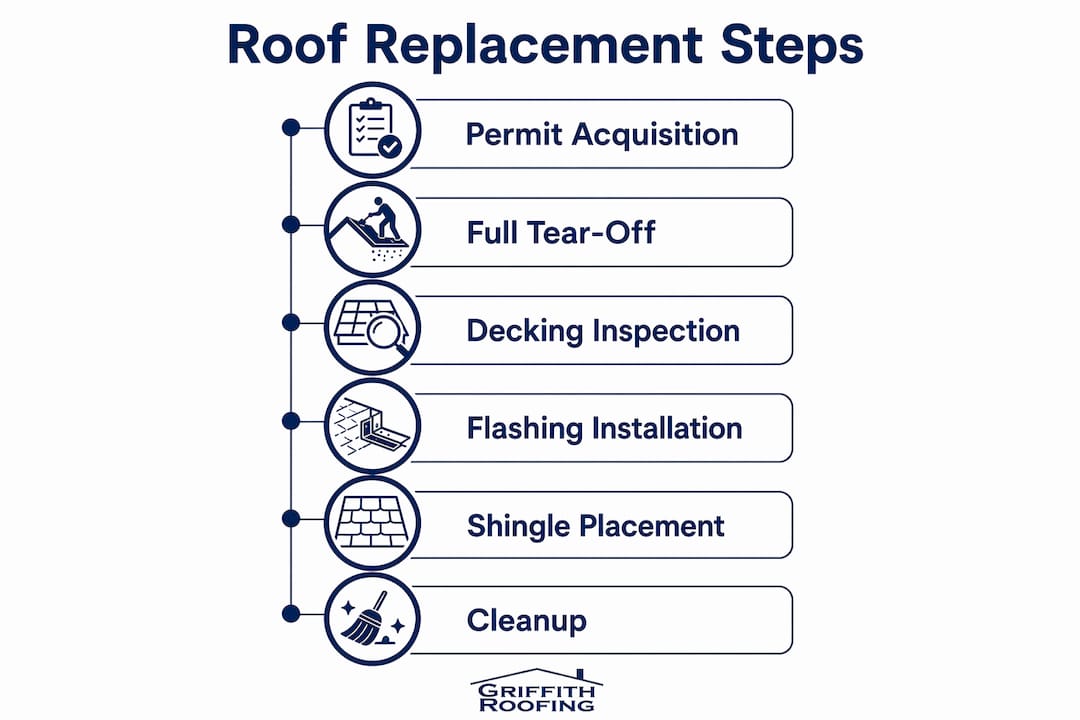
A residential roof replacement, known in the industry as a “re-roof,” follows a strict sequential workflow. Skilled contractors may complete the physical installation in as little as one day, but the full project timeline stretches longer once permits, scheduling, and inspections are factored in. The process covers eight core phases: permit, tear-off, deck inspection and repair, underlayment, flashing, shingle installation, ridge ventilation, and final inspection. Skipping or reordering any of these steps creates leak pathways that often don’t show up until the next heavy rain.
What permits and inspections do Fort Worth homeowners need?
Permit requirements in the Dallas-Fort Worth area are more specific than most homeowners realize, and getting this wrong delays your entire project.
When a permit is required
In Fort Worth, replacing shingles only does not require a building permit. However, if your contractor needs to replace any decking boards, a permit is mandatory. Permit fees typically run between $150 and $300, with issuance taking one to three business days. That fee is minor compared to the cost of a failed inspection or a code violation discovered during a future home sale.
Fort Worth building code also requires crickets behind chimneys wider than 30 inches and drip edge installation on all re-roof projects. These are not optional upgrades. They are code requirements that protect against water intrusion at the most vulnerable points on a complex roof.
What inspectors verify
The city inspector checks that decking repairs were completed correctly, that drip edge is properly installed, and that the overall installation meets local code. Inspections are typically scheduled after the decking work is done and before shingles go on, so the inspector can see the substrate. If your contractor rushes past this window, you lose the opportunity for a clean inspection.
Here is what to confirm before your project starts:
- Whether your project triggers a permit based on expected decking repairs
- Who pulls the permit, you or the contractor (reputable contractors handle this)
- The permit fee and expected issuance timeline
- Whether a mid-project inspection is required before shingles are installed
Pro Tip: Ask your contractor in writing whether they expect to replace any decking boards. If the answer is “we’ll know after tear-off,” make sure your contract specifies that a permit will be pulled if decking replacement is needed. Treating the permit as a project milestone, not a formality, protects you legally and financially.
How does the physical roof replacement work, step by step?
The on-site installation follows a precise order. Improper sequencing is the most frequent cause of roof leaks after replacement, which is why understanding each phase matters even if you are not swinging a hammer.
The full tear-off
Fort Worth prohibits overlay installations, meaning your contractor cannot simply nail new shingles over old ones. A full tear-off is required. This exposes the decking so the crew can assess its condition before any new materials go down. Overlays hide problems and add weight. Full tear-off is the only code-compliant option in this market.
Decking inspection and repair
Once the old roofing is stripped, the crew walks the deck and marks any soft, rotted, or damaged boards. Repairs happen before anything else goes on. This is also the phase where a permit inspection may be triggered if the scope of decking replacement is significant. Do not let a contractor skip this assessment or rush past it.
The waterproofing sequence
The installation sequence that follows is non-negotiable:
- Drip edge at eaves installed first, directing water away from the fascia
- Ice-and-water shield applied at eaves, valleys, and around all penetrations
- Synthetic or felt underlayment covering the remaining deck area
- Drip edge at rakes installed over the underlayment on the sloped edges
- Step flashing at all wall transitions and around chimneys
- Shingles installed from eave to ridge following manufacturer nailing patterns
- Ridge vent installed before cap shingles to allow continuous attic airflow
- Ridge cap shingles as the final layer sealing the peak
Flashing and penetrations
Flashing at wall transitions, chimneys, and valleys combined with proper underlayment layering is the single most critical factor in leak prevention. Step flashing, counter flashing, and drip edges must be installed in the correct order and direction. A contractor who rushes flashing work is setting up a leak that may not appear for months.
Cleanup
Cleanup is not an afterthought. Magnetic sweeps across the yard and driveway remove nail debris that poses real safety hazards to your family and vehicles. Confirm this is in your contract before work begins.
Pro Tip: Ask your contractor to walk you through the installation sequence before work starts. A contractor who can explain each step in plain language is one who actually performs each step correctly.
Which materials matter most for Texas weather?
Material selection for a DFW roof is driven by one reality: North Texas weather is hard on roofs. Hail, wind-driven rain, and summer heat cycles demand a layered waterproofing system, not just shingles.
Ice-and-water shield in a warm climate
Ice-and-water shield is a self-adhering waterproof membrane that seals around nails and vulnerable transitions, protecting the deck from wind-driven rain and hail damage. Many homeowners assume it is only for cold climates. That assumption is wrong. In Texas, hail punches through shingles and wind forces water horizontally under them. The membrane is your last line of defense at eaves, valleys, and around every pipe and skylight.
Texas contractors typically use synthetic underlayment plus targeted ice-and-water shield at vulnerable areas rather than covering the entire deck with membrane. This approach balances protection with cost and suits the DFW climate well.
| Material | Purpose | DFW Relevance |
|---|---|---|
| Ice-and-water shield | Self-sealing membrane at high-risk zones | Critical at eaves, valleys, and penetrations for hail protection |
| Synthetic underlayment | Secondary moisture barrier over full deck | More durable than felt in heat and humidity |
| Architectural shingles | Primary weather layer | Impact-resistant options available for hail-prone areas |
| Ridge vent | Continuous attic ventilation | Extends shingle life by reducing heat buildup |
| Step and counter flashing | Seals wall and chimney transitions | Prevents the most common post-replacement leaks |
Shingle selection
Architectural shingles from manufacturers like Owens Corning are the standard choice for DFW residential roofs. For homes in high-hail zones, Class 4 impact-resistant shingles are worth the premium. Some insurance carriers in Texas offer premium discounts for Class 4 installations, which can offset the upfront cost over time. For guidance on North Texas material choices, the climate-specific factors are worth reviewing before you finalize your material selection.
Pro Tip: Request the product specification sheets for every material your contractor plans to install. Verify that the ice-and-water shield, underlayment, and shingles all meet manufacturer compatibility requirements. Mismatched products can void warranties.
What should DFW homeowners expect for costs and timelines?
Budgeting for a roof replacement in 2025 and 2026 requires accounting for real cost increases. The average Texas residential replacement reached approximately $17,631 in 2025, a 33% increase over the prior four-year average. Material inflation is outpacing labor cost increases, and that trend has not reversed. Understanding what drives your final number helps you evaluate contractor bids accurately.
What affects your total cost
- Roof size and pitch: Steeper roofs require more labor and safety equipment
- Decking repairs: Boards discovered during tear-off add material and labor costs
- Permit fees: Budget $150 to $300 for Fort Worth permits when decking work is involved
- Material grade: Class 4 impact-resistant shingles cost more upfront but may reduce insurance premiums
- Flashing complexity: Chimneys, skylights, and multiple valleys increase labor time
Timeline expectations
Most DFW residential replacements are completed in one to two days of physical installation. The full project timeline, including permit issuance and final inspection scheduling, typically runs one to two weeks from contract signing. Material delivery usually happens the day before installation begins, so plan for a pallet of shingles in your driveway overnight.
Prepare your home before the crew arrives by clearing the driveway, moving vehicles, and warning neighbors about noise and debris. Protect fragile items in your attic, as vibration from tear-off travels through the structure. For a detailed look at how insurance factors into your Texas roof replacement cost, that context is worth reviewing before you finalize your budget.
Key takeaways
A successful residential roof replacement in Dallas-Fort Worth depends on following the correct installation sequence, securing the right permits, and choosing materials matched to Texas weather conditions.
| Point | Details |
|---|---|
| Permits protect you | Fort Worth requires a permit for decking replacement; treat it as a project milestone, not paperwork. |
| Sequence prevents leaks | Drip edge, ice-and-water shield, underlayment, flashing, shingles, and ridge vent must follow strict order. |
| Ice-and-water shield is not optional | This membrane protects DFW roofs from hail and wind-driven rain at every vulnerable transition point. |
| Costs have risen significantly | Average Texas replacements reached $17,631 in 2025, so budget for decking repairs and permit fees as variables. |
| Cleanup is part of the job | Magnetic nail sweeps and full debris removal should be written into your contract before work begins. |
What I’ve learned after 25 years of DFW roofs
After more than two decades of replacing roofs across the Dallas-Fort Worth Metroplex, the pattern I see most often is not bad materials or bad weather. It is homeowners who did not know what questions to ask before the crew arrived.
The homeowners who get the best outcomes are the ones who read their contracts carefully. A contract that does not specify how decking repairs are priced, who pulls the permit, and how cleanup is handled is a contract that leaves you exposed. I have seen projects where the site looked clean but nails turned up in tires two weeks later because no magnetic sweep was used. That detail should be in writing.
The other thing I tell every homeowner: do not accept an overlay in Fort Worth. The code prohibits it, and any contractor suggesting one is either unaware of local requirements or hoping you are. Full tear-off is not just best practice here. It is the law.
Flashing is where I see the most shortcuts taken. Ridge vents and cap shingles get attention because they are visible. Flashing at the chimney base or a wall transition gets rushed because no one is watching. Those are the spots that leak first. Ask your contractor specifically how they handle step flashing and counter flashing at every penetration. The answer tells you a great deal about their standards.
Understanding the roofing contractor selection process in Tarrant County is worth your time before you sign anything. The right contractor makes this process straightforward. The wrong one makes it expensive.
— Mark Griffith
Work with a trusted DFW roofing team
Griffith Roofing has served Dallas-Fort Worth homeowners since 2001, handling every phase of residential roof replacement from the initial inspection through final walkthrough. We know the local permit requirements, the material demands of North Texas weather, and the installation standards that protect your home for decades.
Whether you need a full residential roof replacement or targeted roof repair services after storm damage, Griffith Roofing delivers the quality and transparency you deserve. Contact us today for a personalized estimate and a clear project plan tailored to your home and budget. We do not consider the job done until you are completely satisfied.
FAQ
Does Fort Worth require a permit for roof replacement?
Fort Worth requires a building permit only when decking replacement is involved. Shingle-only replacements do not require a permit, but full tear-off with decking repairs does, with fees typically running $150 to $300.
How long does a residential roof replacement take in DFW?
Physical installation typically takes one to two days for most homes. The full project timeline, including permit issuance and final inspection, generally runs one to two weeks from contract signing.
Is ice-and-water shield necessary in Texas?
Yes. Ice-and-water shield protects against wind-driven rain and hail damage at eaves, valleys, and penetrations. Texas weather makes it a critical component of any properly installed roof system, not just a cold-climate product.
What is the average cost of a roof replacement in Texas?
The average Texas residential roof replacement reached approximately $17,631 in 2025, reflecting a 33% increase over the prior four-year average driven largely by material inflation.
Can a contractor install new shingles over old ones in Fort Worth?
No. Fort Worth building code prohibits overlay installations and requires a full tear-off on all re-roof projects. Any contractor suggesting an overlay is not complying with local code requirements.


