

The roof repair vs replacement decision is defined by one core question: does your roof have enough remaining useful life to justify a repair, or does replacement deliver better long-term protection and value? For homeowners and property managers across the Dallas Fort Worth Metroplex, that question carries real weight. DFW weather is brutal. Hail pummels roofs in spring, summer heat bakes shingles into brittleness, and severe storms leave scars that compound over time. Getting this decision right protects your home, your budget, and your peace of mind. This guide gives you the specific rules, cost thresholds, and inspection steps to make that call with confidence.
What factors determine whether to repair or replace your roof?
The roof repair vs replacement decision rests on five measurable factors. Knowing each one prevents you from spending $1,200 on a patch job that fails in 14 months, or replacing a roof that had years of life left.
Roof age and service life
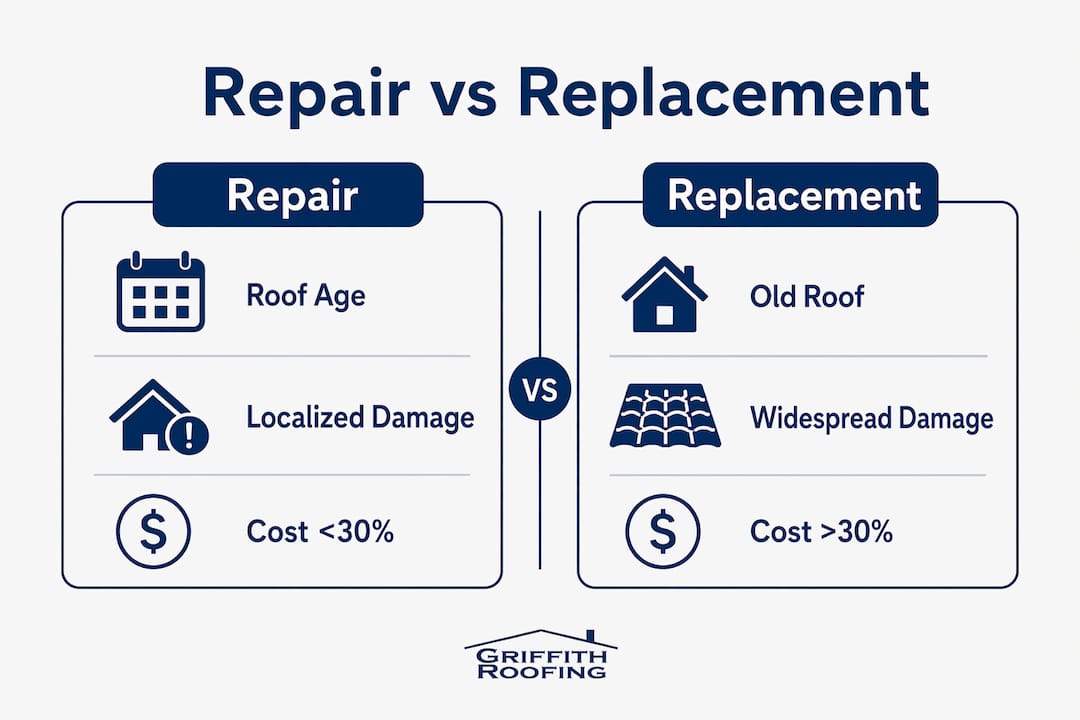
Architectural asphalt shingles last 20–25 years under normal conditions. In DFW, UV exposure and thermal cycling shorten that window. Roofs under 15 years old with localized damage are strong repair candidates. Roofs over 20 years old with systemic damage should be replaced. Age alone does not decide the outcome, but it sets the baseline for every other factor.
Extent and type of damage
Localized damage, such as a few missing shingles or a single flashing failure, points toward repair. Widespread damage across multiple roof sections points toward replacement. Multiple leaks in different locations indicate systemic failure. A single identifiable leak is usually repairable. That distinction matters enormously when you are talking to an insurance adjuster or a contractor.
Underlying deck condition
The roof deck is the wood structure beneath your shingles. Significant rot or delamination in the deck means the surface material must come off regardless. At that point, full replacement becomes more cost-effective than partial repair. The most expensive repair is one that masks failing decking.
Repair history and frequency
A roof repaired twice in three years is telling you something. Recurring issues signal that the system is degrading faster than spot fixes can keep up. Each repair also adds material layers that expand and contract at different rates, accelerating future failures.
Financial and insurance considerations
- Repair costs typically range from $300 to $1,500
- Full replacements average $9,000 to $15,000
- Repair costs exceeding 30% of replacement cost signal diminishing returns
- Insurance claims for storm damage often favor full replacements due to difficulty matching old shingles
Pro Tip: Get written estimates for both repair and replacement before making any decision. The cost gap between the two options is the clearest signal you have.
How to assess your roof’s condition before deciding
A thorough roof condition evaluation takes less than an hour and gives you the data you need to have an informed conversation with any contractor.
-
Start from inside. Go into your attic with a flashlight. Look for water stains, daylight coming through the decking, and soft or spongy wood. These signs point to active leaks or deck damage that a surface inspection alone will miss.
-
Inspect from the ground. Use binoculars to scan for missing, curling, or cracked shingles. Look for granule loss, which shows up as bare patches or dark streaking on shingles. Check your gutters for granule buildup after a storm.
-
Check flashing and penetrations. Flashing around chimneys, vents, and skylights fails before shingles do. Lifted, cracked, or missing flashing is a common source of leaks that are often repairable without a full replacement.
-
Document everything with photos. Date-stamped photos protect you during insurance claims and give contractors a clear picture of damage scope. Photograph every problem area from multiple angles.
-
Hire a licensed roofing inspector. A professional inspection from a contractor like Griffith roofing gives you a written damage assessment and a repair estimate. That document is your negotiating tool with your insurance company and your baseline for comparing bids.
Pro Tip: After any DFW hailstorm, check your storm damage signs within 72 hours. Insurance policies have strict reporting windows, and delayed documentation can cost you a valid claim.
How do cost and damage percentage rules guide your decision?
Two rules give you a clear framework when the decision feels murky. Both are widely used by contractors and insurance adjusters across the roofing industry.
The 25% damage rule
Roofs with more than 25% damage or aged beyond 75% of their expected lifespan commonly trigger replacement recommendations under local building codes. In practical terms, if a DFW hailstorm damages more than one quarter of your roof surface, many municipalities require a full replacement rather than a patch. This rule protects structural integrity and prevents patchwork repairs from creating uneven load distribution.
The 30–50% cost threshold
“Repair costs exceeding 50% of replacement cost generally indicate replacement is a better investment, resetting the warranty and lifespan.” — Frontline Roofing
The math is straightforward. If a full replacement costs $12,000 and your repair estimate comes in at $4,500, you are at 37.5% of replacement cost. That sits in the gray zone. If the repair estimate hits $6,500, you are above 50% and replacement wins on every financial measure. You get a new manufacturer warranty from brands like GAF or Owens Corning, a full lifespan reset, and no risk of the repair failing within 18 months.
Scenario comparison for DFW homeowners
| Scenario | Repair cost | Replacement cost | Recommendation |
|---|---|---|---|
| 10-year-old roof, one leak | $400 | $11,000 | Repair |
| 18-year-old roof, 20% damage | $2,800 | $11,000 | Repair with caution |
| 22-year-old roof, 30% damage | $5,500 | $11,000 | Replace |
| Any age, deck rot present | $6,000+ | $11,000 | Replace |
Warranty resets are often undervalued in this calculation. A new GAF or Owens Corning system comes with manufacturer warranties that a patch repair cannot provide. That warranty also affects your home’s resale value and your ability to transfer coverage to a future buyer.
What should you expect from the repair and replacement process?
Understanding the process for each option helps you plan for time, disruption, and long-term outcomes.
Roof repair: scope and timeline
A typical repair involves patching damaged sections, replacing individual shingles, resealing or replacing flashing, and addressing any minor deck issues. Most repairs in the DFW area are completed in one day. The disruption is minimal. However, patchwork repairs on aging roofs often fail within 12–18 months because new shingles expand differently than old brittle ones. That mismatch creates gaps that let water in.
Roof replacement: scope and timeline
A full replacement involves tearing off existing shingles, inspecting and repairing the deck, installing new underlayment, and laying new shingles or roofing material. In DFW, most residential replacements take one to three days depending on roof size and complexity. The process is louder and more disruptive than a repair, but the outcome is a fully warranted system with a known lifespan.
Key differences at a glance:
- Repair timeline: 1 day in most cases
- Replacement timeline: 1–3 days for most DFW homes
- Repair warranty: Limited to materials and labor on the patched area
- Replacement warranty: Full manufacturer warranty from brands like GAF or Owens Corning, covering the entire system
- Impact on home value: Replacement adds measurable resale value; repairs maintain current value at best
- Insurance: Adjusters often approve full replacements over repairs because matching old shingles is difficult and long-term durability is better for claim payers
Financing is worth factoring in early. Griffith roofing offers guidance on replacement financing options that make a full replacement more accessible when the cost feels like a barrier.
Key Takeaways
The roof repair vs replacement decision requires evaluating roof age, damage extent, deck condition, and cost thresholds together, not any single factor in isolation.
| Point | Details |
|---|---|
| Use the 30% cost rule | If repair costs exceed 30% of replacement cost, replacement delivers better long-term value. |
| Apply the 25% damage rule | Damage covering more than 25% of roof area often triggers code-required replacement in DFW. |
| Inspect the deck first | Hidden deck rot makes repair costs approach replacement costs, making full replacement more efficient. |
| Age determines repair viability | Roofs under 15 years old favor repair; roofs over 20 years old with systemic damage favor replacement. |
| Warranty resets matter | A new GAF or Owens Corning system resets your lifespan and manufacturer warranty, protecting resale value. |
What I’ve learned after 20+ years of DFW roofs
I’ve seen homeowners spend $1,800 on a repair in april, then call me back in october with a leak in a completely different spot. The repair wasn’t wrong. The roof was just done. That’s the pattern I want you to avoid.
The biggest misconception I run into is that repair is always the conservative, safe choice. It isn’t. Repairing a roof that has aged beyond 75% of its useful life is like patching a tire that’s been driven on the rim. You’re spending money to delay an outcome that is already decided. The remaining useful life of your roof is the real variable, not the repair cost in isolation.
DFW conditions accelerate this timeline. The combination of hail, heat, and humidity here is harder on roofing materials than almost anywhere else in the country. A 20-year-old asphalt shingle roof in DFW has often lived a harder life than a 25-year-old roof in a milder climate. That context matters when you’re applying national guidelines to a local decision.
My honest recommendation: get a professional inspection before you commit to either path. A written assessment from a licensed contractor gives you facts, not guesses. It also gives you documentation that protects you with your insurance company. At Griffith roofing, we’ve been doing those assessments since 2001, and the homeowners who come in with clear information always make better decisions.
— Mark Griffith
How Griffith roofing helps DFW homeowners make the right call
Griffith roofing has served Dallas Fort Worth homeowners and property managers since 2001. When you’re facing a repair or replacement decision, you need more than a quote. You need a contractor who will walk your roof, document the damage honestly, and give you a clear comparison of both options.
Griffith roofing provides detailed written assessments for both repair and replacement scenarios, so you can see the real cost difference before committing to anything. The team handles everything from shingle repairs to full residential roof replacements across the DFW area. If you’re ready to stop guessing and get a professional opinion, Griffith roofing is the place to start. Contact the team today for a roof inspection and honest, no-pressure guidance on your best path forward.
FAQ
When should I repair instead of replace my roof?
Repair is the right choice when your roof is under 15 years old, damage is localized to one area, and repair costs fall below 30% of full replacement cost. A single identifiable leak with no deck damage is a clear repair candidate.
What does a full roof replacement cost in DFW?
Full replacements in the Dallas Fort Worth area typically average $9,000 to $15,000 depending on roof size, material choice, and deck condition. Repair costs range from $300 to $1,500 for most localized issues.
Does the 25% damage rule apply in Dallas Fort Worth?
Yes. Local building codes in many DFW municipalities require full replacement when damage covers more than 25% of the roof surface. Your contractor or inspector can measure damage area and confirm whether this threshold applies to your property.
Will my insurance cover a full replacement after storm damage?
Insurance adjusters often approve full replacements over repairs because matching old shingles is difficult and replacement offers better long-term durability. A licensed contractor can document damage and submit supplements to support a full replacement claim.
How do roofing warranties differ between repair and replacement?
A repair carries a limited warranty covering only the patched area and labor. A full replacement from a manufacturer like GAF or Owens Corning resets your entire system warranty, covering materials and installation across the whole roof.


