

Texas homeowners insurance policies define roof coverage through two distinct valuation methods: Replacement Cost Value (RCV) and Actual Cash Value (ACV). Doing a thorough Texas insurance policy roof coverage review before a storm hits can mean the difference between a full payout and a $5,000 to $15,000 out-of-pocket gap. Senate Bill 10 now allows Texas insurers to automatically shift older roofs to ACV coverage, making it critical that you understand exactly what your policy says before you ever file a claim. Griffith roofing has worked with Dallas-Fort Worth homeowners since 2001, and the same policy blind spots keep showing up year after year.
What are the Texas roof coverage options and how do they affect claims?
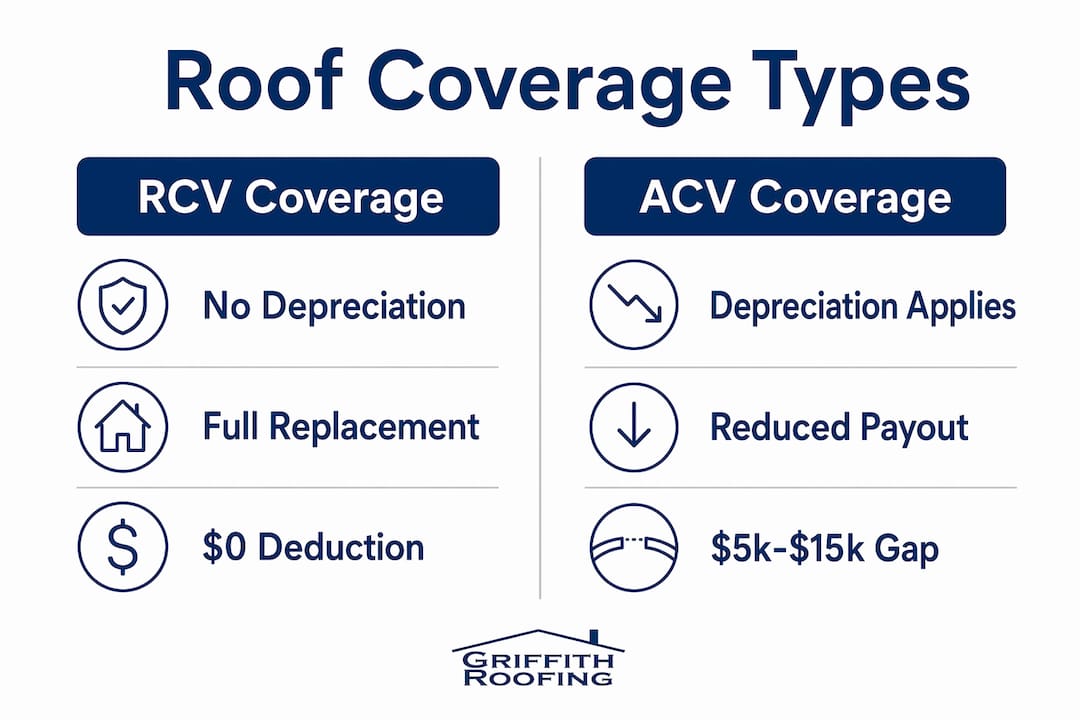
RCV and ACV coverage are the two standard valuation methods in Texas homeowners insurance policies. RCV pays the full cost to replace your roof with materials of like kind and quality, without subtracting depreciation. ACV pays only the depreciated value of your roof at the time of loss, which means the older your roof, the less you receive.
The financial gap between these two methods is significant. ACV payouts often leave homeowners with a $5,000 to $15,000 shortfall on a standard roof replacement. That gap comes directly out of your pocket, on top of your deductible.
Senate Bill 10 allows Texas insurers to automatically limit roof coverage to ACV once your roof reaches a certain age, typically 10 to 15 years. Most carriers implement these age-based restrictions without notifying homeowners clearly at renewal. This is the “age trap” that catches thousands of Texas homeowners off guard every storm season.
Two policy terms you need to know are “roof schedule” and “loss settlement provisions.” A roof schedule lists specific payout percentages based on roof age and material type. Loss settlement provisions define exactly how your insurer calculates what they owe you after a covered loss. Both terms appear in your policy’s endorsements section, not the declarations page.
| Feature | RCV Coverage | ACV Coverage |
|---|---|---|
| Depreciation applied | No | Yes |
| Typical payout gap | Minimal | $5,000–$15,000 |
| Best for | Newer roofs | Older or budget policies |
| Senate Bill 10 impact | Not affected | Triggered at 10–15 years |
| Premium cost | Higher | Lower |
Pro Tip: Request your insurer’s roof schedule in writing at every renewal. If they cannot produce one, ask your agent to confirm in writing whether your roof is covered under RCV or ACV.
How to review your Texas insurance policy for roof coverage accuracy
Your declarations page is the starting point for any policy audit. It lists your coverage amounts, deductibles, and the named perils your policy covers. However, the details that matter most for roof claims live in the endorsements and exclusions sections, which most homeowners never read.
Check these items specifically during your review:
- Roof valuation method: Confirm whether your roof is covered under RCV or ACV, and note any age thresholds that trigger a switch.
- Wind and hail deductible: Wind and hail deductibles in Texas are often percentage-based, typically 1% to 2% of your home’s insured value. On a $400,000 home, that is $4,000 to $8,000 before your insurer pays anything.
- Cosmetic damage exclusions: Many Texas policies exclude hail dents and dings that do not impair the roof’s function. Verify whether your policy contains this exclusion.
- Roof age and material on file: Confirm that your insurer has the correct roof age and material type recorded. Outdated information can delay or reduce your claim payout.
- Endorsements that modify coverage: Look for any added endorsements that cap payouts, exclude certain materials, or change how depreciation is calculated.
Pro Tip: Keep a digital folder with your roof’s installation date, contractor invoice, permit records, and any inspection reports. This documentation is your first line of defense if an insurer questions your roof’s age or condition.
Maintaining annual roof inspection reports from a licensed roofer significantly increases your claim approval likelihood. Insurers frequently deny claims by citing pre-existing damage, and a dated inspection report directly counters that argument.
What steps should Texas homeowners follow when filing a roof damage claim?
Filing a roof damage claim correctly is as important as having the right coverage. Texas Department of Insurance rules require insurers to explain any denial in writing, but that protection only helps you if you file on time and with complete documentation.
Follow these steps after storm damage occurs:
- Document damage immediately. Take timestamped photos and video of every affected area, including gutters, vents, flashing, and the roof surface itself.
- Schedule a professional inspection. A licensed roofer’s written report distinguishes functional damage from cosmetic damage, which directly affects whether your claim is approved.
- File your claim promptly. Claim filing deadlines range from 90 days to 1 year depending on your policy. Filing late is one of the most common and avoidable reasons for denial.
- Submit a complete damage report. Include your contractor’s written estimate, photos, and any prior inspection records that establish your roof’s pre-storm condition.
- Track all communications. Log every call, email, and letter with your insurer, including dates and the names of representatives you speak with.
Know your appraisal rights. If you disagree with your insurer’s damage valuation, the appraisal clause in Texas policies gives you the right to hire an independent appraiser. Both sides select an appraiser, and a neutral umpire resolves any disagreement. This process is faster and far less expensive than litigation.
Functional damage means your roof’s ability to keep water out has been compromised. Cosmetic damage means the appearance is affected but the roof still performs. Texas insurers treat these two categories very differently, and your claim outcome often hinges on which category the adjuster assigns.
What common pitfalls cause Texas insurance roof claim denials?
Claim denials in Texas follow predictable patterns. Understanding those patterns lets you address them before they become problems.
- Pre-existing wear and tear: Insurers deny claims when they can show the damage existed before the storm. Annual inspection reports directly counter this argument by establishing a baseline condition.
- Roof age beyond the ACV threshold: Once your roof crosses the 10 to 15 year mark, insurers automatically shift to ACV coverage under Senate Bill 10. Many homeowners discover this only when they receive a reduced payout.
- Cosmetic damage classification: Cosmetic damage exclusions are common in Texas policies, meaning hail dents that do not cause leaks are often denied outright. Review your policy’s definition of “functional impairment” before filing.
- Late filing: Missing your policy’s filing window, even by a few days, gives your insurer grounds to deny the claim entirely.
- Inaccurate roof information on file: If your insurer has the wrong roof age or material type recorded, it can create coverage disputes that delay or reduce your payout.
- Skipping policy renewal reviews: Coverage terms change at renewal. An insurer can add a cosmetic damage exclusion or lower your coverage limit without you noticing if you do not read the renewal documents.
The Texas Department of Insurance requires insurers to provide written explanations for all denials. If you receive a denial, request the full written explanation immediately and compare it against your policy language.
How can Texas homeowners manage roof coverage and repair costs strategically?
Roof age is the single biggest factor affecting both your insurance premiums and your coverage terms. A roof under 10 years old typically qualifies for RCV coverage and lower premiums. Once it crosses the age threshold set by your insurer, your coverage shifts and your financial exposure grows.
Installing impact-resistant Class 4 shingles can earn you a premium discount of 10% to 35%, depending on your carrier. That discount compounds over years and can offset a meaningful portion of the installation cost. Updating your roof age and material information with your insurer after any replacement is equally important. Carriers use outdated records to justify lower payouts.
A hybrid strategy works well for homeowners with older roofs. Carry an ACV policy at a lower premium and set aside a dedicated roof replacement fund to cover the depreciation gap when a claim occurs. This approach costs less annually than an RCV policy on an aging roof, and it keeps you prepared for the out-of-pocket portion.
| Strategy | Best for | Trade-off |
|---|---|---|
| RCV policy | Roofs under 10 years | Higher annual premium |
| ACV policy + savings fund | Roofs 10+ years | Requires financial discipline |
| Class 4 shingles upgrade | Any age | Upfront installation cost |
| Policy shopping before age cap | Roofs approaching threshold | Requires proactive timing |
Switching carriers before your roof hits the ACV age trap is significantly easier than finding RCV coverage afterward. Review your policy every year at renewal, and if your roof is approaching the 10 to 15 year threshold, compare quotes from other carriers before the automatic downgrade takes effect.
Key takeaways
Texas homeowners who review their policy’s valuation method, deductibles, and age thresholds before a storm hits are far better positioned to receive full claim payouts and avoid costly coverage gaps.
| Point | Details |
|---|---|
| RCV vs ACV gap | ACV coverage can leave homeowners $5,000–$15,000 short on a roof replacement. |
| Senate Bill 10 age trap | Insurers can switch roofs to ACV at 10–15 years; check your renewal documents every year. |
| Wind and hail deductibles | Percentage-based deductibles of 1%–2% can mean thousands out of pocket before coverage kicks in. |
| Documentation wins claims | Timestamped photos and licensed roofer inspection reports are your strongest defense against denials. |
| Proactive policy review | Shopping for new coverage before your roof hits the ACV threshold gives you far more options. |
What I’ve learned after two decades of Texas roof claims
After more than 20 years working with homeowners across the Dallas-Fort Worth area, I can tell you that the most expensive mistake I see is not the storm damage itself. It is the policy review that never happened.
Homeowners call us after a hail event, and we inspect the roof and find legitimate damage. Then the insurer comes back with a fraction of the replacement cost because the roof crossed the ACV threshold two years ago and nobody caught it at renewal. That gap is real money, and it was entirely preventable.
My honest advice: treat your insurance policy renewal like a financial audit. Read the endorsements, not just the declarations page. Confirm your roof’s age and material are recorded correctly. If your roof is approaching 10 years old, call your agent and ask directly whether a coverage change is coming. Do not wait for the claim to find out.
The appraisal clause is another tool most homeowners never use. If your insurer undervalues your damage, you have the right to invoke it. I have seen it recover tens of thousands of dollars for homeowners who would have otherwise accepted a low settlement. Know it is there before you need it.
One more thing: get a professional inspection after every significant storm, even if you do not see obvious damage. Hail bruises shingles in ways that are not visible from the ground but show up clearly to a trained eye. That inspection report, dated and signed by a licensed roofer, is worth more than any amount of follow-up documentation after the fact.
— Mark Griffith
How Griffith roofing helps Texas homeowners protect their roof investment
Navigating insurance claims and policy reviews is far less stressful when you have a trusted roofing partner in your corner. Griffith roofing has helped Dallas-Fort Worth homeowners document storm damage, prepare claim supplements, and get roofs replaced correctly since 2001.
Our team provides detailed written inspection reports that meet insurer documentation standards, helping you build a strong claim from the start. We also work directly with adjusters to ensure functional damage is properly identified and not misclassified as cosmetic. For homeowners facing coverage gaps, our roof replacement financing options make it possible to move forward without waiting on a full insurance settlement. When you are ready to schedule an inspection or discuss your repair options, our residential roofing services team is ready to help.
FAQ
What is the difference between RCV and ACV roof coverage in Texas?
RCV (Replacement Cost Value) pays the full cost to replace your roof without depreciation, while ACV (Actual Cash Value) subtracts depreciation and typically leaves homeowners with a $5,000 to $15,000 gap. Texas policies increasingly default to ACV for older roofs under Senate Bill 10.
Why does Texas insurance deny roof claims so often?
The most common reasons for denial include pre-existing wear and tear, cosmetic damage exclusions, late filing, and roofs that have crossed the insurer’s ACV age threshold. The Texas Department of Insurance requires all denials to be explained in writing.
What is a wind and hail deductible in Texas?
A wind and hail deductible is a separate, percentage-based deductible that applies specifically to storm damage claims. It typically runs 1% to 2% of your home’s insured value, which means it can be significantly higher than your standard all-peril deductible.
How does the appraisal clause work in Texas?
The appraisal clause lets you and your insurer each hire an independent appraiser when you disagree on a claim’s value. A neutral umpire resolves any remaining dispute. It is faster and less expensive than going to court.
When should I shop for a new homeowners insurance policy in Texas?
Shop for new coverage before your roof reaches the 10 to 15 year age threshold that triggers ACV restrictions. Switching carriers is significantly easier before that threshold, and you have more options for maintaining RCV coverage on an aging roof.


