

Texas roofing contractor licensing explained simply: the state of Texas does not issue or require a statewide roofing contractor license. That single fact reshapes everything about how you operate legally in this state. While trades like electrical and HVAC fall under the Texas Department of Licensing and Regulation, roofing is not regulated at the state level. Compliance instead runs through two parallel tracks: mandatory local municipal registrations and voluntary trade credentials like the Roofing Contractors Association of Texas (RCAT) license. Understanding both tracks is not optional. It is the difference between running a legal, competitive business and facing fines, permit denials, or work stoppages.
What is Texas roofing contractor licensing and how does it work?
Texas roofing licensing operates on two tiers: mandatory local registrations and voluntary trade credentials, both essential for successful operation. The Texas Department of Licensing and Regulation licenses electricians, HVAC technicians, and plumbers. Roofers are not on that list. This means no state agency issues you a roofing license, and no state database tracks your credentials.
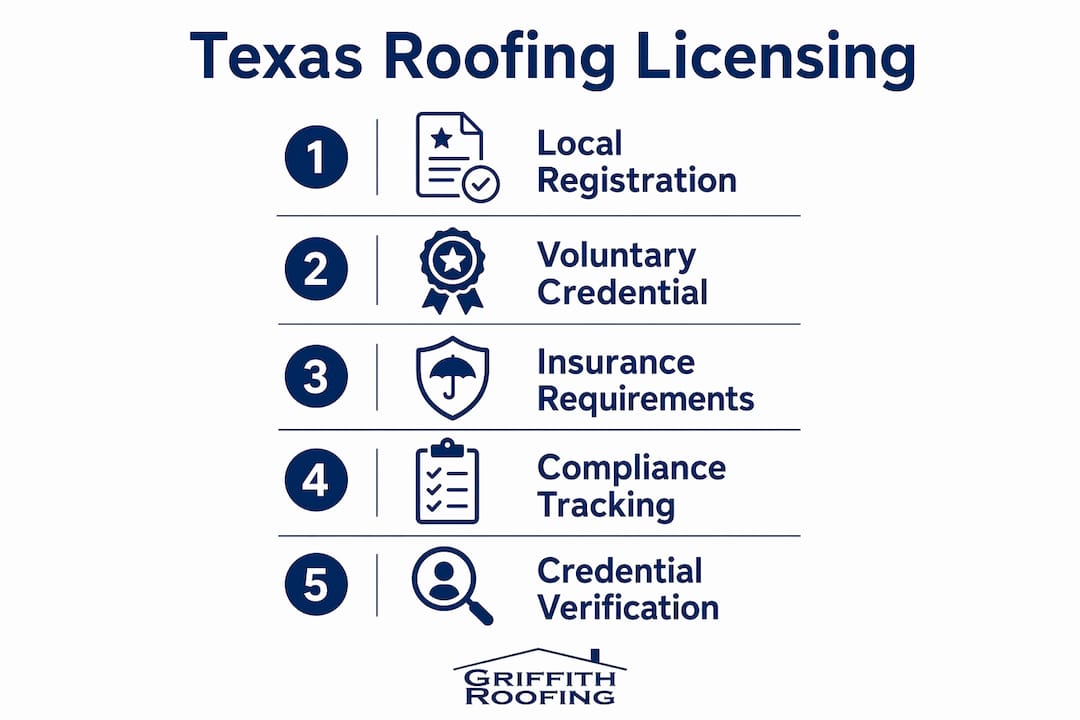
What fills that gap is a patchwork of city and county requirements, plus the voluntary RCAT credential that signals professional standards to clients and municipalities alike. Many contractors mistakenly claim a “Texas state roofing license,” which does not exist. That claim confuses clients and can damage your credibility when a savvy homeowner or commercial property manager checks the facts.
The practical takeaway: your compliance burden is local, not state. You must research and satisfy the registration requirements of every city or county where you pull permits and perform work.
What is the RCAT voluntary license and who qualifies?
The Roofing Contractors Association of Texas offers a voluntary statewide professional credential because Texas issues no state license. RCAT licenses individuals, not companies. That distinction matters when you market your business or vet subcontractors. The credential belongs to the principal, not the business entity.
Who is eligible
To qualify for the RCAT license, you must meet these requirements:
- Business experience: You must be a principal of a Texas-based roofing business for at least 2 continuous years.
- Exam passage: You must pass a business and safety exam plus either a residential or commercial technical exam, with a minimum score of 70% on each.
- Insurance minimums: Residential applicants need at least $300,000 in general liability coverage. Commercial applicants need at least $500,000 in general liability coverage. Workers’ compensation or a compliant alternative is also required.
- Notarized application: You must submit a notarized application packet that includes insurance proof and valid identification. The process is not instant or fully digital. You mail physical documents before you become eligible to sit for the exam.
Why pursue the RCAT credential
The RCAT license does not unlock any legal permission that you lack without it. What it does is signal professionalism to clients who know what to look for. Voluntary credentials and manufacturer certifications like RCAT and GAF certifications help contractors gain trust and competitive advantages despite no legal mandate. Discerning commercial clients and insurance-savvy homeowners increasingly ask for proof of credentials before signing contracts.
Pro Tip: When marketing your RCAT credential, specify that the license belongs to the named principal, not the company as a whole. Transparency here builds more trust than a vague claim of being “RCAT licensed.”
How do local municipal registrations work for Texas roofers?
Local jurisdictions are where your real licensing obligations live. Most major Texas cities require roofing contractors to register or obtain permits before they can operate legally. There is no statewide database. You must verify requirements city by city, and those requirements vary significantly.
Here is a snapshot of how major Texas markets approach contractor registration:
| City | Registration Required | Insurance Minimum | Notes |
|---|---|---|---|
| Dallas | Yes | Varies by project type | Must register with city before pulling permits |
| Houston | Yes | General liability required | Registration tied to permit application process |
| Austin | Yes | Proof of insurance required | City verifies registration before permit approval |
| Fort Worth | Yes | Varies | Part of DFW permit requirements; check city portal |
Failure to register with local municipalities is the single most common compliance failure among Texas roofing contractors. The consequences are concrete: fines, work stoppages, and permit denials that can freeze a job site mid-project. If you work across multiple Texas cities, you need a tracking system for each jurisdiction’s registration status and renewal dates.
Pro Tip: Create a simple spreadsheet that lists every city where you operate, the registration expiration date, the insurance minimum required, and the contact for the local permit office. Review it quarterly. Missing a renewal in Dallas or Houston can cost you more in delays than the registration fee itself.
For contractors working specifically in the Dallas-Fort Worth area, DFW roofing permit requirements carry specific nuances worth reviewing before you pull your next permit.
What insurance and safety requirements do Texas roofers need?
Insurance is not just a formality in Texas roofing. It is the foundation of both your RCAT eligibility and your ability to pull permits in most municipalities. General liability and workers’ compensation or compliant alternatives are required to meet regulatory and client expectations.
The core insurance requirements break down as follows:
- General liability for residential work: Minimum $300,000 in coverage to meet RCAT standards and satisfy most city permit offices.
- General liability for commercial work: Minimum $500,000 in coverage, reflecting the higher risk and liability exposure on commercial projects.
- Workers’ compensation: Texas is one of the few states that does not mandate workers’ comp for private employers, but most municipalities and commercial clients require it or a compliant alternative before approving permits or contracts.
- OSHA safety training: Fall protection training and OSHA 10 or OSHA 30 certification are not legally mandated for all roofers in Texas, but they are increasingly expected by commercial clients and general contractors who manage liability on larger projects.
- Certificate of insurance: You must be able to produce a current certificate of insurance on demand. Municipal permit offices, commercial clients, and homeowners all have the right to request it before work begins.
Carrying adequate insurance also affects your competitive position. Clients who understand roofing brand trust signals look for proof of insurance as a baseline indicator of legitimacy. A contractor without verifiable coverage loses bids to those who carry it, regardless of price.
How can you verify roofing credentials in Texas?
Verifying roofing credentials in Texas requires a different approach than in states with centralized licensing databases. No statewide roofing license database exists. The Texas Department of Licensing and Regulation covers electrical, HVAC, and plumbing. Roofers are not in that system.
Here is how to verify credentials effectively:
- Contact the local permit office directly. Call or visit the permit office in the city where the contractor claims to be registered. Ask whether the contractor has an active registration and whether any violations are on record.
- Request proof of RCAT credentials. Ask the contractor for their RCAT license number and verify it through the RCAT website at rcat.net. Confirm the license belongs to the named individual, not just the company.
- Ask for a current certificate of insurance. Request a certificate naming you or your project as an additional insured. A legitimate contractor produces this document within 24 hours.
- Check for manufacturer certifications. Credentials from brands like GAF signal that a contractor has met third-party training and installation standards. These are verifiable through the manufacturer’s contractor locator tools.
- Flag any claim of a “Texas state roofing license.” That license does not exist. A contractor who claims to hold one is either misinformed or misleading you. Redirect the conversation to local registrations and verifiable credentials.
For a deeper look at how to vet a contractor before hiring, the guide on identifying a licensed roofer in Texas walks through the verification process step by step.
Key Takeaways
Texas roofing compliance requires two parallel tracks: mandatory local municipal registrations and voluntary credentials like RCAT, with no state-issued license filling either role.
| Point | Details |
|---|---|
| No state roofing license exists | Texas does not issue or require a statewide roofing contractor license as of 2026. |
| Local registration is mandatory | Cities like Dallas, Houston, and Austin require contractor registration before permits are approved. |
| RCAT licenses individuals, not companies | The credential belongs to the named principal; marketing must reflect this distinction. |
| Insurance drives compliance | $300,000 GL for residential and $500,000 GL for commercial work are the RCAT minimums. |
| Verification requires local contact | No statewide database exists; verify credentials through city permit offices and RCAT directly. |
What I have learned after 20+ years of roofing in Texas
The question I hear most often from newer contractors is some version of: “Where do I get my Texas roofing license?” The honest answer still surprises people. There is no such thing. After more than two decades running Griffith roofing in the Dallas-Fort Worth area, I have watched this confusion cost contractors real money, real time, and real reputation damage.
The contractors who struggle most are the ones who treat licensing as a one-time checkbox. They register in one city, assume it covers the surrounding area, and then get blindsided when a permit office in a neighboring municipality flags them as unregistered. Texas is a big state with a fragmented regulatory structure. That fragmentation is not going away.
What actually works is treating local registration like an ongoing operational responsibility, not a startup task. The contractors I respect most in this market maintain a clear record of every jurisdiction where they operate, every renewal date, and every insurance certificate on file. They pursue the RCAT credential not because the law requires it, but because it gives clients a concrete reason to choose them over an unverified competitor.
My honest advice: get your RCAT credential, carry insurance above the minimums, and build a registration tracking system before you need it. Consumer expectations around contractor credentials are rising. The contractors who get ahead of that shift now will not be scrambling to catch up later.
— Mark Griffith
Griffith roofing: licensed, insured, and ready to serve DFW
Griffith roofing has operated in the Dallas-Fort Worth Metroplex since 2001, maintaining full local registrations, proper insurance coverage, and the professional credentials that Texas roofing compliance demands.
Whether you need residential roofing services for your home or expert roof repair work after storm damage, Griffith roofing brings over two decades of verified, insured experience to every project. Every job meets local permit requirements and is backed by the kind of documentation that protects you as a property owner. Reach out to Griffith roofing today to get a clear, honest assessment of your roofing needs from a team that knows exactly what compliance looks like in the DFW market.
FAQ
Does Texas require a roofing contractor license?
Texas does not issue or require a statewide roofing contractor license. Compliance is governed by local municipal registrations and voluntary credentials like the RCAT license.
What is the RCAT license and is it required?
The RCAT license is a voluntary credential offered by the Roofing Contractors Association of Texas. It is not legally required, but it demonstrates professional standards and helps contractors win client trust and competitive bids.
How do I get a roofing license in Texas?
There is no state roofing license to obtain. You must register with each city or county where you operate and may pursue the voluntary RCAT credential by meeting its experience, exam, and insurance requirements.
What insurance does a Texas roofing contractor need?
Residential roofing contractors need at least $300,000 in general liability coverage. Commercial contractors need at least $500,000. Workers’ compensation or a compliant alternative is also required for RCAT eligibility and most municipal permits.
How do I verify a roofing contractor’s credentials in Texas?
Contact the local city permit office to confirm active registration, request the contractor’s RCAT license number for verification at rcat.net, and ask for a current certificate of insurance before any work begins.


