

What Does Synthetic Cedar Shake Roofing Cost in 2026?
Synthetic cedar shake roofing cost typically falls between $14 to $20 per square foot installed, depending on your roof size, complexity, and location. Here’s a quick snapshot for North Texas homeowners:
| Roof Size | Estimated Total Cost |
|---|---|
| 600 sq ft | $4,200 – $6,000 |
| 1,000 sq ft | $7,600 – $9,700 |
| 1,600 sq ft | $16,300 – $19,100 |
| 2,000 sq ft | $16,000 – $19,800 |
| 3,000 sq ft | $45,000 – $60,000 |
National average: ~$18,000 (typical range: $13,000 – $24,000)
Choosing the right roofing material after storm damage is stressful enough. Add in confusing pricing, contractor jargon, and a dozen competing options — and most homeowners feel overwhelmed before they’ve even made a single call.
Synthetic cedar shake sits in a unique spot in the market. It looks nearly identical to real wood cedar shake, but it’s engineered from polymer composites that resist rot, insects, and hail. For homeowners in North Texas — where storms can be brutal and insurance claims are common — it’s become a seriously attractive option.
But the cost question is the one that stops most people cold. How much will this actually run me? That’s exactly what this guide answers.
I’m Mark Griffith, founder of Griffith Roofing, and having replaced over 3,000 roofs across the DFW Metroplex since 2001, I’ve helped hundreds of homeowners navigate synthetic cedar shake roofing cost and make confident, informed decisions. Let’s walk through everything you need to know.
Breaking Down the Synthetic Cedar Shake Roofing Cost
When we talk about the price of a new roof, it is easy to get lost in the “price per square” (a 100-square-foot area). In 2026, the synthetic cedar shake roofing cost typically ranges from $15.00 to $20.00 per square foot for a complete system. While this is higher than standard asphalt, it reflects a premium product designed to last half a century.
The cost is split between two main categories: materials and labor. Synthetic shakes are engineered from high-tech polymers, recycled plastics, or compressed resins. These materials are more expensive to manufacture than oil-based shingles. Furthermore, the installation is labor-intensive. Unlike “strip” shingles that cover large areas quickly, synthetic shakes are often installed one by one to ensure a natural, staggered look. This meticulous process requires skilled craftsmen who understand the specific expansion and contraction properties of composite materials.
For a deeper dive into how these prices have evolved, you can view the 2026 Synthetic Cedar Shake Roofing Cost. At Griffith Roofing, we specialize in these high-end Residential Roofing projects, ensuring that the premium price you pay translates into flawless execution.
Average Cost per Square Foot in 2026
As of April 2026, the market has stabilized somewhat, but premium polymer materials still command a respectable price. You can expect to pay between $14.00 and $18.00 per square foot for the materials and basic installation.
Why the range? Brand matters. High-end manufacturers like DaVinci or CeDUR offer different thicknesses and color blends. Some products are molded from actual hand-split cedar pieces to capture every grain and knot, which naturally costs more than entry-level synthetic options. If you are curious about which brands fit your budget, our team can walk you through Our Services to find the perfect match.
Total Project Estimates for Standard Homes
Let’s look at the “big picture” numbers. For a standard 3,000-square-foot roof in areas like Southlake or Keller, the total synthetic cedar shake roofing cost usually lands between $45,000 and $60,000.
While the national average is cited at $18,000, that often accounts for smaller 1,500-square-foot homes or simpler roof designs. In the DFW Metroplex, our homes tend to be larger and more architecturally complex, which pushes the average higher. When budgeting for 2026, it is wise to look at a Synthetic Cedar Shake Pricing Guide (2023 Update) to see how the baseline has shifted over the last few years.
Factors Influencing Your Total Investment
No two roofs are the same, and several variables can swing your estimate by thousands of dollars. We always tell our clients that the “square footage” is just the starting point.
- Roof Size: Obviously, more surface area equals more material and more hours on the clock.
- Pitch (Steepness): If a roof is too steep to walk on without safety harnesses and scaffolding, the labor cost increases. Steep roofs require more time for every single shingle laid.
- Accessibility: Can we get our supply trucks right next to the eaves? If we have to manually carry materials across a large estate or navigate tight urban alleys, labor costs rise.
- Waste Factor: Complex roofs with many valleys and hips result in more “cut” shingles that can’t be used, increasing the total material order by 10% to 15%.
If your current roof is failing, you might also need a Roof Repair of the underlying structure before the new shakes can even be installed.
How Roof Complexity Impacts Synthetic Cedar Shake Roofing Cost
Complexity is the “silent” cost driver. A roof with multiple dormers, chimneys, and intersecting rooflines (valleys) requires extensive flashing work. Synthetic shakes cannot be bent into valleys like asphalt; they require custom metal valleys—often copper or high-grade aluminum—to ensure they remain watertight.
Custom ridge caps are another factor. To get that authentic “heavy shake” look, we use specialized ridge pieces that mirror the texture of the shingles. These accessories are more expensive than standard shingles but are essential for the finished aesthetic. We often integrate these with Metal Roofing Solutions for a hybrid look that is both modern and rustic.
Geographic Location and Labor Rates
In the Texas market, specifically the Dallas-Fort Worth area, labor rates are influenced by the high demand for skilled trades. Since we deal with frequent hailstorms, the best crews are often booked months in advance.
Furthermore, local building codes in cities like Colleyville or Frisco may require specific underlayments or permit fees. Disposal costs are another regional factor; hauling away a heavy old wood shake roof can cost significantly more in dump fees than a light asphalt tear-off. You can check our Service Areas to see exactly where we operate and how local regulations might affect your quote.
Synthetic vs. Natural Cedar: A Long-Term Cost Comparison
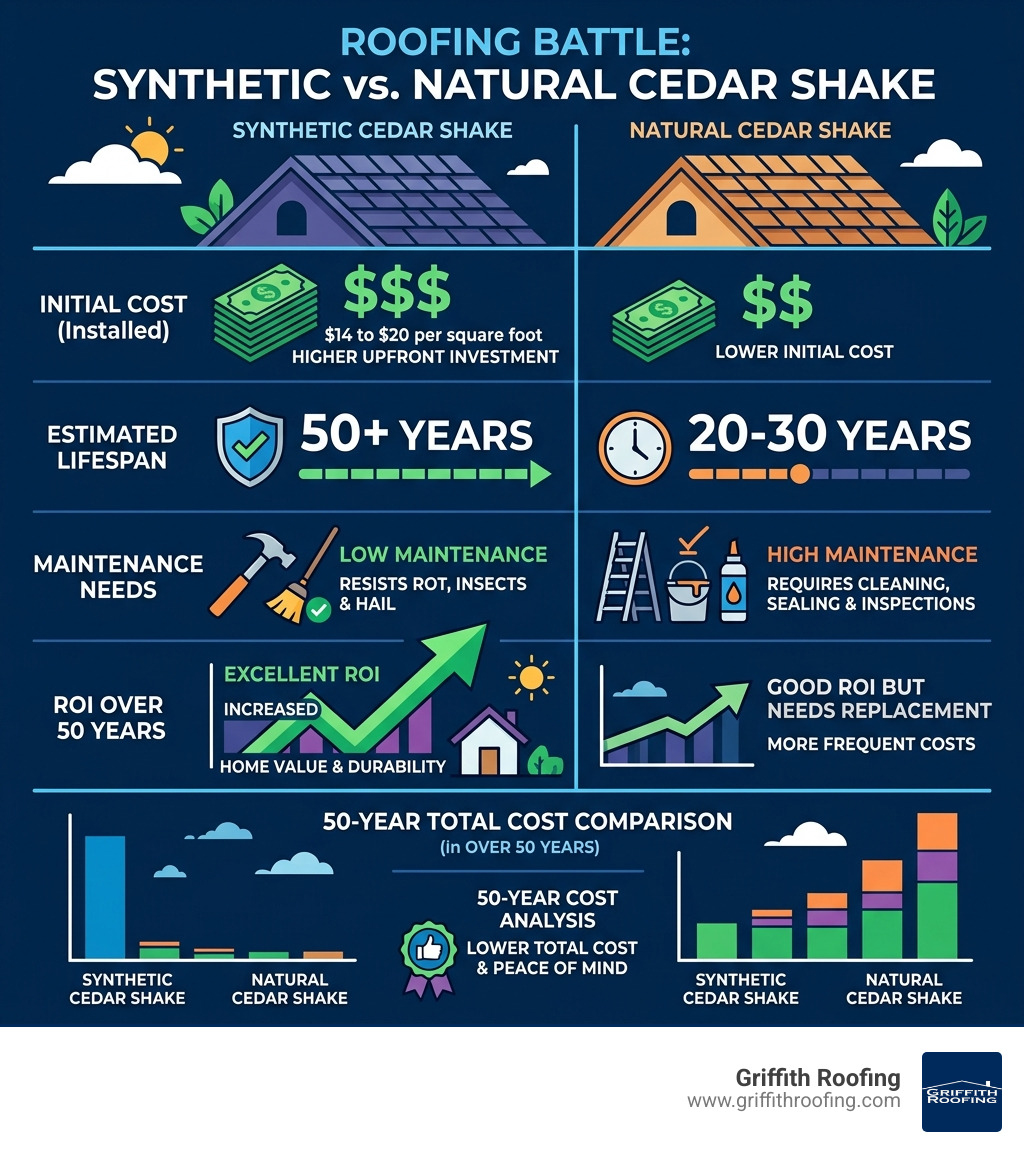
Many homeowners ask us, “If synthetic costs as much as real wood, why not just go with the real thing?” It’s a fair question. Natural cedar typically costs $25 to $30 per square foot installed—actually more than synthetic in many cases.
| Feature | Synthetic Cedar Shake | Natural Cedar Shake |
|---|---|---|
| Installed Cost | $14 – $20 per sq. ft. | $25 – $30 per sq. ft. |
| Lifespan | 40 – 50+ Years | 20 – 30 Years (with heavy maintenance) |
| Fire Rating | Class A (highest) | Requires expensive chemical treatment |
| Impact Rating | Class 4 (Hail Resistant) | Prone to splitting/cracking |
| Maintenance | Virtually Zero | High (cleaning, treating, moss removal) |
Synthetic shakes offer a Class 4 impact resistance, which is the highest possible rating. In North Texas, this can lead to significant insurance premium discounts—sometimes up to 35%. You can find more data on this in the Synthetic Cedar Shake Roofing Cost in 2025 | CEDUR report.
Maintenance Savings Over Time
Natural wood is beautiful, but it is high-maintenance. It requires periodic chemical treatments to prevent rot, insect infestations, and moss growth. Over 30 years, you could easily spend $10,000 to $15,000 just keeping a wood roof alive.
Synthetic shakes are UV-stable and rot-resistant. They don’t warp, crack, or curl. You don’t need to spray them with fungicides or worry about termites. This “set it and forget it” nature is a massive part of the synthetic cedar shake roofing cost equation. If your home has recently suffered from Storm Damage, switching to synthetic is often the smartest move to prevent future headaches.
Lifespan and Warranty Value
A properly installed synthetic roof can easily last 50 years. Most manufacturers offer a “Limited Lifetime Warranty,” and many of these are transferable to the next homeowner. This adds incredible resale value. When you look at our Residential Roofing Portfolio, you’ll see homes that look just as good ten years later as they did on day one.
How to Plan for Installation and Additional Expenses
When we provide an estimate, we look at the whole “roofing system,” not just the shingles.
- Tear-off Fees: Removing your old roof and disposing of it properly.
- Decking Inspection: If your old roof leaked, we may need to replace rotted plywood (decking).
- Drip Edge and Flashing: New metal edges to keep water away from your fascia.
- Ventilation Upgrades: Synthetic roofs perform best when the attic is properly vented to prevent heat buildup.
In some cases, homeowners choose Stone Coated Steel as an alternative, but synthetic cedar remains the gold standard for that specific “Cape Cod” or “Rustic Manor” look.
Hidden Expenses in Synthetic Cedar Shake Roofing Cost
There are a few “gotchas” to watch out for. Because some synthetic shakes are heavier than asphalt, a structural engineer might need to verify that your home’s framing can handle the load. While rare, structural reinforcement can add to the cost.
We also recommend an “Ice and Water Shield” in all valleys and around penetrations, which is a premium underlayment. Some homeowners even opt for copper valley flashing for a high-end look, which can add several thousand dollars to the total. If you are dealing with a complex claim, our Roof Repair Portfolio shows how we handle these intricate details.
Professional Installation Requirements
You should never DIY a synthetic cedar roof. These materials require specialized fasteners—often stainless steel or high-quality galvanized nails—and a specific staggered joint pattern to maintain the warranty and the look.
Certified contractors (like us!) have been trained by the manufacturers to ensure the expansion gaps are correct. If you install them too tightly, they can buckle in the Texas heat. If you’re ready to get a precise quote, Contact us today for a consultation.
Frequently Asked Questions about Synthetic Cedar Shake
How long does a synthetic cedar shake roof last?
Typically, you can expect a 30 to 50-year lifespan. Because they are made of advanced polymers, they don’t “decay” like organic materials. They are engineered to withstand the extreme UV rays we get here in Texas without becoming brittle.
Does synthetic cedar shake increase home value?
Absolutely. Most experts estimate a 30% to 70% ROI (Return on Investment). Beyond the raw numbers, the curb appeal is unmatched. A house with a synthetic cedar roof stands out in the neighborhood, often selling faster and for a higher premium than homes with standard shingles.
Is synthetic cedar shake cheaper than real wood?
While the upfront cost is often lower or comparable to high-grade “Select” cedar, the long-term cost is significantly lower. When you factor in the lack of maintenance, insurance discounts, and double the lifespan, synthetic is the much more affordable choice over 20+ years.
Conclusion
At Griffith Roofing, we believe your roof should be a one-time investment that protects your family for decades. Whether you are in Southlake, Plano, or anywhere in the DFW area, we bring over 20 years of expertise to every project. We aren’t just installers; we are craftsmen who take pride in flawless execution and customer-focused service.
If you aren’t quite ready for synthetic but want a high-quality upgrade, we also offer premium Composition Shingles that provide excellent protection. Give us a call today, and let’s build a roof that exceeds your expectations!


