

A roofing contractor license is a state or locally issued credential that legally authorizes a business or individual to perform roofing work while meeting minimum competency and financial responsibility standards. Texas operates under one of the most open roofing regulatory environments in the country, which makes understanding the licensing landscape here especially important for both contractors and homeowners. The state currently has no mandatory statewide roofing license, though that may soon change. Proposed legislation and voluntary certification programs are reshaping what it means to be a licensed roofing contractor in the Lone Star State.
What is a roofing contractor license and what does it typically require?
A roofing contractor license is defined as official authorization to perform roofing work legally, with built-in standards for competence, insurance, and consumer protection. Licensing is less about granting permission and more about enforcing standards that protect both the public and the integrity of the roofing industry. When a state or municipality issues a roofing license, it creates a regulatory framework for discipline, complaint resolution, and accountability.
Across the United States, common licensing components include the following requirements:
- Trade exams: Written tests covering roofing techniques, material selection, installation methods, and job site safety.
- Business and law exams: Tests on contract law, insurance requirements, lien rights, and regulatory compliance.
- Proof of liability insurance: Coverage that protects homeowners if property damage occurs during a project.
- Workers’ compensation insurance: Required in most states to cover employees injured on the job.
- Surety bonds: Financial guarantees that protect clients if a contractor fails to complete work or causes damage.
- Documented experience or education: Proof of hands-on roofing experience, often two or more years, or formal trade education.
There is also an important distinction between a specialty roofing license and a general contractor license with a roofing endorsement. Specialty licenses focus exclusively on roofing work and require roofing-specific exams. General contractor licenses cover a broader range of construction trades and may include roofing as one component. The type required depends entirely on the state and the scope of work being performed.
Licensed roofing contractors must also obtain permits and pass inspections to comply with local building codes. These inspections serve as critical checkpoints that verify installation quality and reduce the risk of future liability for both the contractor and the homeowner.
How does roofing contractor licensing work in Texas?
Texas does not currently have a mandatory statewide roofing contractor license. This sets roofing apart from other skilled trades in the state. Specialty trades like electrical and HVAC are licensed at the state level through the Texas Department of Licensing and Regulation (TDLR), requiring exams, insurance, and state-issued credentials. Roofing remains a notable exception, operating largely under deregulation at the state level.
That regulatory gap is now being addressed. The Texas Reroofing Contractor Licensing and Consumer Protection Act, known as HB 3344, proposes to create a new reroofing contractor license administered by TDLR. The bill introduces requirements including liability insurance, surety bonds, criminal background checks, and contract transparency rules. It would also establish a public searchable database of licensed contractors, giving homeowners a direct tool to verify credentials before signing a contract.
In the absence of a state license, cities like Austin and San Antonio currently enforce their own local roofing permit and licensing requirements. If you are a contractor working across the Dallas-Fort Worth Metroplex, you need to check DFW permit requirements for each jurisdiction, because requirements vary from one city to the next.
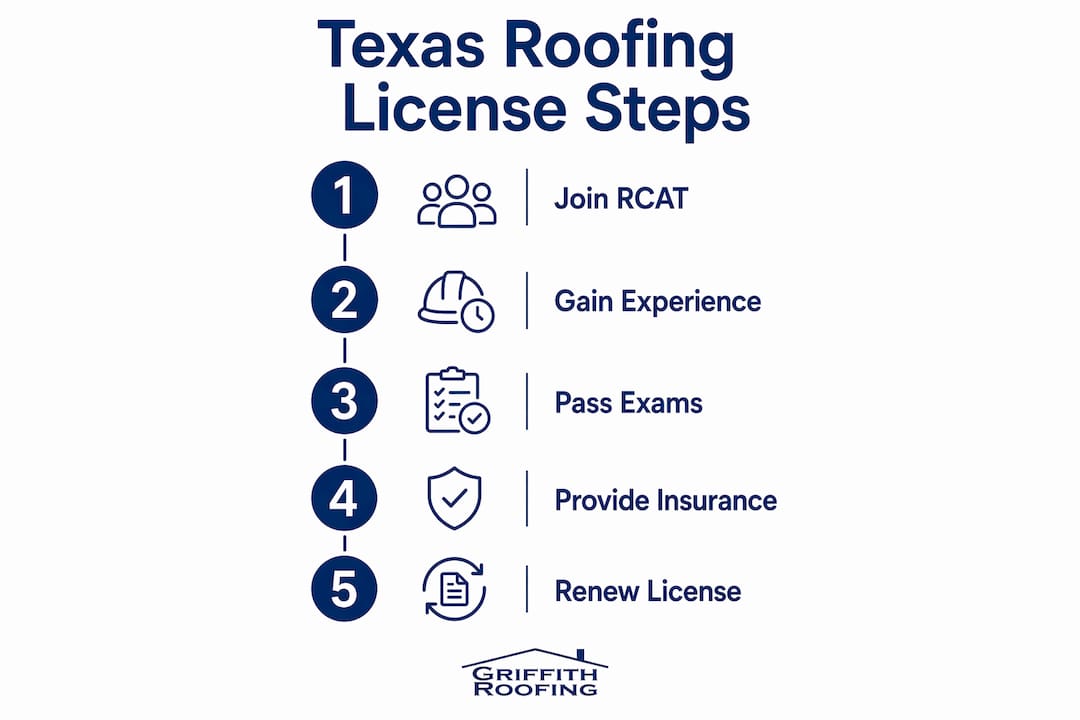
The Roofing Contractors Association of Texas (RCAT) fills part of the credentialing gap through a voluntary licensing program. RCAT requires passing business and safety exams, two years of documented experience, and proof of liability insurance or bonding. Separate license categories exist for residential and commercial roofing work. This voluntary credential functions as an auditable mark of quality for consumers and insurers, even without a state mandate behind it.
Pro Tip: Before hiring any roofing contractor in Texas today, ask for proof of general liability insurance and workers’ compensation coverage. These documents are the primary state-level financial safeguards currently available to you as a homeowner.
How does Texas compare to other states on roofing licensing?
Texas sits at one end of the licensing spectrum. Other states impose far stricter requirements, and the differences have real consequences for both contractors and consumers.
| State | License Type | Insurance Minimum | Exam Required | Bond Required |
|---|---|---|---|---|
| Texas | No state license (HB 3344 pending) | No state minimum | No (RCAT voluntary) | No state requirement |
| Florida | Specialty roofing license | $300,000 liability minimum | Yes | Yes |
| California | C-39 Roofing Contractor classification | State-mandated coverage | Yes | Yes |
| Louisiana | State contractor license required | Required by law | Yes | Yes |
Florida and California represent the stricter end of the spectrum. Florida requires a dedicated roofing contractor license with a $300,000 liability insurance minimum, written exams, and bonding. California’s C-39 Roofing Contractor classification through the Contractors State License Board demands documented experience, a trade exam, and financial vetting. These requirements create meaningful barriers to entry, which can reduce the number of fly-by-night operators but may also raise project costs for homeowners.
Texas’ approach prioritizes market entry freedom over strict regulation, relying on insurance requirements and local controls rather than a statewide licensing gate. The new HB 3344 framework attempts to create a middle ground: it increases transparency and consumer protection without fully restricting market participation. Unlicensed roofing work would not be banned under HB 3344, but misrepresenting licensure status would be prohibited. That distinction matters because it targets deceptive behavior directly rather than creating a blanket barrier.
The practical impact for Texas homeowners is that you cannot assume a roofing contractor is vetted simply because they are operating in the state. Verification falls on you until the HB 3344 database becomes operational.
Steps to get a roofing license or certification in Texas
Whether you are a contractor building your credentials or a homeowner trying to understand what to look for, here is how the roofing contractor licensing process works in Texas right now.
- Register your business entity. File with the Texas Secretary of State as an LLC, corporation, or sole proprietorship. This is the foundation of any legitimate roofing operation.
- Obtain general liability insurance. Carry at minimum $300,000 in general liability coverage. Many commercial clients and insurers require $1 million or more.
- Secure workers’ compensation coverage. Texas does not mandate workers’ comp for private employers, but carrying it protects your crew and your business from catastrophic claims.
- Apply for RCAT voluntary licensing. Submit proof of two years of roofing experience, pass the RCAT business and safety exams, and provide documentation of your insurance and bonding. Separate applications exist for residential and commercial categories.
- Pull local permits for each project. Cities like Fort Worth have their own roofing code requirements that require permits before work begins. Inspections follow completion.
- Verify subcontractor credentials. If your project involves licensed specialty trades such as electrical or HVAC work, confirm those subcontractors hold valid TDLR credentials individually.
- Monitor HB 3344 implementation. Once enacted, the new reroofing contractor license will require registration with TDLR, additional background checks, and compliance with new contract disclosure rules.
RCAT licenses require renewal, typically on an annual or biennial basis, and continuing education may be required to maintain standing. Staying current with renewal deadlines protects your ability to market yourself as a certified contractor.
Pro Tip: Use the RCAT member directory and, once live, the HB 3344 public database to verify any contractor you are considering hiring. A quick search takes two minutes and can save you from a costly dispute.
Benefits and challenges of licensing for Texas contractors and consumers
Voluntary licensing and the incoming HB 3344 framework create real advantages, but they also come with trade-offs worth understanding.
Benefits for contractors:
- Market differentiation in a crowded field where most competitors carry no formal credentials
- Increased trust from homeowners, insurance adjusters, and commercial property managers
- Reduced liability exposure through documented insurance and bonding compliance
- Access to larger commercial contracts that require proof of certification
Benefits for homeowners:
- Easier verification of contractor legitimacy before signing a contract
- A public complaint database under HB 3344 that tracks disciplinary actions against licensed contractors
- Reduced exposure to roofing scams that spike after major Texas storms
- Clearer contract terms required by the new law, reducing disputes over scope and pricing
Challenges to consider:
- RCAT exam fees, insurance premiums, and renewal costs add overhead for small operators
- Administrative requirements create paperwork burdens for sole proprietors
- The voluntary nature of current licensing means bad actors can still operate without credentials
- HB 3344 compliance timelines are still being finalized, creating uncertainty for contractors planning ahead
Voluntary certifications like the RCAT license serve as quality signals that consumers and insurers actively look for, even without a legal mandate. For contractors, the cost of certification is modest compared to the business it can generate. For homeowners, the absence of a mandatory license means due diligence is not optional. It is the only protection currently available.
Key takeaways
A roofing contractor license in Texas is currently voluntary at the state level, making insurance verification and RCAT certification the most reliable tools for both contractors and homeowners to establish and confirm credibility.
| Point | Details |
|---|---|
| No statewide license yet | Texas has no mandatory roofing license, though HB 3344 proposes to change that through TDLR. |
| RCAT fills the gap | The voluntary RCAT license requires exams, two years of experience, and insurance, serving as the current quality benchmark. |
| Local permits still apply | Cities like Austin, San Antonio, and Fort Worth enforce their own roofing permit requirements regardless of state law. |
| HB 3344 adds transparency | The proposed law creates a public contractor database and bans misrepresentation of licensure status. |
| Insurance is non-negotiable | Liability insurance and workers’ compensation are the primary financial safeguards for Texas homeowners right now. |
Why I think Texas contractors should get certified before the law forces them to
I have been in the Dallas-Fort Worth roofing market since 2001, and I have watched the licensing conversation shift dramatically over the past few years. My honest view is this: the contractors who wait for HB 3344 to force their hand are making a strategic mistake.
The RCAT certification process is not burdensome. Two years of experience, a couple of exams, and proof of insurance. Most legitimate operators already meet those standards. The difference is that certified contractors can prove it, and that proof matters more than ever in a market where storm chasers flood Texas neighborhoods after every major weather event.
What I tell homeowners is simple. In the absence of a state license, your two most powerful tools are a certificate of insurance and a signed contract with clear scope language. Ask for both before any work begins. If a contractor hesitates to provide either, that hesitation is your answer.
For contractors, I would add one more thing. The HB 3344 public complaint database will eventually be searchable by any homeowner with a phone. Your reputation will be a matter of public record. Building clean credentials now, before that database goes live, is the smartest move you can make for your business.
Texas is moving toward greater accountability in roofing. The contractors who get ahead of that shift will be the ones still standing when the dust settles.
— Mark Griffith
Work with a trusted, insured roofing contractor in DFW
Griffith roofing has served the Dallas-Fort Worth Metroplex since 2001 with a commitment to transparency, verified insurance, and quality craftsmanship on every project. Whether you need a full roof replacement or targeted repairs, Griffith roofing carries the liability insurance and workers’ compensation coverage that protect you throughout the process. Every project begins with a clear written contract and ends only when you are completely satisfied. Explore Griffith roofing’s residential roofing services to see how a properly insured, experienced contractor approaches your home. You deserve a roofer who can back up their work with credentials, not just a sales pitch.
FAQ
What is a roofing contractor license?
A roofing contractor license is an official credential issued by a state or local authority that authorizes an individual or business to legally perform roofing work while meeting minimum standards for competency, insurance, and financial accountability.
Does Texas require a roofing contractor license?
Texas does not currently require a statewide roofing contractor license, though proposed legislation HB 3344 would create a mandatory reroofing contractor license administered by TDLR. Some Texas cities, including Austin and San Antonio, enforce their own local licensing or permit requirements.
How do I get a roofing license in Texas?
The primary path today is through the Roofing Contractors Association of Texas (RCAT), which offers a voluntary license requiring two years of experience, passing business and safety exams, and proof of liability insurance. Contractors must also pull local permits in each city where they work.
Why does a roofing license matter if Texas doesn’t require one?
A roofing license or voluntary certification signals verified competency and financial responsibility to homeowners and insurers. Without a state mandate, unlicensed operators face no formal barrier, making voluntary credentials the clearest way to distinguish legitimate contractors from unqualified ones.
What should Texas homeowners check before hiring a roofer?
Homeowners should request a certificate of general liability insurance, proof of workers’ compensation coverage, and confirmation of any RCAT certification or local permits. Once HB 3344’s public database is operational, searching a contractor’s name there will also reveal any complaint history.


