

Flat roof failure in Texas rain occurs primarily because stagnant water accelerates membrane deterioration faster than most property owners realize. The industry term for this is “ponding water,” defined by the National Roofing Contractors Association (NRCA) as standing water that remains more than 48 hours after rainfall. Texas compounds this problem with extreme heat, intense storm events, and thermal cycling that quietly weakens seams and flashing long before a visible leak appears. Understanding why flat roofs fail in Texas rain is the first step toward protecting your property and your warranty.
Why flat roofs fail in Texas rain: the core causes
Ponding water is the single leading cause of flat roof membrane failure. The NRCA defines ponding water as standing water lasting more than 48 hours after rain stops. That threshold matters because most manufacturer warranties exclude damage caused by ponding, meaning a single storm can void your coverage if your roof lacks adequate slope or drainage.
Texas flat roofs are especially vulnerable because many older buildings were constructed with slopes of just 1/8 inch per foot. The current minimum standard is 1/4 inch per foot. Roofs built before 2010 frequently used the shallower slope, and structural deflection over time makes the problem worse even on roofs that initially drained correctly.
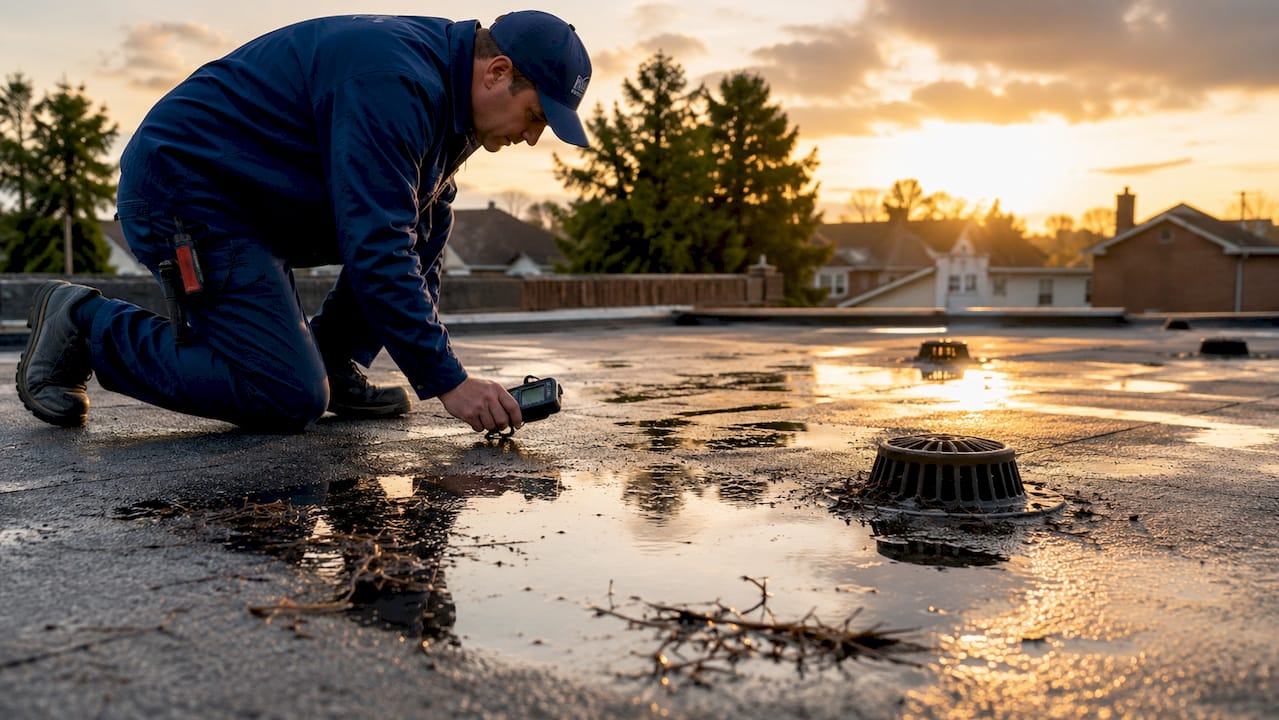
Thermal stress adds another layer of damage. Texas summers push dark membrane surfaces to extreme temperatures, weakening seams and flashing before a single raindrop falls. When a heavy storm arrives, those pre-weakened points fail first. The DFW climate’s roofing impact on membranes is a factor that most property owners underestimate until they are facing a repair bill.
How does ponding water cause flat roof failure during heavy rain?
Ponding water does not just sit on your roof. It works against the membrane continuously, accelerating degradation by 50–70% faster than normal weathering. That acceleration means a membrane rated for 20 years could fail in 10 or fewer if ponding is a recurring problem.
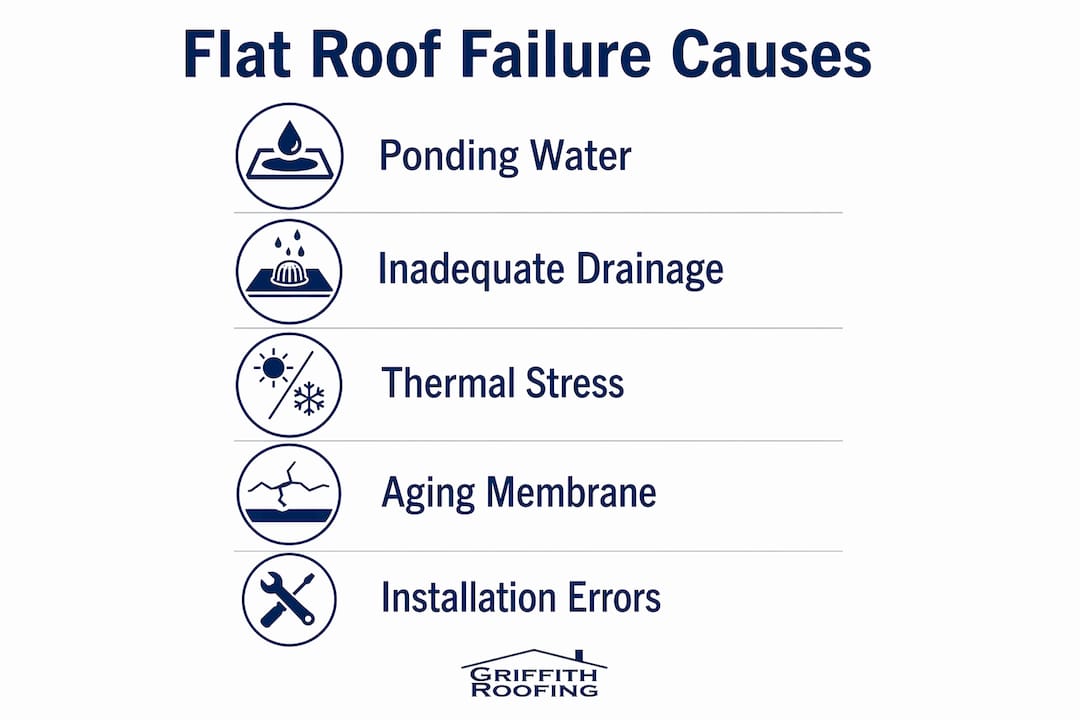
The mechanics are straightforward. Water weight adds load stress to the deck. UV exposure breaks down the membrane surface. Freeze-thaw cycles in North Texas winters open micro-cracks that water then exploits. Each rain event pushes water deeper into those cracks, and the cycle repeats until a full leak develops.
Warranty implications are serious. Most manufacturers void coverage the moment ponding is documented. That means a roof inspection report noting standing water can disqualify you from a warranty claim on the very damage that water caused. Ignoring a leaky roof has real financial consequences that compound quickly.
Key warning signs of ponding-related damage include:
- Visible water rings or staining on the membrane surface after rain clears
- Soft or spongy spots when walking the roof
- Interior ceiling stains that appear 24–48 hours after a storm
- Blistering or bubbling on the membrane surface
- Sagging or deflection visible from ground level on low-slope sections
Pro Tip: Schedule a roof walk-through 48 hours after any significant rain event. If you see standing water at that point, you have a drainage problem that needs professional attention before the next storm.
Why is drainage design critical for flat roofs in Texas rainstorms?
Texas rainfall intensity demands more from drainage systems than most other U.S. regions. Texas building codes require flat roof drainage systems to handle rainfall intensities with 3.5 to 4.5 square inches of drain capacity per 100 square feet. Effective stormwater management requires one drain for every 32 to 41 square feet of roof area. That is a significantly tighter requirement than what you find in drier climates.
Most flat roof drainage failures fall into one of three categories: undersized drains, blocked drains, or missing overflow drainage. Undersized drains simply cannot move water fast enough during a Texas downpour. Blocked drains back up within minutes. Missing overflow drainage is the most dangerous failure of all.
IPC 1106 mandates overflow drainage on all flat roofs. Without it, a clogged primary drain during a heavy storm can allow water to accumulate to a load that exceeds the structural capacity of the roof deck. That is not a leak. That is a collapse risk.
Drainage issues are often caused by roof structural deflection and compressed insulation creating low spots, not just visible blockages at the drain itself. A drain can look perfectly clear and still fail to move water if the surrounding deck has deflected and created a water sump.
Pro Tip: Do not rely on a visual check of your drains. Flow testing, where water is introduced at the drain and timed for clearance, is the only reliable way to confirm your drainage system is working at full capacity.
How do Texas heat and thermal stress contribute to flat roof failures?
Summer thermal cycling is the hidden precondition to most rain-related flat roof failures in Texas. Temperatures on dark membranes can reach 180°F during Texas summers. That extreme heat causes the membrane to expand significantly. When temperatures drop at night or during a storm, the membrane contracts. Repeated expansion and contraction loosens fasteners, breaks down sealant, and causes blistering.
Thermal expansion quietly loosens the seams and flashing that hold your flat roof together. By the time a heavy rain arrives, those weakened points are already primed to fail. The storm does not cause the damage. It reveals damage that summer heat already created.
Reflective membranes like TPO (thermoplastic polyolefin) perform significantly better in Texas conditions than dark EPDM membranes. TPO reduces heat absorption and slows the thermal cycling that degrades seams and flashing. If your flat roof uses a dark membrane, heat-related wear is accelerating faster than it would with a reflective alternative.
The practical implication is timing. Inspections scheduled in early summer, before peak heat arrives, catch thermal damage at its earliest stage. Waiting until after a storm to investigate means you are already dealing with a leak rather than preventing one.
What installation and maintenance mistakes increase rain damage risk?
Most flat roof failures trace back to decisions made during installation or skipped during routine maintenance. Slopes less than 1/4 inch per foot cause ponding. Poor penetration seals around HVAC units, pipes, and vents create direct water entry points. Skipped seam testing leaves heat-welded joints unverified until rain exposes the flaw.
The most common installation and maintenance mistakes Texas property owners encounter include:
- Insufficient slope. Any slope below 1/4 inch per foot guarantees ponding during heavy rain. Older buildings are the highest risk.
- Poor penetration detailing. Every pipe, vent, and HVAC curb that penetrates the membrane is a potential leak point if flashing is not installed and sealed correctly.
- Skipped seam testing. Heat-welded seams on TPO and PVC membranes must be tested after installation. Untested seams are the most common source of early leaks.
- Clogged drains and scuppers. Debris accumulates quickly in Texas, especially after wind events. Blocked drains turn a minor rain into a ponding event within minutes.
- Deferred repairs. Early intervention under $1,000 can prevent repairs exceeding $15,000 when water damage reaches the deck and interior structure.
Pro Tip: Add drain cleaning to your seasonal maintenance calendar twice a year: once before spring storm season and once before fall. It takes 30 minutes and prevents the most common cause of emergency repairs.
How can Texas property owners prevent flat roof failures from heavy rain?
Prevention is a system, not a single action. The most effective approach combines regular professional inspections, drainage maintenance, and material upgrades that match Texas climate demands.
Start with inspections. A professional inspection focused on drains, seams, and flashing should happen at least twice a year. Early summer and late fall are the best windows. Early summer catches thermal damage before peak heat worsens it. Late fall prepares the roof for winter freeze-thaw cycles.
Drainage upgrades deliver the highest return on investment for most Texas flat roofs. Tapered insulation systems correct slope problems without a full tear-off. Additional drains reduce the load on existing ones. Scupper cleaning and overflow drain verification should be part of every inspection. The repair vs. replacement decision often hinges on whether drainage can be corrected without replacing the entire membrane.
Membrane selection matters for new installations and re-roofing projects. Reflective membranes outperform dark alternatives in Texas conditions. The cost difference between TPO and EPDM is modest at installation. The difference in lifespan and repair frequency over 15 years is significant.
Prevention steps that deliver the most value include:
- Test drain flow, not just visual cleanliness, after every major storm
- Clear debris from scuppers and gutters before storm season begins
- Inspect all penetration flashings annually for sealant cracking or separation
- Document roof condition with photos twice a year to support warranty claims
- Address any soft spots or blistering immediately rather than waiting for a leak
Professional repair costs for ponding issues range from minor repairs at $75 to complete tapered insulation retrofits exceeding $14,000 for a 4,000 square foot roof. Acting early keeps you at the low end of that range.
Key Takeaways
Flat roofs in Texas fail during heavy rain primarily because ponding water, inadequate drainage, thermal stress, and installation errors combine to destroy membrane integrity faster than the warranty timeline assumes.
| Point | Details |
|---|---|
| Ponding water voids warranties | Standing water beyond 48 hours accelerates membrane failure by 50–70% and disqualifies most manufacturer warranty claims. |
| Texas drainage codes are strict | Codes require 3.5–4.5 sq in of drain capacity per 100 sq ft, far more than most other U.S. regions demand. |
| Heat damage precedes rain damage | Dark membranes reach 180°F in Texas summers, weakening seams before storms arrive to exploit them. |
| Overflow drains are non-negotiable | IPC 1106 requires overflow drainage; without it, clogged primary drains create structural collapse risk. |
| Early repairs cost far less | Fixing issues early costs under $1,000; deferred repairs regularly exceed $15,000 once water reaches the deck. |
What Texas property owners overlook about flat roofs and rain
After more than two decades working on flat roofs across the Dallas-Fort Worth area, the pattern I see most often is not ignorance. It is misplaced confidence. Property owners assume that because a roof passed inspection two years ago, it is still performing the same way today. Texas heat does not give roofs that kind of grace period.
The thermal cycling issue is the one that surprises people most. They call us after a storm, convinced the rain caused the damage. In most cases, the seam or flashing that failed had been weakening since june. The storm just made it visible. That distinction matters because it changes the inspection schedule you need. Waiting for storm season to think about your roof means you are already behind.
I also see property owners skip overflow drain verification during routine maintenance. It is the most dangerous oversight on a flat roof. A clogged primary drain during a heavy Texas downpour is manageable if overflow drainage works. Without it, you are one blocked drain away from a structural event. That is not a leak repair. That is a crisis.
The good news is that flat roofs in Texas are not inherently problematic. They perform well when they are designed correctly, installed with proper slope and drainage, and maintained on a real schedule. The failures I see are almost always preventable. The cost of prevention is a fraction of the cost of the repair that follows neglect.
— Mark Griffith
Griffith roofing’s flat roof protection services for Texas property owners
Texas flat roofs face a specific set of challenges that require local expertise, not generic solutions. Griffith roofing has worked with Dallas-Fort Worth property owners since 2001, and flat roof drainage failures, membrane repairs, and ponding water corrections are among the most common issues we address.
Whether your roof needs a drain flow test, a seam repair, or a full drainage upgrade with tapered insulation, Griffith roofing brings the experience to diagnose the real problem rather than patch the symptom. Our residential roofing services cover flat roof inspections and repairs for Texas property owners who want answers before the next storm arrives. For existing damage, our roof repair team handles membrane sealing, drainage correction, and penetration detailing. Contact Griffith roofing to schedule an inspection and get a clear picture of where your roof stands.
FAQ
What causes flat roofs to fail in Texas rain?
Flat roofs in Texas fail during heavy rain primarily due to ponding water, inadequate drainage capacity, and thermal stress that weakens seams and flashing before storms arrive. Installation errors like insufficient slope below 1/4 inch per foot compound all three problems.
How long can water sit on a flat roof before it causes damage?
The NRCA defines ponding water as standing water that remains more than 48 hours after rain stops. Water lasting beyond that threshold accelerates membrane degradation by 50–70% and voids most manufacturer warranties.
What is the minimum slope required for a Texas flat roof?
The current standard requires a minimum slope of 1/4 inch per foot. Roofs built before 2010 often used 1/8 inch per foot, which causes chronic ponding and is a leading source of flat roof issues in Texas.
Do I need overflow drains on my flat roof?
Yes. IPC 1106 mandates overflow drainage on flat roofs. Without it, a clogged primary drain during a Texas storm can allow water to accumulate beyond the structural load capacity of the roof deck.
How much does it cost to fix flat roof drainage problems in Texas?
Costs range from minor repairs at $75 for simple fixes to more than $14,000 for a complete tapered insulation retrofit on a 4,000 square foot roof. Drain additions typically cost between $1,500 and $4,000 depending on complexity.


