

Texas hail damages roofs because hailstones strike roofing materials with enough force to bruise shingles, strip protective granules, and crack tiles in a single storm. A quarter-size hailstone is generally the threshold for functional damage to asphalt shingles, and Texas storms routinely exceed that size. The state set a record in 2024 with a hailstone measuring 7.1 inches in diameter, confirmed by NOAA, which illustrates just how extreme conditions here can get. Understanding the mechanics of that damage, and what it costs you, is the first step toward protecting your home and your wallet.
Why Texas hail damages roofs more than most states
Texas sits in one of the most hail-active corridors in North America. The combination of warm Gulf moisture, cold fronts from the north, and flat terrain creates ideal conditions for large, fast-moving hailstones. When those stones hit your roof, the damage follows a predictable but serious pattern.
Hail damage to roofing is the industry term for impact-related deterioration caused by hailstones striking roofing materials. The physical damage mechanisms include granule loss, shingle bruising and cracking, dents in metal surfaces, and loosened seals around roof penetrations. Each of these compromises your roof’s ability to shed water, which is its most fundamental job.
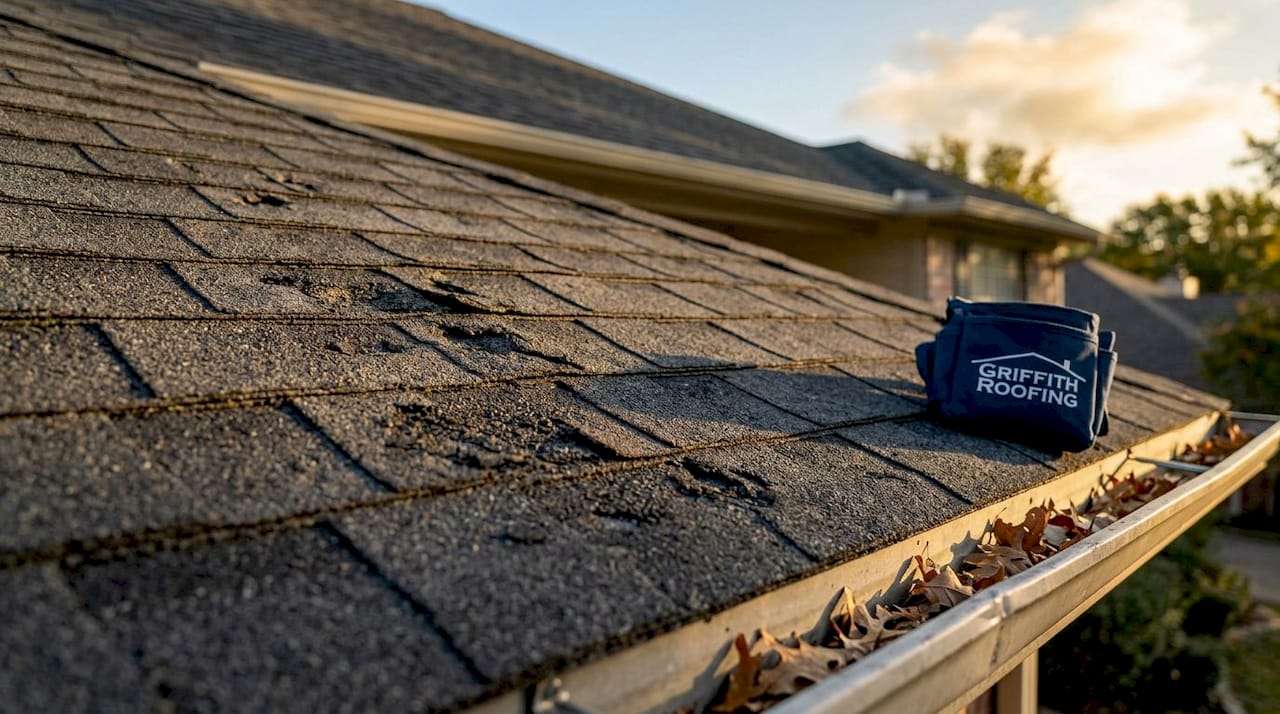
The size of the hailstone matters, but so does velocity. A one-inch stone falling at terminal velocity carries enough kinetic energy to fracture the asphalt mat beneath a shingle’s surface without visibly breaking it. That hidden bruising is what makes hail damage so deceptive. Your roof can look intact from the street while the structural layer underneath has already been compromised.
What physical effects does hail have on different roofing materials?
Different roofing materials respond to hail impact in distinct ways, and knowing those differences helps you understand what a post-storm inspection should actually look for.
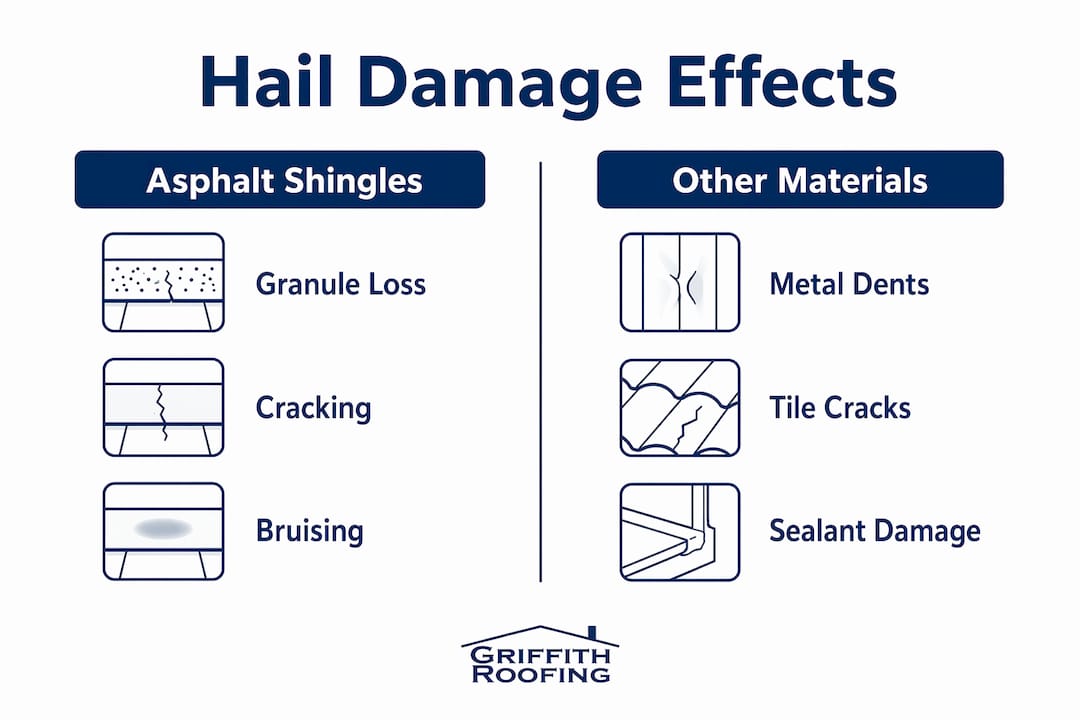
Asphalt shingles are the most common roofing material in Texas, and they take hail damage in two forms. First, granule loss occurs when hailstones knock the protective mineral coating off the shingle surface. Those granules exist to block UV radiation and slow weathering. Lose enough of them and the asphalt beneath begins to oxidize rapidly. Second, bruising occurs when the impact fractures the fiberglass mat inside the shingle, leaving a soft spot that eventually cracks and allows water infiltration. Older, more brittle shingles lose granules more easily and bruise more severely than newer materials.
Metal roofs dent rather than crack, but dents are not purely cosmetic. A deep enough dent can weaken the seam or fastener area, allowing water to work its way under the panel over time. Standing seam metal roofs handle hail better than exposed-fastener panels because the fasteners are protected.
Tile roofs, whether clay or concrete, crack or break outright under significant hail impact. A cracked tile no longer sheds water properly, and the underlayment beneath it takes the full brunt of every subsequent rainstorm.
- Granule loss on asphalt shingles accelerates UV degradation by months or years
- Bruised shingles may not leak immediately but fail within one to three seasons
- Metal dents can compromise seam integrity on older panel systems
- Cracked tiles expose underlayment to direct water contact
Pro Tip: After any storm, check your gutters and downspouts for granule accumulation. A significant deposit of dark, sand-like material is one of the clearest early indicators of shingle damage, and you can spot it safely from the ground.
How does hail frequency in Texas accelerate roof aging?
The most underappreciated aspect of why Texas hail damages roofs is not the single catastrophic event. It is the cadence. Repeated hail impacts rapidly age and weaken roofs in ways that one large storm cannot fully explain.
Think of it like metal fatigue. A steel beam can withstand one large load without failing, but repeated smaller loads at the same stress point will eventually cause a fracture. Your roof works the same way. Each hailstorm that crosses the Dallas-Fort Worth area chips away at shingle integrity, loosens flashing, and degrades sealants. By the time a major storm hits, the roof is already compromised.
| Hail event type | Immediate damage | Cumulative effect |
|---|---|---|
| Single large storm (2+ inch hail) | Visible cracks, punctures, heavy granule loss | Accelerated failure within 1-2 seasons |
| Repeated moderate storms (0.75-1.5 inch hail) | Minor bruising, gradual granule loss | Roof lifespan shortened by 3-7 years |
| Frequent small storms (under 0.75 inch) | Minimal visible damage | Sealant degradation, flashing loosening over time |
“Hail risk is driven by the cadence of events, not just peak hail size. Frequent smaller storms cause cumulative material stress that shortens roof lifespan just as effectively as rare giant hail events.” — Verisk, 2026
Texas averages more hail events per year than nearly any other state, and the Dallas-Fort Worth Metroplex sits in one of the highest-frequency zones within Texas. That frequency is precisely why roof replacement costs remain elevated in the region, driven by severe weather increases and ongoing material price fluctuations.
What are the financial impacts of hail damage for Texas homeowners?
Hail damage repair in Texas is expensive, and the insurance structure here makes the out-of-pocket exposure larger than most homeowners expect.
Texas homeowners commonly face percentage-based wind and hail deductibles ranging from 1% to 5% of the insured home value. That structure means your deductible scales with your home’s value, not with the actual repair cost. On a $350,000 home with a 2% hail deductible, you owe $7,000 before insurance pays a single dollar. Many homeowners discover this only after filing a claim.
Here is a step-by-step breakdown of how a hailstorm insurance claim in Texas typically unfolds:
- Document damage immediately after the storm with dated photos and video of every affected surface.
- Contact your insurer to open a claim and request an adjuster inspection, ideally within 48 to 72 hours.
- Get an independent roof inspection from a licensed contractor before the adjuster arrives so you have a professional assessment to compare against.
- Review the adjuster’s estimate carefully. Adjusters sometimes miss hidden bruising or undervalue granule loss on older shingles.
- Negotiate or supplement the claim if the estimate does not cover the full scope of damage. A qualified roofing contractor can help you document discrepancies.
Pro Tip: Understanding your policy’s actual cash value versus replacement cost value provision changes everything. Actual cash value policies deduct depreciation, meaning a 15-year-old roof may only receive a fraction of replacement cost. Check your declarations page before a storm hits, not after.
Understanding how insurance pays for roof replacement in Texas before a storm gives you far more leverage when a claim becomes necessary.
How to identify hail damage on your roof
Hail damage assessment in Texas is a skill that combines ground-level observation with professional inspection. You do not need to climb on your roof to spot the warning signs.
From the ground, look for:
- Dents in gutters, downspouts, or metal trim around windows and doors. Soft metals show hail impact clearly and confirm the storm had enough force to damage roofing materials.
- Granule deposits in gutters or at the base of downspouts. Heavy granule loss after a storm indicates shingle surface damage.
- Visible cracks or missing pieces on tile roofs, observable with binoculars from the yard.
- Dents on HVAC equipment or satellite dishes mounted on the roof. These metal surfaces are reliable indicators of hail size and impact force.
Documentation of hail damage is time-sensitive. Granule deposits wash away in the next rain. Impact marks on soft metals can be misattributed to other causes. Delaying inspection and documentation after hail can void insurance claims entirely, because adjusters need to see fresh evidence of the specific storm event.
A professional hail damage assessment in Texas goes beyond what you can see from the yard. A trained roofer walks the entire surface, probes for soft spots in shingles, checks flashing integrity, and inspects penetrations around vents and chimneys. That assessment becomes your primary evidence for an insurance claim and your roadmap for repairs.
Repair and replacement options after hail damage
Not every hail event requires a full roof replacement. The right response depends on the extent of damage, the age of the roof, and the material involved.
For asphalt shingle roofs with localized damage, spot replacement of affected shingles is viable when the surrounding material is in good condition and the roof is less than ten years old. Beyond that age threshold, matching shingle color and texture becomes difficult, and the repaired sections often stand out visually. More importantly, if more than 30% of the roof surface shows damage, most contractors and insurers treat it as a replacement rather than a repair.
| Roofing material | Hail resistance | Repair complexity | Best for Texas? |
|---|---|---|---|
| Standard 3-tab asphalt | Low | Simple spot repair | Budget option only |
| Architectural asphalt (Class 4) | High | Moderate | Strong value choice |
| Metal (standing seam) | Very high | Complex seam work | Excellent long-term |
| Concrete tile | Moderate | Requires matching tiles | Good with maintenance |
| Clay tile | Moderate | Fragile, hard to match | Premium aesthetic |
Class 4 impact-resistant asphalt shingles, rated under UL 2218 testing, are the most practical upgrade for most Texas homeowners. They withstand larger hailstones without bruising and often qualify for insurance premium discounts. Choosing the best roofing material for North Texas weather involves balancing upfront cost against long-term durability and insurance savings.
Pro Tip: Ask your contractor specifically for UL 2218 Class 4 rated shingles when replacing a hail-damaged roof. Some insurers in Texas offer premium reductions of 20% or more for homes with Class 4 roofing. That discount can offset a significant portion of the upgrade cost over five to ten years.
After any repair or replacement, schedule an annual inspection each spring before peak hail season. Catching loose flashing or cracked sealant early prevents minor issues from becoming major claims.
Key takeaways
Texas roofs face accelerated damage because hail here is both large and frequent, and the financial exposure from percentage-based deductibles makes early detection and documentation non-negotiable.
| Point | Details |
|---|---|
| Quarter-inch threshold | Hailstones at or above one inch in diameter cause claimable bruising and granule loss on asphalt shingles. |
| Frequency compounds damage | Repeated moderate hailstorms shorten roof lifespan by years, even when no single storm causes obvious destruction. |
| Deductible exposure is high | A 2% wind/hail deductible on a $350,000 home means $7,000 out of pocket before insurance contributes. |
| Document immediately | Granule deposits and impact marks fade quickly. Photograph damage within 24 hours of a storm. |
| Class 4 shingles reduce risk | UL 2218 Class 4 impact-resistant shingles withstand larger hail and often qualify for insurance premium discounts in Texas. |
What 23 years of Texas roofs taught me about hail
After more than two decades inspecting and repairing roofs across the Dallas-Fort Worth area, the pattern I see most often is not the dramatic aftermath of a baseball-sized hailstorm. It is the homeowner who ignored three moderate storms over five years and then wonders why their roof failed at 12 years instead of 25.
The conventional wisdom says hail damage is obvious. In my experience, the most costly damage is invisible from the street and only reveals itself during a professional inspection or, worse, during the next heavy rain. Bruised shingles do not leak on day one. They leak on day 400, after the compromised mat has absorbed enough thermal cycling to crack through.
The other mistake I see constantly is homeowners waiting too long to file a claim because they are not sure the damage is “bad enough.” Texas insurance policies have filing deadlines, and adjusters are far more receptive to fresh evidence than to damage that has been rained on six more times. If a storm hit your neighborhood, get an inspection. The cost of that inspection is nothing compared to a denied claim.
My honest recommendation for any Texas homeowner is this: treat your roof like a car. You would not skip oil changes and wait for the engine to seize. Schedule an annual inspection, upgrade to Class 4 shingles when you replace, and document every storm event the day it happens. That discipline is what separates homeowners who get full claim settlements from those who pay out of pocket.
— Mark Griffith
Griffith Roofing is ready to assess your hail damage
When a hailstorm scars your roof, the clock starts immediately on documentation, claims, and repairs. Griffith Roofing has served Dallas-Fort Worth homeowners since 2001, and hail damage is the core of what we do every storm season.
Our team provides thorough roof repair services for hail-damaged shingles, metal panels, and tile systems, along with full residential roof replacement when the damage warrants it. We also guide you through the insurance claim process from inspection to final settlement, so you are never navigating that alone. Contact Griffith Roofing today for a free post-storm inspection and let us put 23 years of Texas roofing experience to work for your home.
FAQ
What size hail causes roof damage in Texas?
Quarter-size hail, approximately one inch in diameter, is the standard threshold for functional damage to asphalt shingles. Larger hailstones cause proportionally more severe bruising, cracking, and granule loss.
How do I know if my roof has hail damage?
Check gutters for granule deposits, inspect soft metals like gutters and downspouts for dents, and look for cracked or missing tile pieces from the ground. A professional hail damage assessment in Texas will confirm hidden bruising that ground-level inspection cannot detect.
What is a wind and hail deductible in Texas?
A wind and hail deductible is a separate, percentage-based deductible on Texas homeowner policies, typically ranging from 1% to 5% of the insured home value. It applies specifically to wind and hail claims, separate from your standard deductible.
How long do I have to file a hail damage insurance claim in Texas?
Texas law generally allows one year from the date of loss to file a property insurance claim, but documenting damage promptly within 24 to 72 hours of the storm gives you the strongest evidence and the best chance of a full settlement.
Are impact-resistant shingles worth the cost in Texas?
Class 4 impact-resistant shingles rated under UL 2218 testing withstand larger hailstones without bruising and often qualify for insurance premium discounts in Texas. The long-term savings on claims and premiums typically offset the higher upfront material cost within five to ten years.


